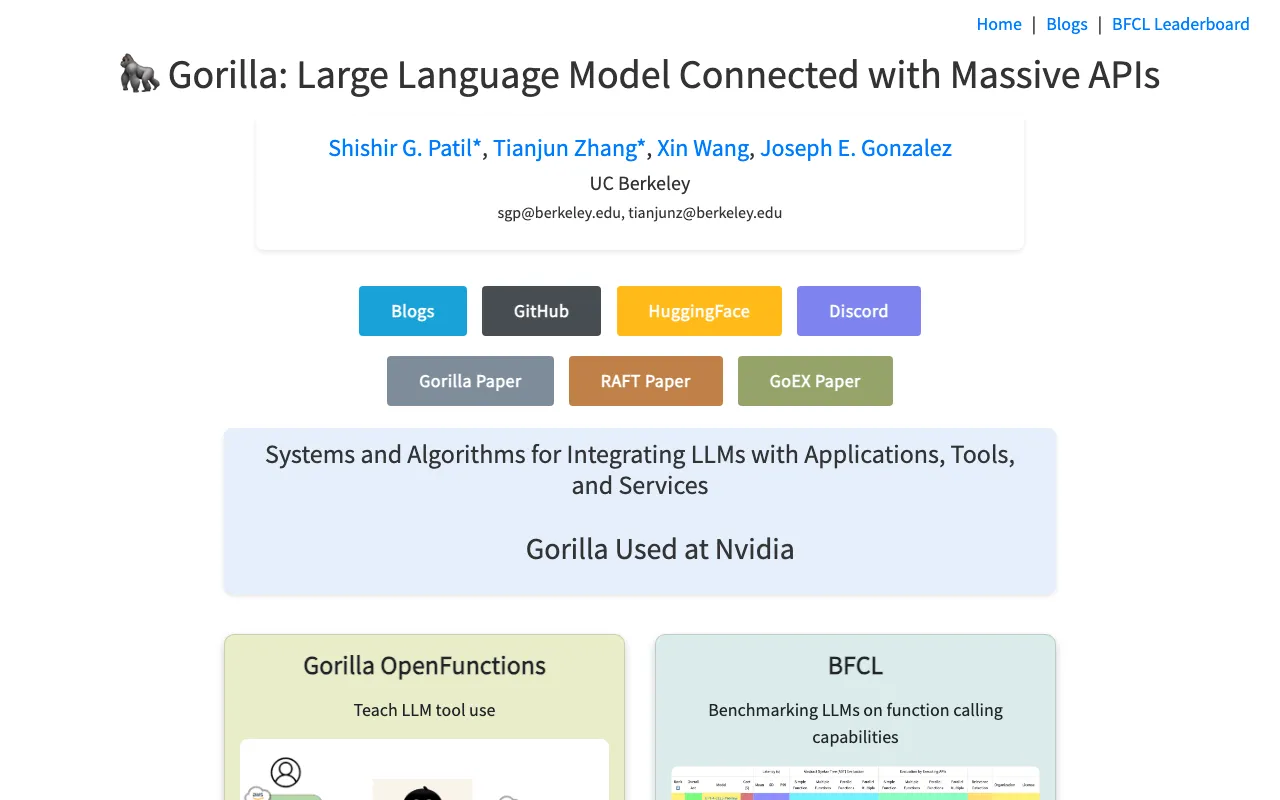
Gorilla connects large language models to real APIs so natural language queries map to correct tool invocations. It ships models, benchmarks, datasets, and runtimes for evaluation and integration.
Overview
Gorilla is a research and product stack for teaching language models to call external APIs from user prompts. Given everyday language, the models aim to produce syntactically and semantically valid calls across a large and growing API collection while reducing fabricated endpoints.
OpenFunctions variants provide drop-in function-calling models with parallel and multi-function support, relevance detection, and handlers for Python, Java, JavaScript, and REST shapes. Complementary pieces include APIBench data, an API Zoo index of documentation, RAFT fine-tuning recipes, and the Gorilla Execution Engine for running generated actions with validation and undo-style safeguards.
The Berkeley Function Calling Leaderboard evaluates single-turn, multi-turn, and enterprise-style scenarios with cost and latency metrics. Agent Arena compares agent setups across frameworks. Developers can try browser demos, install a command-line client, or run inference locally with published weights.
Models are released under permissive licensing suitable for commercial use. Gorilla is designed to plug into agent frameworks and other orchestration tools rather than replacing them outright.
Key features
- OpenFunctions function-calling models
- APIBench API training dataset
- Berkeley Function Calling Leaderboard
- Gorilla API Zoo documentation index
- GoEx safe action execution runtime
- RAFT retrieval fine-tuning recipe
- Agent Arena comparisons
- CLI and local inference paths
Use cases
- Tool use from chat interfaces
- Benchmarking function callers
- Building API-aware agents
- Domain-specific RAG tuning


 Anthropic Claude
 ChatGPT