
Causal ML
Python uplift modeling and causal inference toolkit
Causal ML estimates conditional average treatment effects from experiments or observational data using machine learning estimators.
Probabilistic deep learning time series toolkit for Python
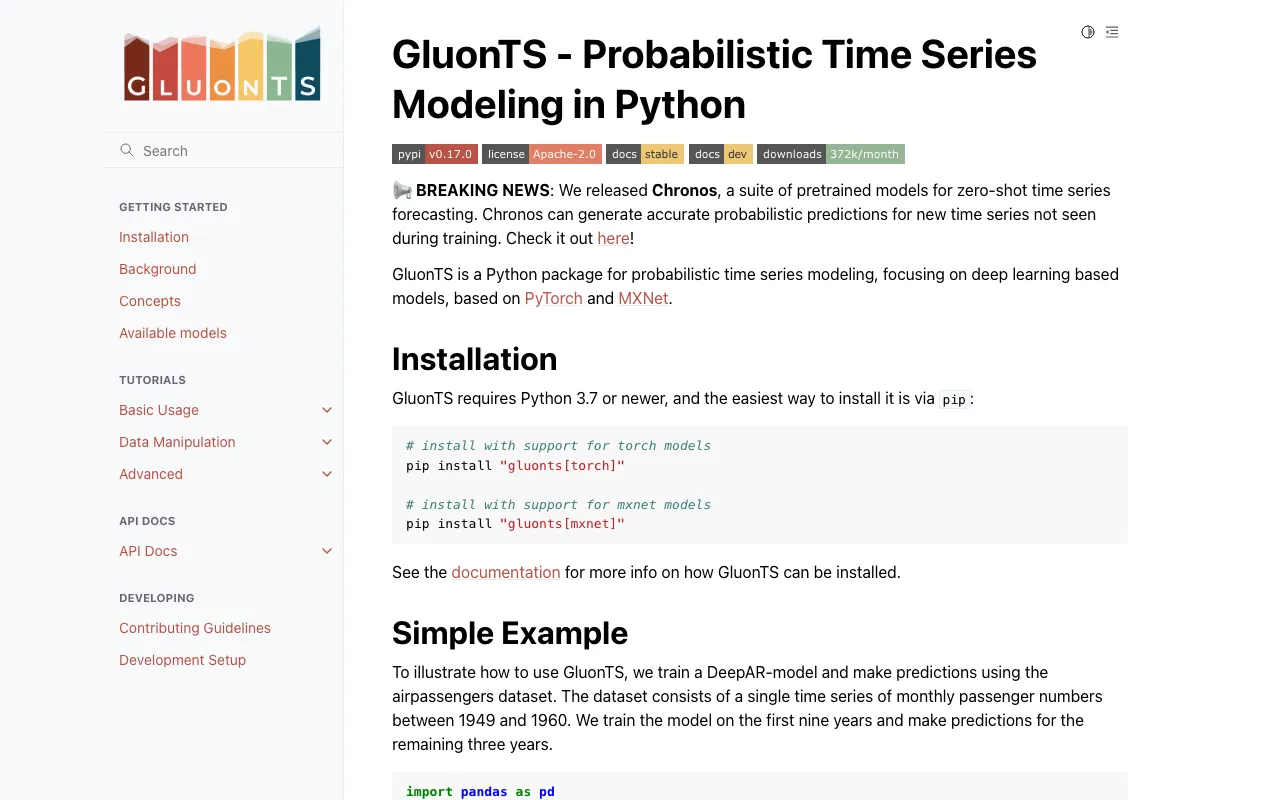
GluonTS trains and runs probabilistic forecasting models on time series data, centered on PyTorch backends.
GluonTS is a Python package for building probabilistic time series models, especially neural architectures that output forecast distributions rather than single point estimates. It is oriented toward deep learning workflows on PyTorch, with optional MXNet-related install extras in documentation.
Typical usage wires datasets into estimators such as DeepAR, trains on historical windows, and produces prediction intervals for future horizons. Pandas-friendly dataset helpers and split utilities support holdout evaluation on standard benchmark series.
The project also points to Chronos, a related suite of pretrained models for zero-shot forecasting on series not seen during training.
Install via pip or environment tools; optional extras pull backend-specific dependencies. Tutorials, stable and development docs, and workshop materials cover training, prediction, and plotting forecast bands.
Python uplift modeling and causal inference toolkit
Causal ML estimates conditional average treatment effects from experiments or observational data using machine learning estimators.
Python toolkit for heterogeneous causal treatment effect estimation
EconML estimates how treatment effects vary across individuals using machine learning on observational or experimental data. It unifies econometrics-style causal methods behind one Python API.

Pure Python survival analysis and reliability library
lifelines implements survival analysis in Python with parametric, semi-parametric, and non-parametric models. It handles right, left, and interval censored data and includes plotting helpers.

End-to-end machine learning platform and tooling ecosystem
TensorFlow is a machine learning platform with Python and C++ APIs, optional GPU packages, and companion libraries for data, training, deployment, and visualization.

Run open AI models locally or in the cloud
Ollama runs open language models such as Gemma, Qwen, DeepSeek and gpt-oss on macOS, Windows and Linux, locally or in the cloud. It offers a CLI, a REST API, and Python and JavaScript libraries.

Shared model definitions for multimodal ML workloads
Transformers is a Python library that defines pretrained text, vision, audio, and multimodal models once in PyTorch for shared inference and training across the ecosystem.