
Playwright
Cross-browser web automation and testing framework
Playwright drives Chromium, Firefox, and WebKit through one API for tests, scripts, and agent-driven browser control.

Open-source load testing as code
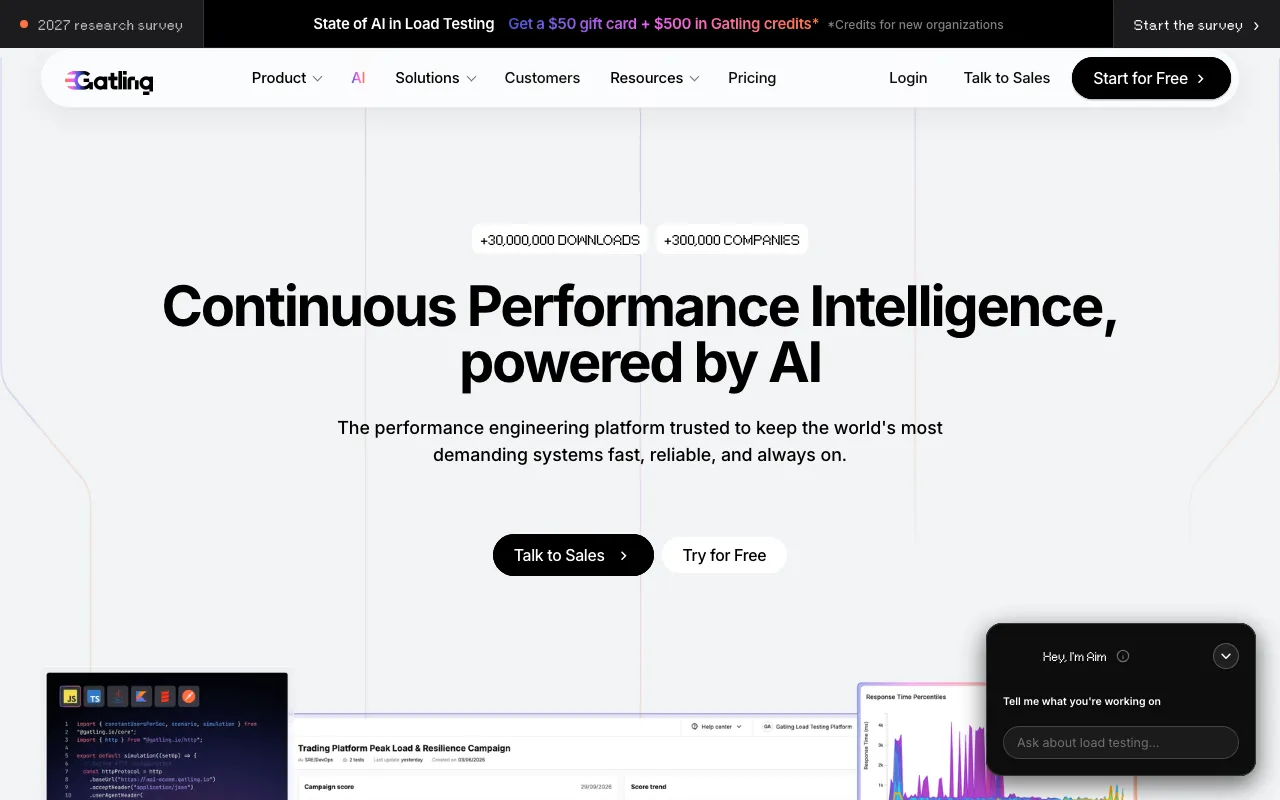
Gatling Community Edition is a load testing tool where scenarios are written as code. Runs produce HTML reports with timings, throughput, and errors, and can fail CI builds on thresholds.
Gatling lets teams define load test simulations in Java, JavaScript, TypeScript, Kotlin, or Scala, version them like application code, and execute them on a workstation or in continuous integration. Each run yields an HTML report with percentiles, throughput over time, and per-request errors, plus assertions that can break the build when limits are exceeded.
The engine uses a non-blocking design built on Netty, modeling virtual users as lightweight messages rather than one thread per user. The same simulation can run locally or in CI through Maven, Gradle, sbt, or npm plugins. Community Edition covers HTTP/1.1, HTTP/2, WebSocket, Server-Sent Events, and JMS without caps on duration or virtual users for those protocols.
Authoring tools include a Recorder that turns browser sessions or HAR files into simulations, feeders for CSV, JSON, and databases, and checks on status codes, bodies, headers, and timings. Open and closed workload models are supported. Additional protocols and enterprise-oriented load generation are offered separately from the core open-source edition.
Gatling is aimed at developers who want performance tests kept alongside application code, reviewed in pull requests, and wired into existing build pipelines without a proprietary scenario format.
Cross-browser web automation and testing framework
Playwright drives Chromium, Firefox, and WebKit through one API for tests, scripts, and agent-driven browser control.
JavaScript library for automating Chrome and Firefox
Puppeteer exposes a high-level JavaScript API to drive Chrome or Firefox through the DevTools Protocol or WebDriver BiDi. It defaults to headless browser control for scripts and tests.
Isolated workshop for UI components and pages
Storybook runs a local dev workshop where teams build, test, and document components in isolation. It integrates with major frontend frameworks and addons for docs, accessibility, visual review, and agent tooling.

Local runner for GitHub Actions workflows
A command-line tool that executes GitHub Actions workflows on your machine using Docker. It mirrors GitHub’s environment for faster feedback while editing workflow files.

MCP and CLI bridge from coding agents to Chrome DevTools
Lets coding agents control and inspect a live Chrome session for automation, debugging, performance traces, and Lighthouse-style checks.

Autonomous AI penetration tester for web apps and APIs
Shannon analyzes web application source code, plans attack paths, and runs real exploits against staging targets. Only vulnerabilities confirmed with a working proof of concept appear in reports.