
TensorFlow
End-to-end machine learning platform and tooling ecosystem
TensorFlow is a machine learning platform with Python and C++ APIs, optional GPU packages, and companion libraries for data, training, deployment, and visualization.

Industrial speech recognition toolkit and serving stack
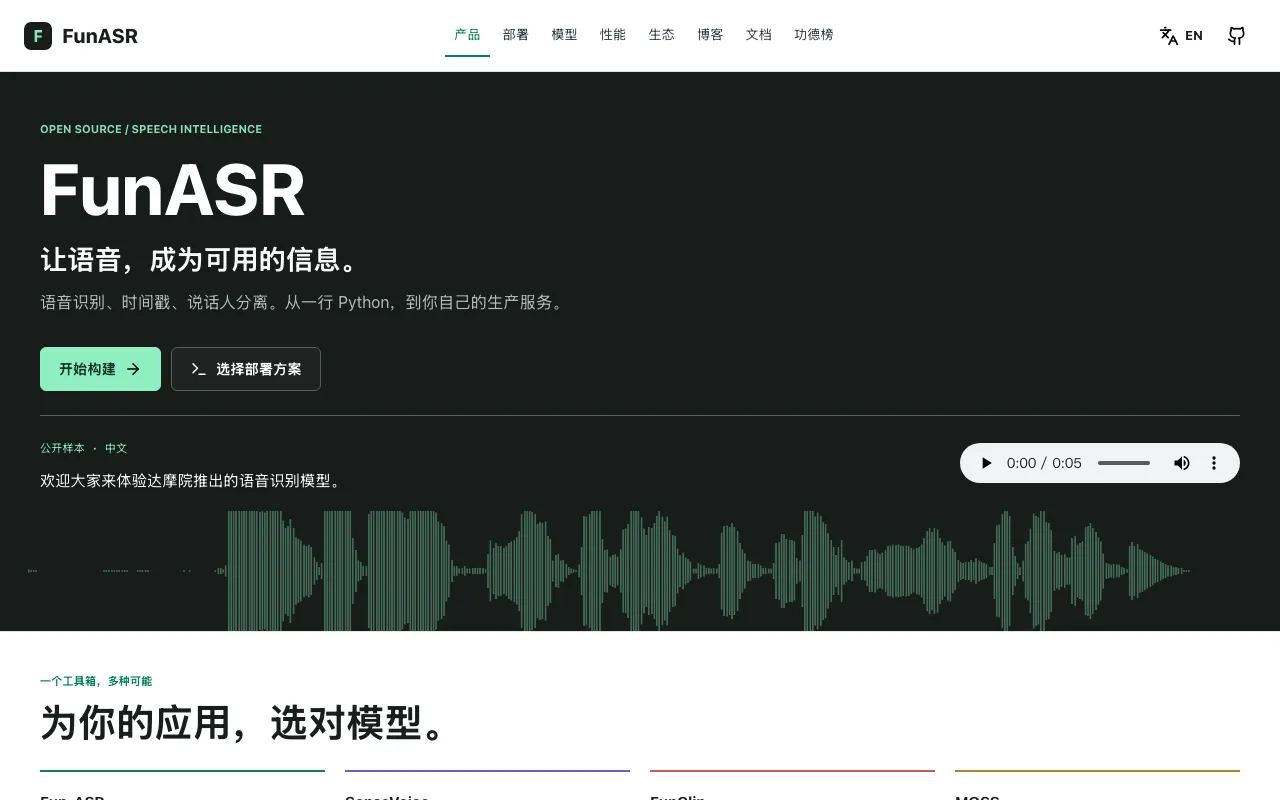
Python toolkit and runtimes for offline, streaming, and edge ASR with VAD, punctuation, speaker clustering, emotion tags, and API or MCP deployment options.
FunASR bundles research-grade speech models with pipelines you assemble for file transcription, live chunks, or speaker-aware segments. Checkpoints such as SenseVoiceSmall, Paraformer streaming variants, Fun-ASR-Nano, and third-party adapters cover multilingual recognition, punctuation restoration, voice-activity detection, and optional emotion or audio-event labels.
Developers load models through AutoModel APIs, a CLI with named presets, or higher-level recipes that chain VAD, embedding clustering, and text cleanup. Documentation maps each task to the correct checkpoint because capabilities differ between offline, streaming, and edge paths.
Serving options span local CPU microservices, GPU vLLM batching, OpenAI-compatible HTTP endpoints, MCP servers for agents, Docker and Kubernetes templates, and llama.cpp GGUF binaries for CPU-only edge devices. Colab notebooks and Hugging Face integrations provide browser-first trials before local installs.
The project maintains a broad model zoo with licensing called out per checkpoint, benchmark guidance for comparing latency and accuracy on your own audio, and migration notes for teams moving from Whisper or hosted ASR vendors.
End-to-end machine learning platform and tooling ecosystem
TensorFlow is a machine learning platform with Python and C++ APIs, optional GPU packages, and companion libraries for data, training, deployment, and visualization.

Run open AI models locally or in the cloud
Ollama runs open language models such as Gemma, Qwen, DeepSeek and gpt-oss on macOS, Windows and Linux, locally or in the cloud. It offers a CLI, a REST API, and Python and JavaScript libraries.

Shared model definitions for multimodal ML workloads
Transformers is a Python library that defines pretrained text, vision, audio, and multimodal models once in PyTorch for shared inference and training across the ecosystem.

LLM inference engine in C/C++ for local and cloud hardware
llama.cpp runs large language models and multimodal models locally or in the cloud with minimal setup. It includes a CLI, an OpenAI-compatible server with a built-in chat app, and a C library API.

General-purpose speech recognition and translation model
Whisper is a speech recognition model trained on diverse audio. It supports multilingual transcription, speech-to-English translation, and language identification via Python or the command line.

High-throughput, memory-efficient inference and serving engine for LLMs
vLLM is a library and server for running and serving large language models. It uses PagedAttention and continuous batching for throughput, offers an OpenAI-compatible API, and runs on many GPU, CPU and accelerator types.