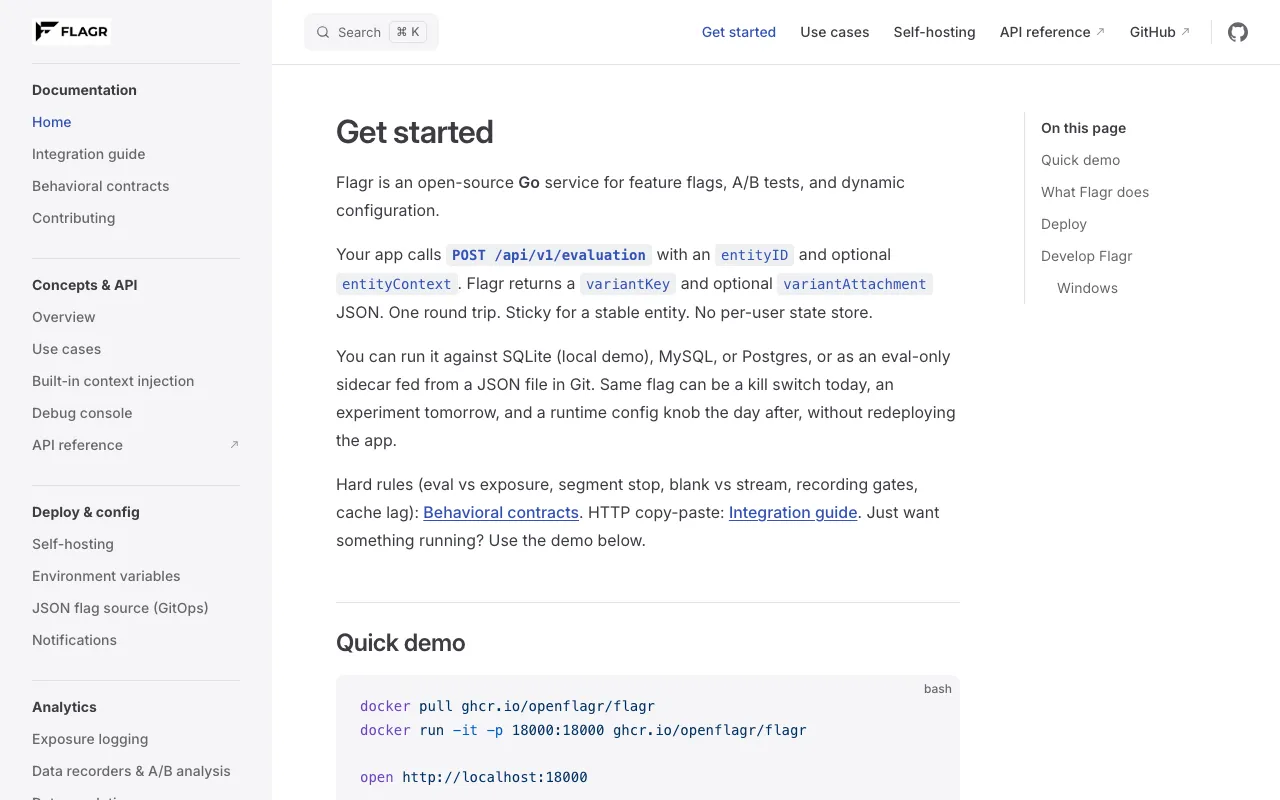
Flagr is an open-source Go service for evaluating feature flags, experiments, and runtime configuration. Applications call its HTTP API to receive sticky variants and optional JSON attachments.
Overview
Flagr centralizes feature flagging, A/B testing, and dynamic configuration behind one evaluation API. Client applications send an entity identifier and optional context; the service returns a variant key and optional attachment JSON in a single request, with stable assignment per entity.
The same flag can act as a kill switch, experiment bucket, or config knob without redeploying application code. Segments, constraints, exposure logging, and data recorders support rollout and analytics. A Vue-based UI manages flags, and the API is documented for integration.
You can self-host with SQLite for local demos, or MySQL, PostgreSQL, or JSON/GitOps eval-only mode. An official container image is published for quick runs. Development targets Linux, macOS, and Windows with Make-based workflows.
Hosted demo endpoints exist for trials, but production setup is intended on your own infrastructure with configurable databases, auth, recorders, and environment variables defined in the project config package.
Key features
- POST /api/v1/evaluation API
- Sticky variant assignment
- Feature flags and kill switches
- A/B test segments and constraints
- Runtime config on variants
- Vue 3 management UI
- SQLite, MySQL, or Postgres backends
- GitOps JSON flag source option
Use cases
- Gradual feature rollouts
- Kill switches in production
- Audience-targeted experiments
- Runtime config without redeploy
- Eval-only sidecar from Git JSON