
QLib
AI-oriented quantitative investment research platform
Qlib is a Python platform for quant research from data prep through backtest. It supports supervised learning, market dynamics modeling, and reinforcement learning workflows.
Reinforcement learning framework for quantitative trading
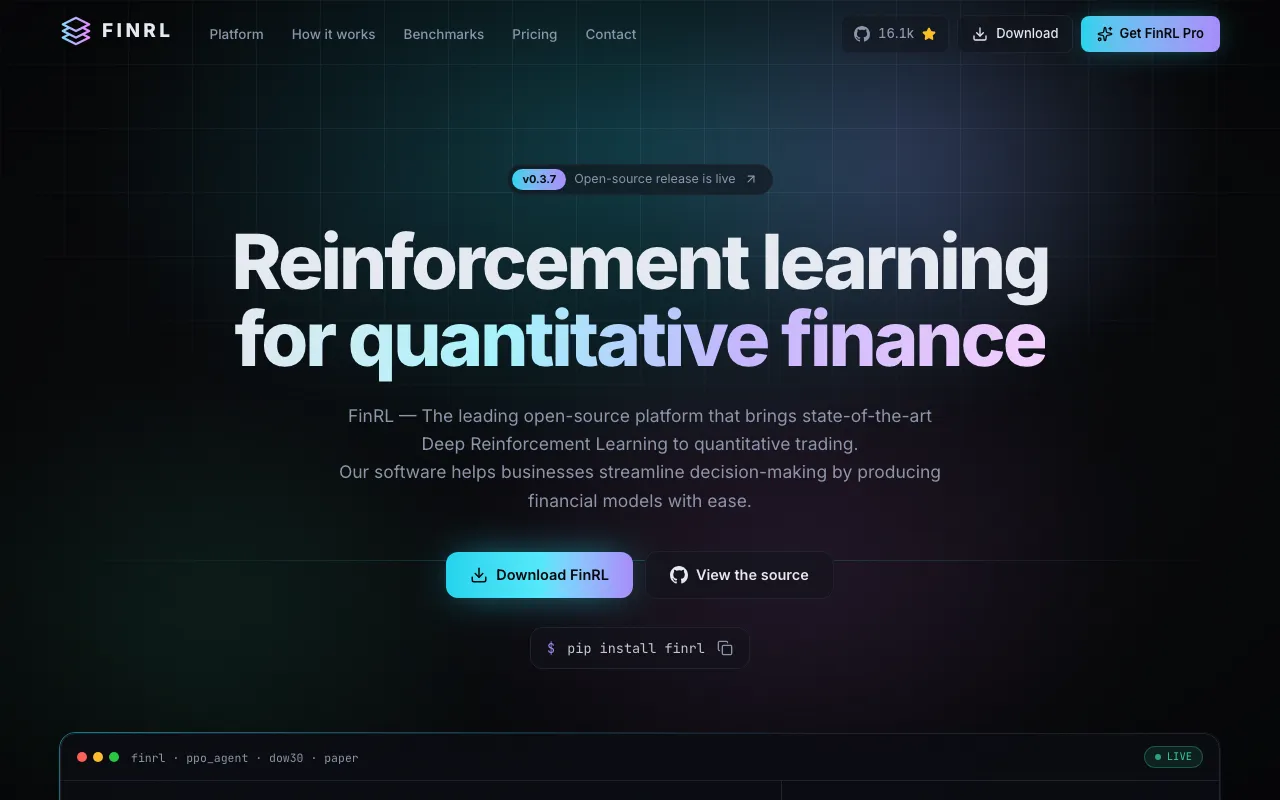
A Python framework for training deep reinforcement learning agents on simulated market environments. It targets education, benchmarking, and research with a train-test-trade workflow and multiple data connectors.
FinRL organizes quantitative trading research around three layers: market environments where agents act, DRL agent implementations, and application scripts for training, testing, and trading workflows. Users download and preprocess price data, fit policies with algorithms such as A2C, DDPG, PPO, SAC, and TD3, then backtest against baselines like mean-variance optimization or index buy-and-hold.
Environments integrate with Gym-style interfaces and can ingest equities, crypto, and other feeds from sources listed in the project, including Yahoo Finance, Binance, WRDS, and broker APIs mentioned in the ecosystem material. Technical indicators and risk-related signals such as turbulence indexes can augment raw OHLCV features.
The classic FinRL stack emphasizes an end-to-end pipeline with Stable Baselines 3 on PyTorch, custom evaluation loops, and tutorials aimed at learners and researchers. The maintainers note a newer FinRL-X line for production-oriented deployment, while the classic edition keeps the original educational framework.
Installation supports major desktop operating systems via pip, with tutorial scripts that download data, train several agents, and plot backtest comparisons. Documentation and community channels sit under the AI4Finance Foundation umbrella.
AI-oriented quantitative investment research platform
Qlib is a Python platform for quant research from data prep through backtest. It supports supervised learning, market dynamics modeling, and reinforcement learning workflows.

Python quantitative trading framework for multi-market strategies
AbuQuant is a Python-based quantitative trading and investment stack for stocks, futures, options, and cryptocurrencies, with lectures, a UI layer, and many built-in technical models.

End-to-end machine learning platform and tooling ecosystem
TensorFlow is a machine learning platform with Python and C++ APIs, optional GPU packages, and companion libraries for data, training, deployment, and visualization.

Run open AI models locally or in the cloud
Ollama runs open language models such as Gemma, Qwen, DeepSeek and gpt-oss on macOS, Windows and Linux, locally or in the cloud. It offers a CLI, a REST API, and Python and JavaScript libraries.

Shared model definitions for multimodal ML workloads
Transformers is a Python library that defines pretrained text, vision, audio, and multimodal models once in PyTorch for shared inference and training across the ecosystem.

LLM inference engine in C/C++ for local and cloud hardware
llama.cpp runs large language models and multimodal models locally or in the cloud with minimal setup. It includes a CLI, an OpenAI-compatible server with a built-in chat app, and a C library API.