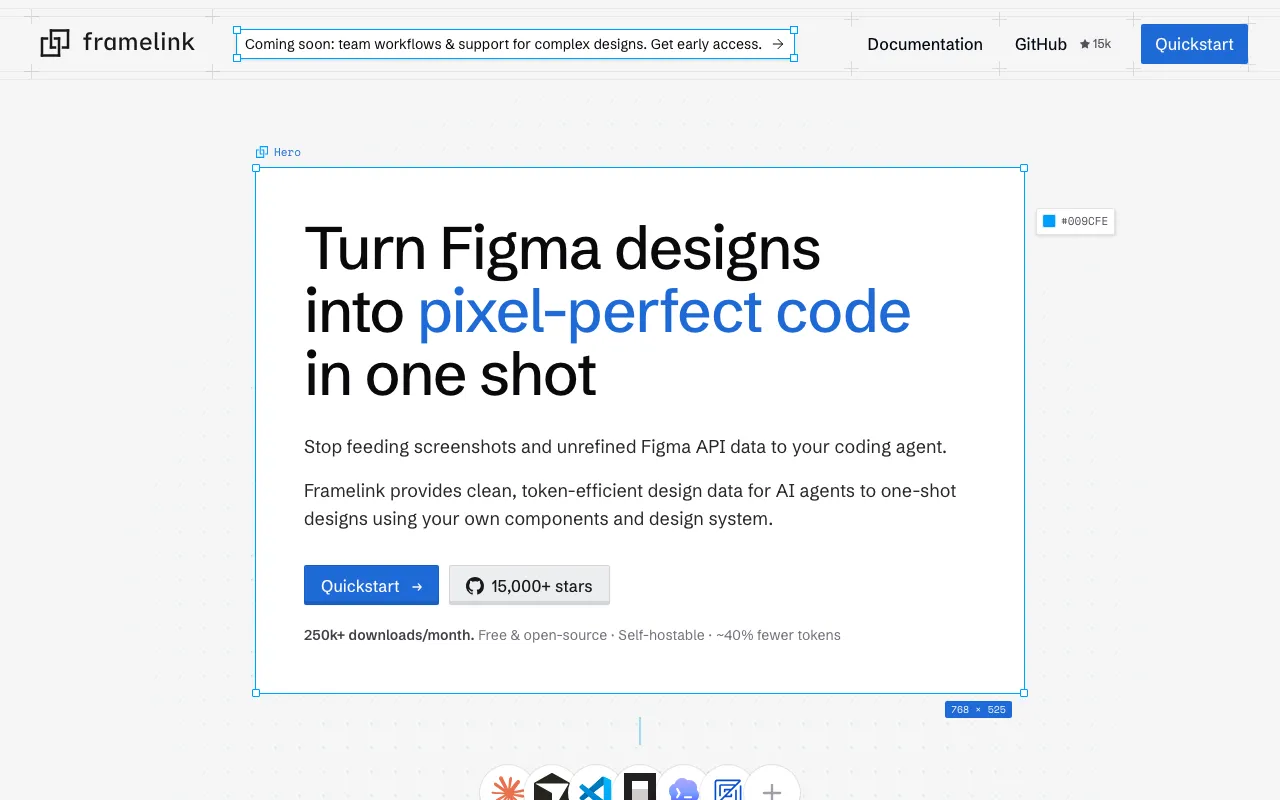
A Model Context Protocol server that pulls Figma file metadata into AI coding tools such as Cursor, so agents can implement UI from design links instead of screenshots.
Overview
Framelink MCP for Figma connects design files to IDE chat and agent workflows. You paste a link to a Figma file, frame, or group and ask the agent to implement or adapt the design; the server fetches data from the Figma API and returns trimmed layout and styling context for code generation.
Before context is sent to the model, responses are simplified so only relevant structure and style information remains, which the project describes as improving accuracy and keeping prompts smaller. Output is descriptive JSON about borders, padding, and similar attributes rather than framework-specific generated code, so the model can follow your own components and conventions.
The server is wired into editors and other MCP clients through their MCP configuration. Use requires a Figma API access token, which you can supply via environment variables or config fields. Documentation covers setup on macOS, Linux, and Windows.
Compared with Figma’s own MCP offering, the project emphasizes smaller payloads, preserved style names, nested components, and deduplication of styles and duplicate elements. Both rely on the same Figma API, so API rate limits apply similarly.
Key features
- Figma API integration for files, frames, and groups
- Simplified layout and styling context for LLMs
- Descriptive JSON rather than prescriptive framework code
- MCP configuration for Cursor and other clients
- Figma access token via config or environment
- Preserves style names and component props where applicable
- Smaller context payload than prescriptive alternatives
Use cases
- One-shot UI implementation from Figma links in the IDE
- Design-to-code in Cursor agent or chat mode
- Accurate spacing, typography, and color in generated UI
- Framework-agnostic design handoff to coding agents



 Base44