
CLIProxyAPI
Local proxy exposing CLI AI accounts as standard model APIs
Runs a local server that translates OpenAI-, Gemini-, Claude-, and Codex-compatible clients to OAuth-backed CLI provider accounts.

Python framework for MCP servers and clients
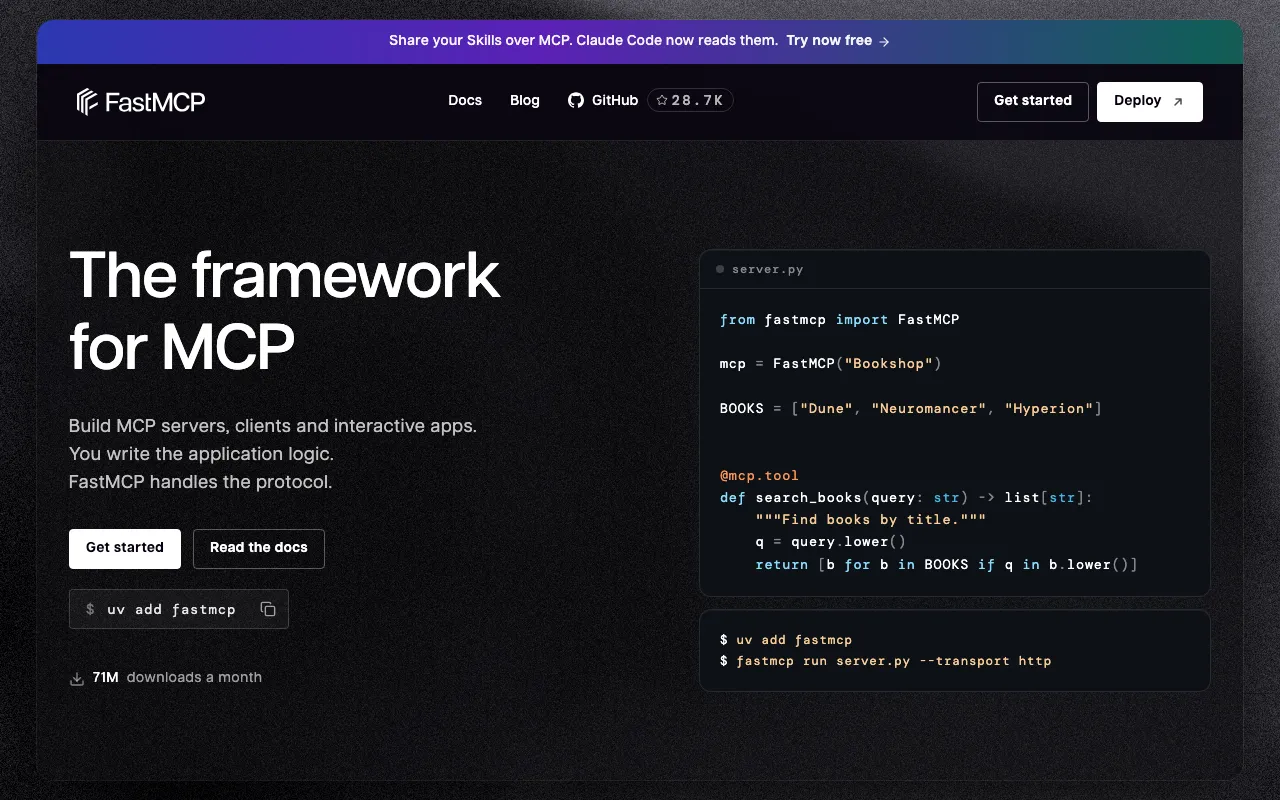
FastMCP builds Model Context Protocol servers, clients, and interactive apps from Python functions. It generates schemas, handles transport, and exposes a CLI to run servers.
FastMCP sits on the Model Context Protocol that links large language models to tools and data. You decorate ordinary Python callables to publish tools, resources, and prompts, while the framework produces JSON schema, validation, and documentation automatically.
Server support covers HTTP and other transports with authentication hooks for providers such as GitHub OAuth. Clients connect to local or remote MCP endpoints with protocol lifecycle handled in library code. Apps can attach interactive UI components such as tables and forms that render inside compatible MCP clients.
Additional capabilities include tool renaming and input shaping, composing multiple servers behind one endpoint, middleware and background tasks, in-memory testing helpers, and skill catalog providers that serve validated Agent Skills to teams. A TypeScript edition mirrors the same pillars for npm-based projects.
Install with uv or pip, run servers through the fastmcp CLI, and extend with provider-specific auth and Prefab UI widgets. Prefect offers a separate FastMCP Gateway product for hosted deployment, registry, and governance, while the open framework remains suitable for self-run servers on your own machines.
Local proxy exposing CLI AI accounts as standard model APIs
Runs a local server that translates OpenAI-, Gemini-, Claude-, and Codex-compatible clients to OAuth-backed CLI provider accounts.
SDK and CLI for connecting AI agents to many apps
Composio equips AI agents with large sets of pre-authenticated toolkits, per-user sessions, authentication, triggers, and a sandbox. SDKs ship for TypeScript and Python with adapters for common agent frameworks.

Integration platform for AI agents and products
Nango connects AI agents and products to 1,300+ APIs through managed authentication, an authenticated proxy, and TypeScript functions. It offers 10,000+ prebuilt tools and runs on Nango Cloud, in your own cloud account, or self-hosted.
Open-source tool-calling platform with unified MCP server for AI agents
ACI.dev connects AI agents and agentic IDEs to 600+ tools through direct function calls or a unified MCP server. It handles multi-tenant authentication, natural-language permissions and dynamic tool discovery.

Open-source plugin-based agent harness from DeepSeek
DeepSeek Harness is an open-source agent harness built on an everything-is-a-plugin architecture powered by Cordis. It offers a web UI, desktop app, and extensible plugins for daily work, coding, and automation.

Self-improving open-source AI agent with memory, skills and messaging gateway
Open-source AI agent from Nous Research that keeps persistent memory, creates skills from experience, and runs from a terminal, desktop app or messaging platforms with any model provider.
 Anthropic Claude
 ChatGPT