
CLIProxyAPI
Local proxy exposing CLI AI accounts as standard model APIs
Runs a local server that translates OpenAI-, Gemini-, Claude-, and Codex-compatible clients to OAuth-backed CLI provider accounts.

SDK and CLI for connecting AI agents to many apps
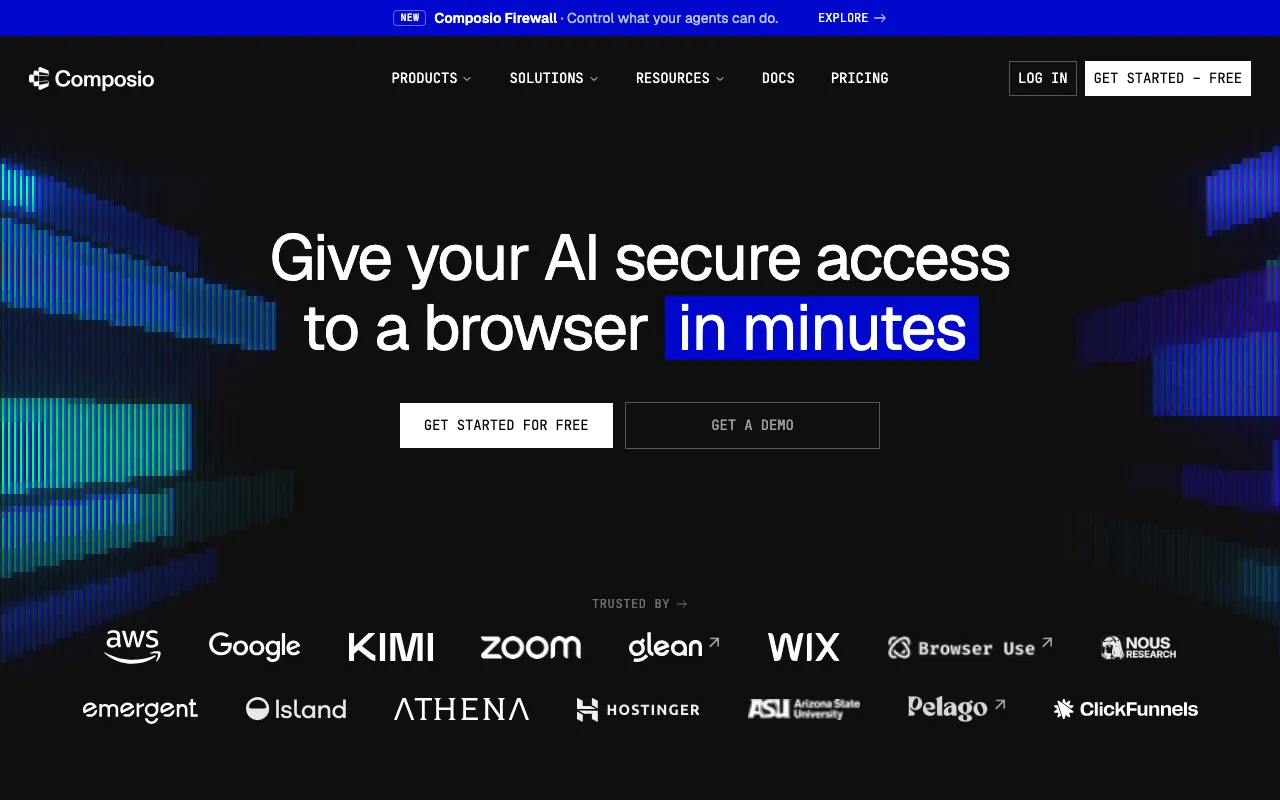
Composio equips AI agents with large sets of pre-authenticated toolkits, per-user sessions, authentication, triggers, and a sandbox. SDKs ship for TypeScript and Python with adapters for common agent frameworks.
Composio is a toolkit layer for AI agents that need to act in real applications rather than only generate text. It exposes many pre-authenticated toolkits and handles per-user sessions, authentication, triggers, and a sandbox so agents can turn intent into actions across numerous third-party apps.
The monorepo centers on a TypeScript package and a Python package, plus a command-line interface to search, execute, and script tools from the shell. Provider adapters translate Composio tools into native tool formats for frameworks such as OpenAI Agents, Claude Agent SDK, Vercel AI SDK, LangChain, and others listed in the documentation table.
A typical flow starts by creating a session for a user, optionally reusing a stored session id across turns. Sessions can receive meta tools that discover, authenticate, and execute app tools at runtime instead of loading hundreds of static tool definitions into context. Configuration options restrict toolkits, auth configs, and connected accounts.
Each session can also expose a hosted MCP endpoint when MCP mode is enabled at creation time, so clients such as Claude or Cursor can connect to session.mcp.url. Developers who do not use a listed framework can build a custom provider or connect over MCP directly.
Local proxy exposing CLI AI accounts as standard model APIs
Runs a local server that translates OpenAI-, Gemini-, Claude-, and Codex-compatible clients to OAuth-backed CLI provider accounts.

Python framework for MCP servers and clients
FastMCP builds Model Context Protocol servers, clients, and interactive apps from Python functions. It generates schemas, handles transport, and exposes a CLI to run servers.

Integration platform for AI agents and products
Nango connects AI agents and products to 1,300+ APIs through managed authentication, an authenticated proxy, and TypeScript functions. It offers 10,000+ prebuilt tools and runs on Nango Cloud, in your own cloud account, or self-hosted.
Open-source tool-calling platform with unified MCP server for AI agents
ACI.dev connects AI agents and agentic IDEs to 600+ tools through direct function calls or a unified MCP server. It handles multi-tenant authentication, natural-language permissions and dynamic tool discovery.

Open-source plugin-based agent harness from DeepSeek
DeepSeek Harness is an open-source agent harness built on an everything-is-a-plugin architecture powered by Cordis. It offers a web UI, desktop app, and extensible plugins for daily work, coding, and automation.

Self-improving open-source AI agent with memory, skills and messaging gateway
Open-source AI agent from Nous Research that keeps persistent memory, creates skills from experience, and runs from a terminal, desktop app or messaging platforms with any model provider.
 Anthropic Claude
 ChatGPT