
TensorFlow
End-to-end machine learning platform and tooling ecosystem
TensorFlow is a machine learning platform with Python and C++ APIs, optional GPU packages, and companion libraries for data, training, deployment, and visualization.

PaddlePaddle toolkit for LLM and VLM inference deployment
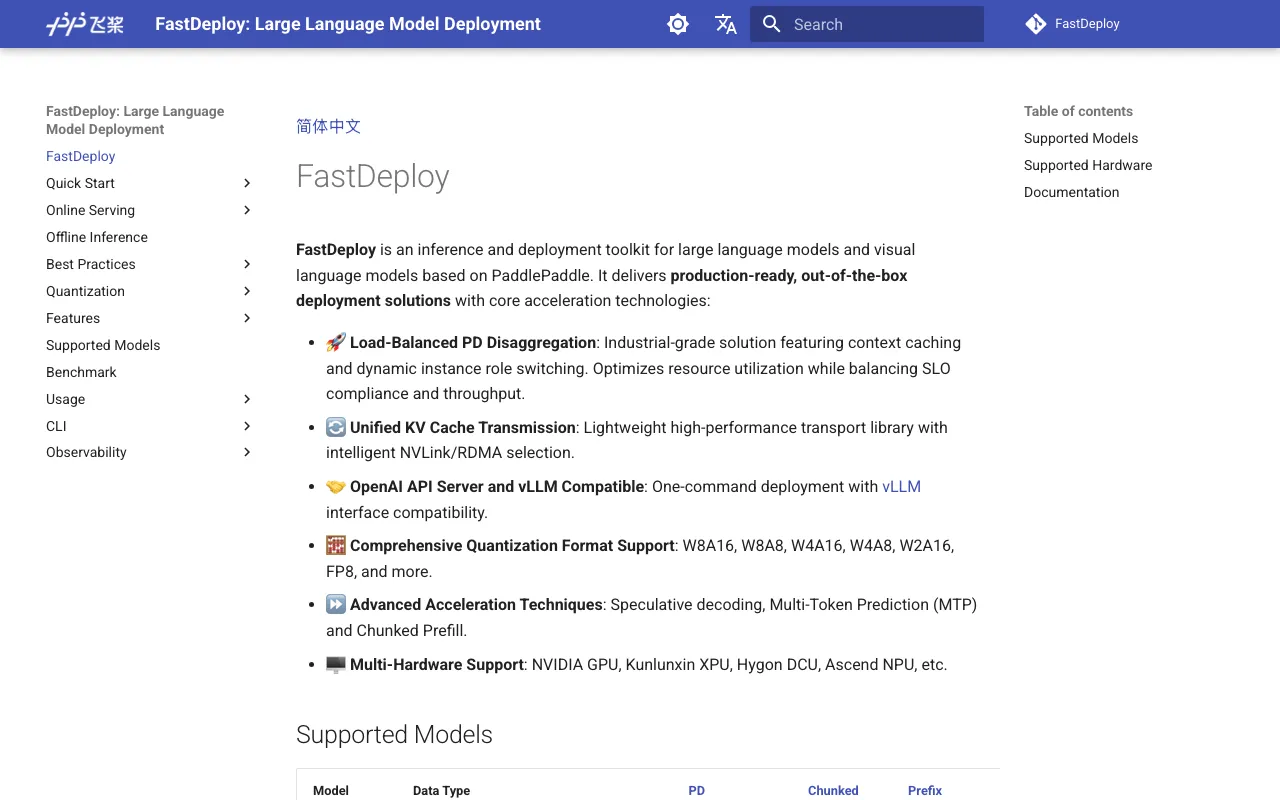
FastDeploy serves large language and vision-language models with production-oriented inference features. It supports multiple hardware vendors, quantization formats, and vLLM-compatible APIs.
FastDeploy builds on PaddlePaddle to deploy LLMs and VLMs with tuning aimed at throughput, latency, and hardware diversity. Documented capabilities include load-balanced prefill-decode disaggregation, unified KV cache transport with NVLink or RDMA selection, and broad weight precisions such as W8A16, W4A8, FP8, and related variants.
Acceleration options cover speculative decoding, multi-token prediction, chunked prefill, prefix caching, CUDA Graph where applicable, and routing components for global cache pooling. An OpenAI-compatible API server is provided with stated vLLM interface alignment.
Model coverage listed in docs spans ERNIE 4.5 family members, Qwen variants, DeepSeek, GLM, and others with per-model notes on PD separation, context length, and feature support. Hardware tables include NVIDIA GPU plus Kunlunxin XPU, Hygon DCU, Iluvatar GPU, MetaX GPU, Enflame GCU, Ascend NPU, and additional accelerators with varying maturity per model.
Deployment expects Linux hosts and supported Python versions. Guides cover quick deployment, offline inference, online services, quantization, disaggregated serving, and router-based scheduling for production clusters.
End-to-end machine learning platform and tooling ecosystem
TensorFlow is a machine learning platform with Python and C++ APIs, optional GPU packages, and companion libraries for data, training, deployment, and visualization.

Run open AI models locally or in the cloud
Ollama runs open language models such as Gemma, Qwen, DeepSeek and gpt-oss on macOS, Windows and Linux, locally or in the cloud. It offers a CLI, a REST API, and Python and JavaScript libraries.

Shared model definitions for multimodal ML workloads
Transformers is a Python library that defines pretrained text, vision, audio, and multimodal models once in PyTorch for shared inference and training across the ecosystem.

LLM inference engine in C/C++ for local and cloud hardware
llama.cpp runs large language models and multimodal models locally or in the cloud with minimal setup. It includes a CLI, an OpenAI-compatible server with a built-in chat app, and a C library API.

General-purpose speech recognition and translation model
Whisper is a speech recognition model trained on diverse audio. It supports multilingual transcription, speech-to-English translation, and language identification via Python or the command line.

High-throughput, memory-efficient inference and serving engine for LLMs
vLLM is a library and server for running and serving large language models. It uses PagedAttention and continuous batching for throughput, offers an OpenAI-compatible API, and runs on many GPU, CPU and accelerator types.