
Playwright
Cross-browser web automation and testing framework
Playwright drives Chromium, Firefox, and WebKit through one API for tests, scripts, and agent-driven browser control.

Python package for realistic fake test and sample data
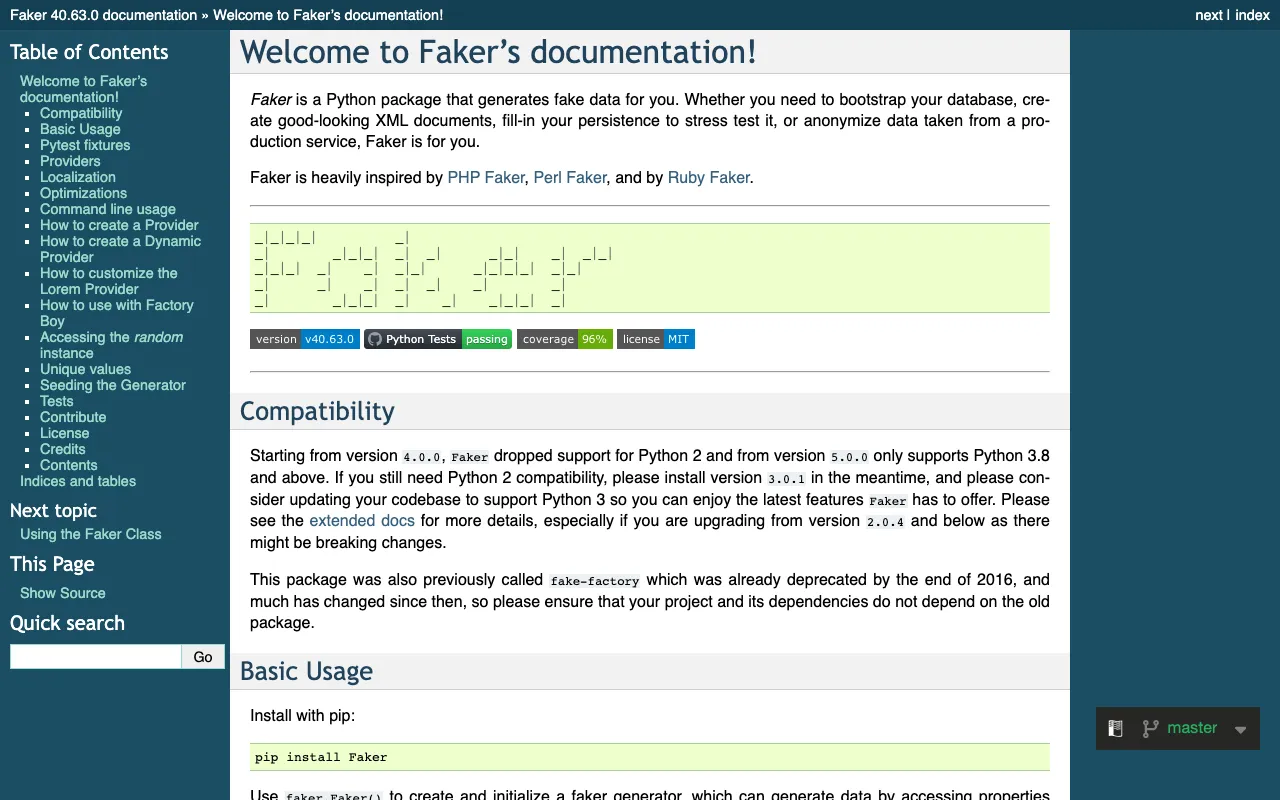
Faker is a Python library that produces randomized names, addresses, and other structured fake values. Teams use it to seed databases, build test fixtures, and anonymize sensitive fields.
Faker is a Python library that synthesizes believable stand-in data on demand. A generator exposes typed accessors—names, addresses, paragraphs of text, network identifiers, and many more—so tests and prototypes can avoid hard-coded examples.
Data types are grouped into providers that ship with the package, and you can attach extra providers or define your own classes and dynamic lists. Constructors accept locale codes and can mix multiple locales, falling back to US English when a localized provider is missing.
For repeatable tests, seeding pins the random stream so the same calls return the same values, while a unique mode avoids duplicates within a generator instance. An optional weighting mode biases frequencies toward patterns seen in real-world datasets at some performance cost.
A command-line entry point prints selected fakes with locale, repeat, and separator options when the package is installed. A pytest plugin supplies a ready-made fixture, and Factory Boy can delegate attribute generation to Faker formatters.
Cross-browser web automation and testing framework
Playwright drives Chromium, Firefox, and WebKit through one API for tests, scripts, and agent-driven browser control.
JavaScript library for automating Chrome and Firefox
Puppeteer exposes a high-level JavaScript API to drive Chrome or Firefox through the DevTools Protocol or WebDriver BiDi. It defaults to headless browser control for scripts and tests.

Isolated workshop for UI components and pages
Storybook runs a local dev workshop where teams build, test, and document components in isolation. It integrates with major frontend frameworks and addons for docs, accessibility, visual review, and agent tooling.

Local runner for GitHub Actions workflows
A command-line tool that executes GitHub Actions workflows on your machine using Docker. It mirrors GitHub’s environment for faster feedback while editing workflow files.

MCP and CLI bridge from coding agents to Chrome DevTools
Lets coding agents control and inspect a live Chrome session for automation, debugging, performance traces, and Lighthouse-style checks.

Autonomous AI penetration tester for web apps and APIs
Shannon analyzes web application source code, plans attack paths, and runs real exploits against staging targets. Only vulnerabilities confirmed with a working proof of concept appear in reports.