
TensorFlow
End-to-end machine learning platform and tooling ecosystem
TensorFlow is a machine learning platform with Python and C++ APIs, optional GPU packages, and companion libraries for data, training, deployment, and visualization.

Library for dense vector similarity search and clustering
Indexes and searches large sets of embedding vectors with CPU or GPU backends. Python and C++ APIs support exact and approximate nearest-neighbor methods.
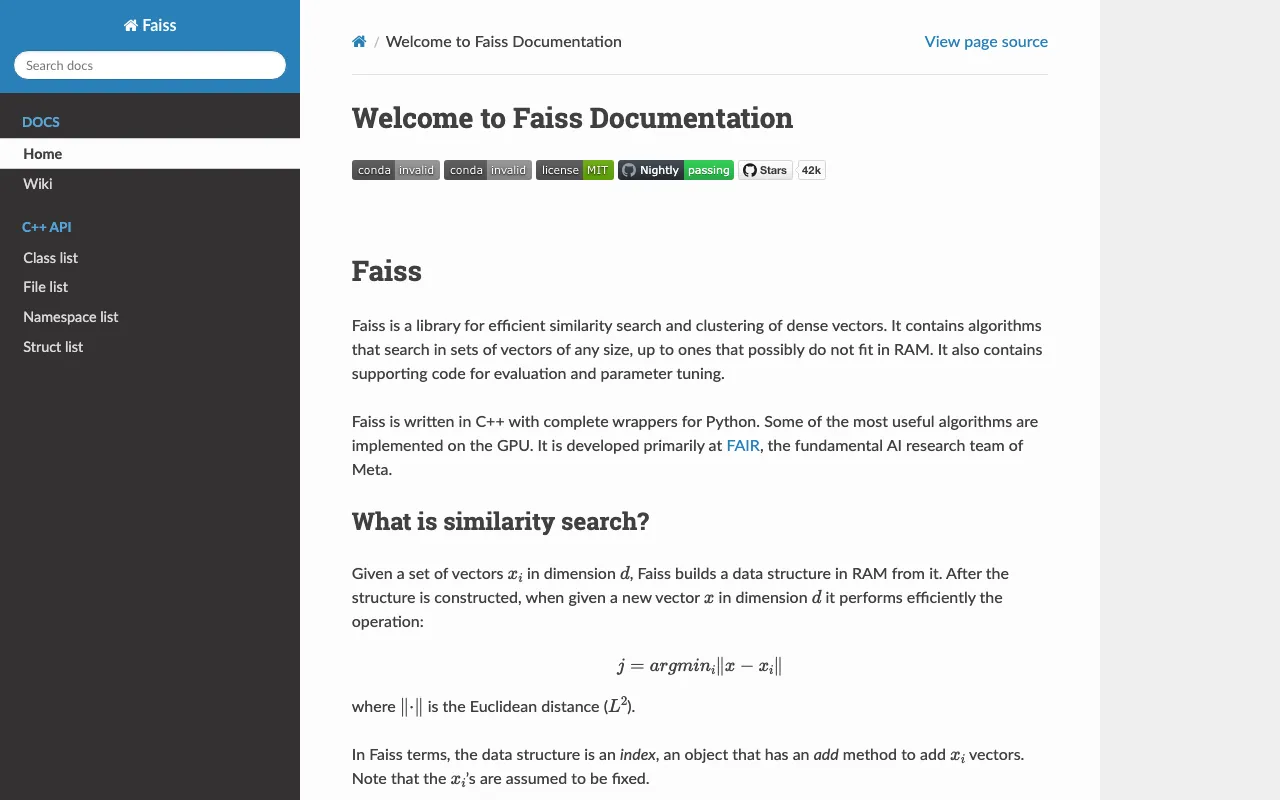
Faiss is a library for similarity search and clustering over dense floating-point vectors. It builds in-memory index structures, adds vectors in batches, and runs nearest-neighbor queries under L2 distance, inner product, or related metrics, including cosine via normalized dot products.
Algorithms range from exact flat search to compressed and graph-based indexes that trade memory or accuracy for speed. Some indexes store only quantized codes so billions of vectors can fit on one machine; others layer structures such as HNSW or NSG on raw vectors.
The core implementation is C++ with complete Python bindings. GPU variants accelerate many index types when CUDA or ROCm hardware is available, and optional integrations extend to additional GPU backends. Supporting utilities cover evaluation and parameter tuning.
Installations are commonly distributed through Conda packages for CPU-only or GPU-enabled builds. Faiss is developed primarily at Meta’s Fundamental AI Research group and underpins retrieval and embedding search in research and applied ML pipelines.
End-to-end machine learning platform and tooling ecosystem
TensorFlow is a machine learning platform with Python and C++ APIs, optional GPU packages, and companion libraries for data, training, deployment, and visualization.

Run open AI models locally or in the cloud
Ollama runs open language models such as Gemma, Qwen, DeepSeek and gpt-oss on macOS, Windows and Linux, locally or in the cloud. It offers a CLI, a REST API, and Python and JavaScript libraries.

Shared model definitions for multimodal ML workloads
Transformers is a Python library that defines pretrained text, vision, audio, and multimodal models once in PyTorch for shared inference and training across the ecosystem.

LLM inference engine in C/C++ for local and cloud hardware
llama.cpp runs large language models and multimodal models locally or in the cloud with minimal setup. It includes a CLI, an OpenAI-compatible server with a built-in chat app, and a C library API.

General-purpose speech recognition and translation model
Whisper is a speech recognition model trained on diverse audio. It supports multilingual transcription, speech-to-English translation, and language identification via Python or the command line.

High-throughput, memory-efficient inference and serving engine for LLMs
vLLM is a library and server for running and serving large language models. It uses PagedAttention and continuous batching for throughput, offers an OpenAI-compatible API, and runs on many GPU, CPU and accelerator types.