
AIF360
Open toolkit for fairness metrics and bias mitigation
AI Fairness 360 is an extensible library with fairness metrics, explanations, and bias mitigation algorithms for datasets and machine learning models.

Python toolkit for assessing fairness in AI systems
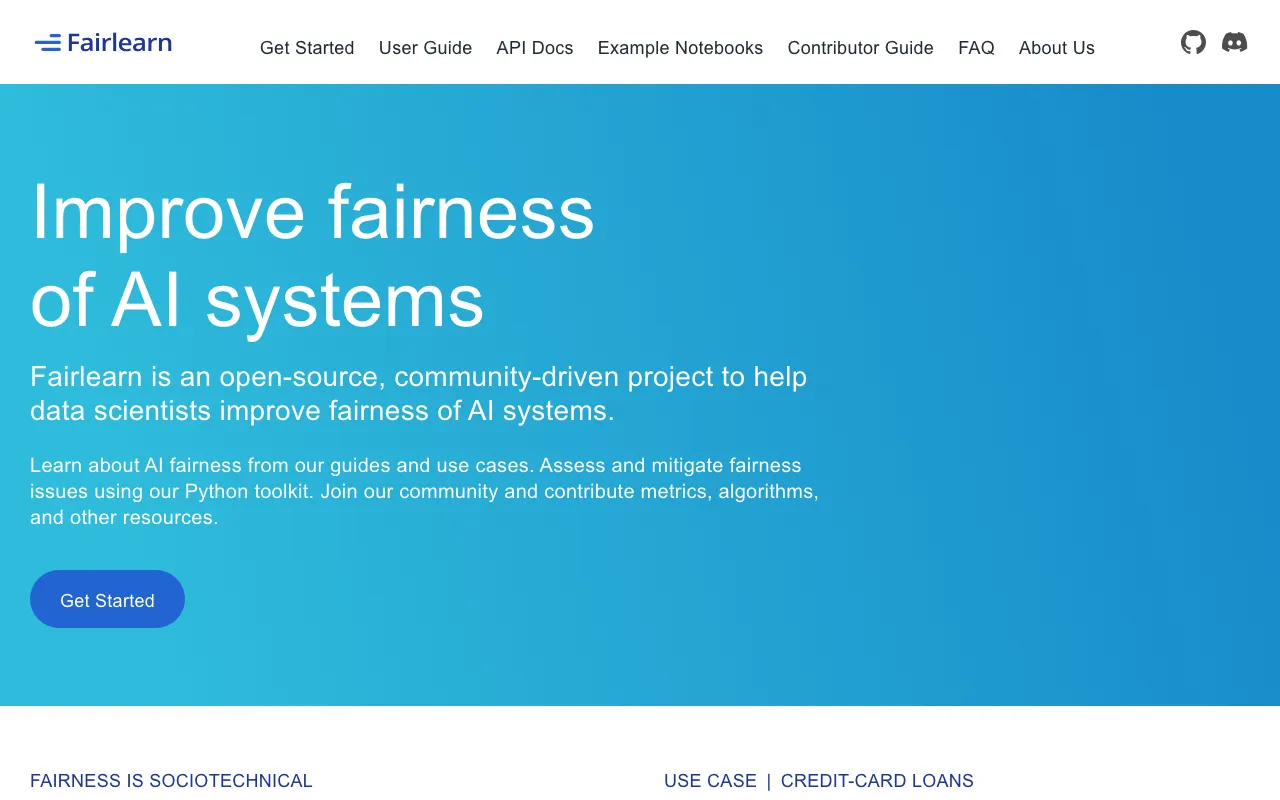
Fairlearn is a Python package for measuring fairness and mitigating unfairness in machine learning models. It includes metrics and algorithms aimed at group-fairness harms.
Fairlearn supports developers of AI systems who need to check whether a model treats different groups unfairly and to reduce disparities where they appear. The package combines assessment metrics with mitigation methods across several common fairness definitions.
Fairness is framed in terms of harms to people: allocation harms when opportunities or resources are extended or withheld unevenly, and quality-of-service harms when the system works worse for some users even without explicit allocation differences. Relevant demographic or application groups must be chosen by the practitioner.
The toolkit is split into metrics for comparing models and groups under fairness and accuracy measures, and algorithms that adjust models for tasks under various fairness constraints. Documentation, a user guide, quickstart material, and example notebooks illustrate credit, lending, and similar scenarios.
Installation is via pip from PyPI. Fairlearn is presented as a sociotechnical aid: quantitative metrics cannot capture every notion of justice, and multiple metrics may conflict, so human judgment on trade-offs remains necessary.
Open toolkit for fairness metrics and bias mitigation
AI Fairness 360 is an extensible library with fairness metrics, explanations, and bias mitigation algorithms for datasets and machine learning models.

End-to-end machine learning platform and tooling ecosystem
TensorFlow is a machine learning platform with Python and C++ APIs, optional GPU packages, and companion libraries for data, training, deployment, and visualization.

Run open AI models locally or in the cloud
Ollama runs open language models such as Gemma, Qwen, DeepSeek and gpt-oss on macOS, Windows and Linux, locally or in the cloud. It offers a CLI, a REST API, and Python and JavaScript libraries.

Shared model definitions for multimodal ML workloads
Transformers is a Python library that defines pretrained text, vision, audio, and multimodal models once in PyTorch for shared inference and training across the ecosystem.

LLM inference engine in C/C++ for local and cloud hardware
llama.cpp runs large language models and multimodal models locally or in the cloud with minimal setup. It includes a CLI, an OpenAI-compatible server with a built-in chat app, and a C library API.

General-purpose speech recognition and translation model
Whisper is a speech recognition model trained on diverse audio. It supports multilingual transcription, speech-to-English translation, and language identification via Python or the command line.