qmetrics.net

FaceSwap

Local deep learning face replacement toolkit

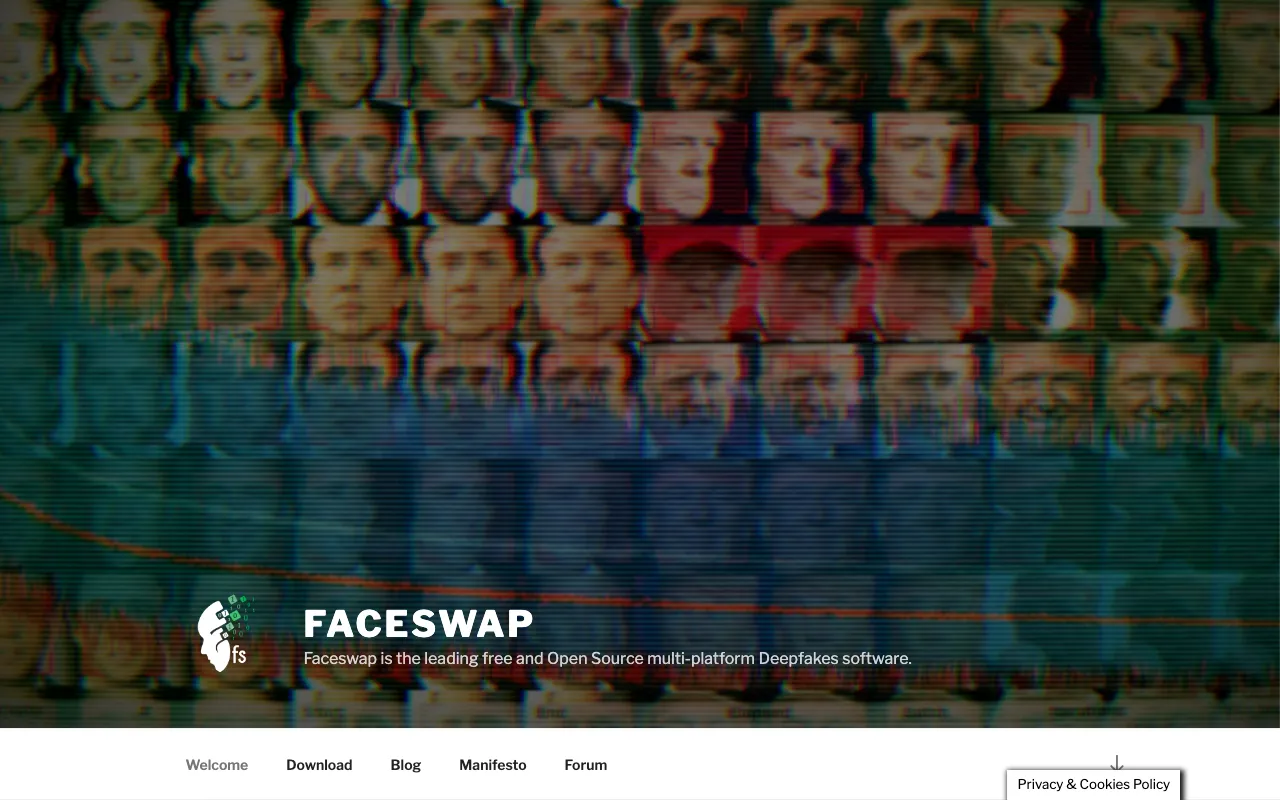
FaceSwap screenshot

Faceswap trains models to swap faces in images and videos on your own hardware. It provides extract, train, convert, and GUI workflows powered by TensorFlow and Keras.

Overview

Faceswap is a deep learning application for recognizing and replacing faces in pictures and video. It runs as a Python program on Windows, macOS, and Linux and is oriented toward hands-on experimentation with generative face models rather than hosted services.

The typical pipeline gathers source media, extracts aligned face images, trains a model pairing two identities, then converts new footage or stills using the saved weights. Commands cover extraction, training, conversion, and an optional graphical interface, with helper tooling to split or reassemble video via external ffmpeg workflows.

Hardware expectations favor a modern GPU with CUDA on NVIDIA cards, while some AMD GPUs are supported through ROCm on Linux. The community provides forums and chat for usage questions, and maintainers publish ethical-use guidelines discouraging non-consensual or deceptive applications.

Project messaging frames the tool as an educational entry point into neural face synthesis, with reusable models that train faster when prior checkpoints are available.

Key features

  • Extract-align faces from raw media
  • Train pairwise identity models
  • Convert stills or video with learned weights
  • Graphical interface alongside CLI entry points
  • Multiple published model architectures
  • TensorFlow and Keras runtime stack
  • Community forum and Discord support
  • Video helpers via companion tooling

Use cases

  • Researching generative face models locally
  • VFX experiments with consenting subjects
  • Learning neural training pipelines hands-on
  • Swapping faces in curated personal footage
Tags

Similar software

Video2X

Vulkan video upscaling and interpolation tool

Video2X enlarges or smooths video using Anime4K, Real-ESRGAN, Real-CUGAN, RIFE, and MPV-style GLSL shaders. Windows and Linux builds include a GUI installer; Docker images and Colab notebooks are also documented.

★ 22.9k⟳ 8 months agoAGPL-3.0

GoCV

Go language bindings for OpenCV computer vision

GoCV wraps OpenCV 4 for Go programs, covering capture, image processing, DNN, CUDA, OpenVINO, and contrib modules. It targets Linux, macOS, Windows, and Docker, with Android support in progress.

★ 7.5k⟳ 10 months agoApache-2.0

withoutBG Python

Python SDK for local and API background removal

withoutBG is a Python package to remove image backgrounds locally with open weights or via a cloud API. It returns RGBA images for scripts, notebooks, batches, and CLI use.

★ 1.3k⟳ 6 days agoApache-2.0

TensorFlow

End-to-end machine learning platform and tooling ecosystem

TensorFlow is a machine learning platform with Python and C++ APIs, optional GPU packages, and companion libraries for data, training, deployment, and visualization.

★ 201.8k⟳ todayApache-2.0

Ollama

Run open AI models locally or in the cloud

Ollama runs open language models such as Gemma, Qwen, DeepSeek and gpt-oss on macOS, Windows and Linux, locally or in the cloud. It offers a CLI, a REST API, and Python and JavaScript libraries.

★ 188.3k⟳ 2 days agoMIT
Open Source Alternative to:OpenAI API

Transformers

Shared model definitions for multimodal ML workloads

Transformers is a Python library that defines pretrained text, vision, audio, and multimodal models once in PyTorch for shared inference and training across the ecosystem.

★ 169.4k⟳ todayApache-2.0