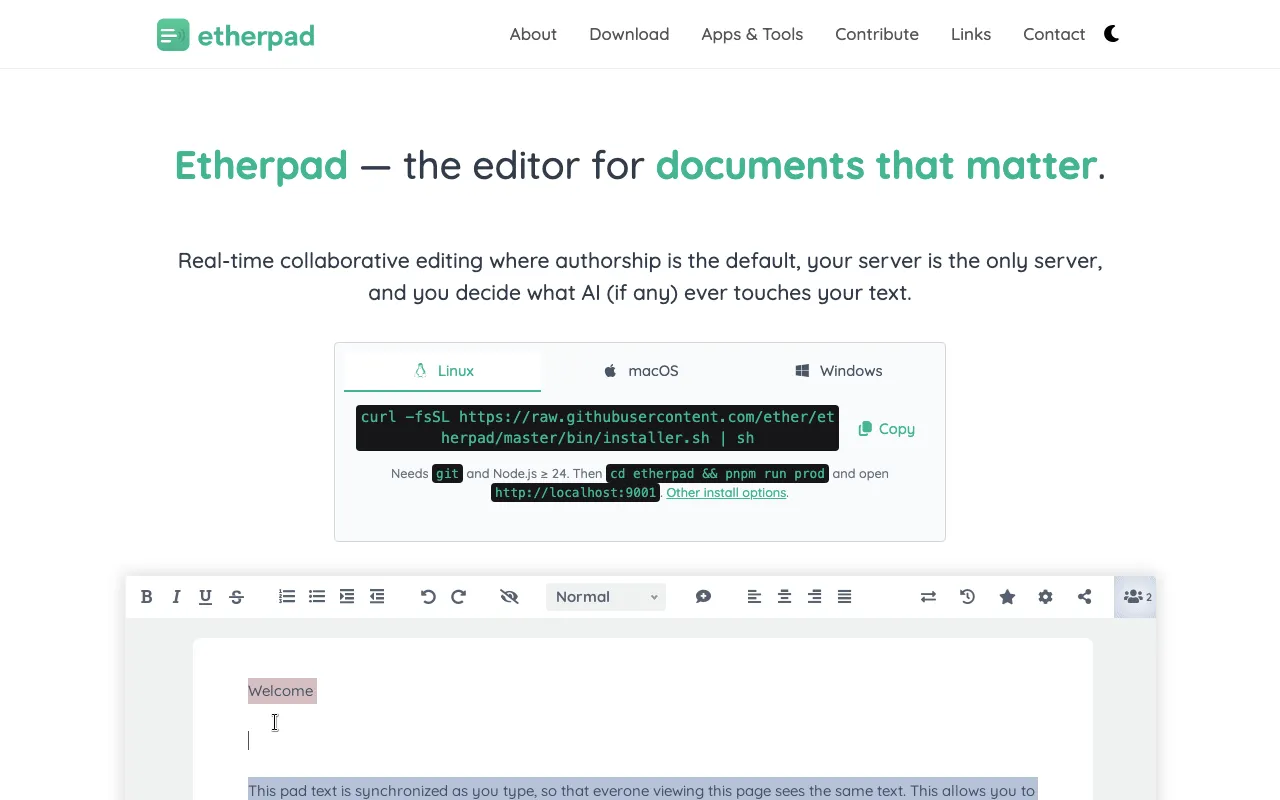
Etherpad is a browser-based editor where multiple people write together in real time. Each keystroke is attributed, revisions are kept, and a timeslider replays full pad history.
Overview
Etherpad focuses on shared documents where provenance matters. Authors see colour-coded contributions, preserved revisions, and a timeslider that steps through history character by character rather than hiding edits behind menus.
The application is meant to run on infrastructure you control, with optional AI added only through plugins aimed at models and hosts you pick. Built-in export keeps pad history portable, and the stack scales to large numbers of simultaneous editors per pad according to project materials.
Operators install it with scripted setup, package managers, or official container images from Docker Hub and GitHub Container Registry. Hundreds of plugins extend comments, auth, media, tables, and integrations, and an HTTP API supports embedding pads in other sites.
Institutional write-ups cite use in wiki communities, public sector, education, civic deliberation, and newsrooms where attribution and editing history carry legal or editorial weight, alongside many independently operated instances.
Key features
- Real-time multi-user editing
- Per-author attribution and colours
- Timeslider document history replay
- Plugin-based customization
- HTTP API and embedding
- Docker and compose deployment
- Full data export
- Optional AI via plugins
Use cases
- Team collaborative drafting
- Public-sector sovereign editing
- Education shared documents
- Civic consultation sessions
- Newsroom attributed editing
Does the same job as
Etherpad doesn't name these products itself, but its own description shows it does the same job.

 Miro

 Discord

 Dropbox


 Fathom
 Fireflies.ai