qmetrics.net

DSPy

Python framework for composable language-model programs

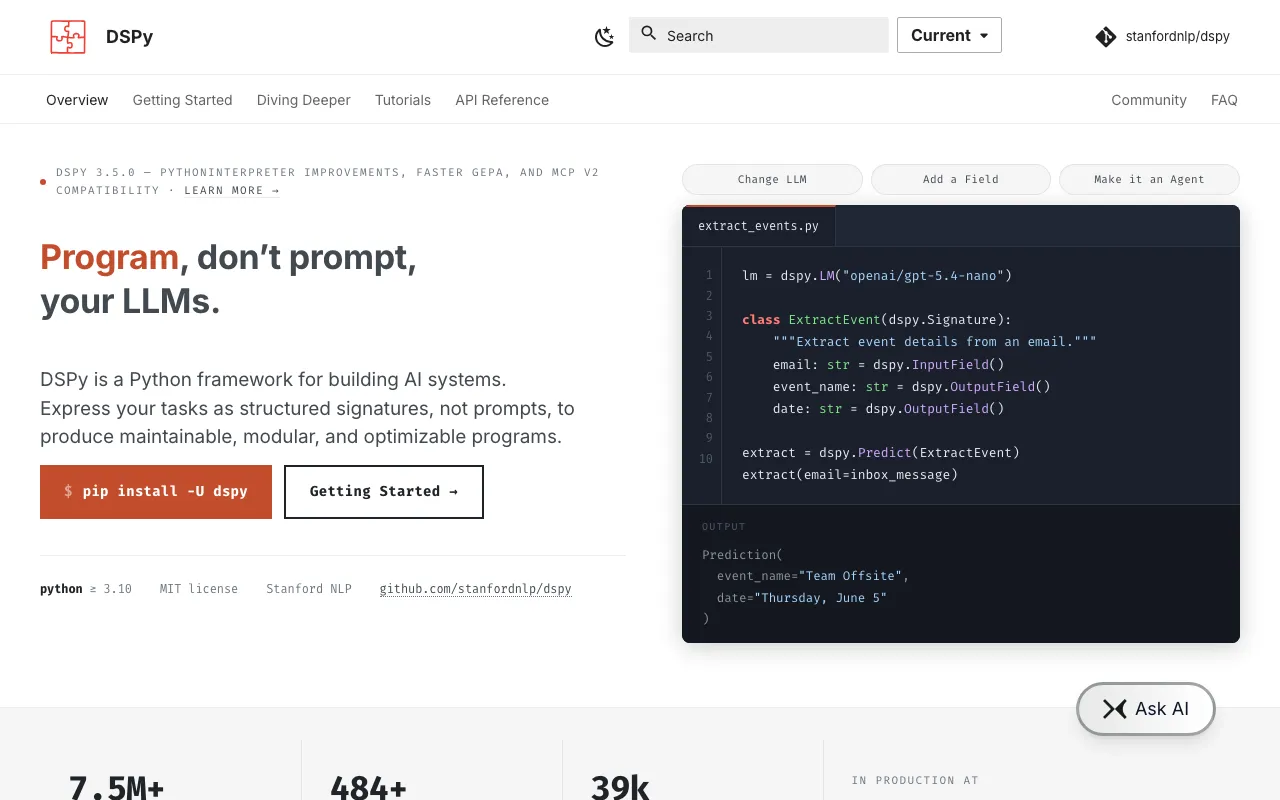
DSPy screenshot

Express AI tasks as typed Python modules instead of ad hoc prompts. Includes optimizers that tune prompts and weights against your metrics.

Overview

DSPy is a Python framework for building modular programs on top of language models rather than hand-tuning single prompts. The name reflects declarative, self-improving Python: you define tasks with structured signatures and wire them with modules such as predictors, chain-of-thought, ReAct loops, and custom pipelines.

Signatures describe typed inputs and outputs for each step, which keeps tasks portable and easier to refactor. Modules swap execution strategies—direct completion, reasoning steps, tool use, or multimodal fields—without rewriting the underlying task definition.

Optimizers compile programs against user-provided metrics and training examples, automatically adjusting prompts or configurations. Research-backed algorithms such as GEPA are part of the toolkit for improving quality on classification, retrieval-augmented generation, agents, and multimodal flows.

The project targets Python 3.10+ and integrates bundled language-model backends. Documentation and community channels support adoption in research and production-style AI engineering.

Key features

  • Typed task signatures
  • Composable modules and agents
  • Prompt and program optimizers
  • ReAct and tool calling
  • Multimodal signature fields
  • Metric-driven compilation
  • RAG and classifier pipelines
  • Python 3.10+ package

Use cases

  • Structured LLM classifiers
  • RAG pipelines with tuning
  • Agent loops with tools
  • Event or entity extraction
  • Fact-checking multi-step flows

Similar software

DeepSeek Harness

Open-source plugin-based agent harness from DeepSeek

DeepSeek Harness is an open-source agent harness built on an everything-is-a-plugin architecture powered by Cordis. It offers a web UI, desktop app, and extensible plugins for daily work, coding, and automation.

★ 288k⟳ 6 days agoMIT

Hermes Agent

Self-improving open-source AI agent with memory, skills and messaging gateway

Open-source AI agent from Nous Research that keeps persistent memory, creates skills from experience, and runs from a terminal, desktop app or messaging platforms with any model provider.

★ 266.6k⟳ todayMIT
Open Source Alternative to:Anthropic ClaudeChatGPT+5

Firecrawl

Web scrape crawl and search infrastructure for AI agents

Firecrawl turns websites into LLM-ready markdown and structured data via API, CLI, and MCP. It supports scrape, crawl, map, batch jobs, optional cloud scale, and self-hosted server deployment.

★ 211.5k⟳ todayAGPL-3.0
Open Source Alternative to:TavilyZyte

TensorFlow

End-to-end machine learning platform and tooling ecosystem

TensorFlow is a machine learning platform with Python and C++ APIs, optional GPU packages, and companion libraries for data, training, deployment, and visualization.

★ 201.8k⟳ todayApache-2.0

MarkItDown

Python utility converting office and media files to Markdown

MarkItDown converts many file types into Markdown for LLM and text analysis pipelines. It aims to preserve headings, lists, tables, and links rather than perfect human layout.

★ 198.7k⟳ 21 days agoMIT

Transformers

Shared model definitions for multimodal ML workloads

Transformers is a Python library that defines pretrained text, vision, audio, and multimodal models once in PyTorch for shared inference and training across the ecosystem.

★ 169.4k⟳ todayApache-2.0