Kubernetes
Open-source container scheduling and management system
Kubernetes (K8s) manages containerized applications across many hosts. It automates deployment, scaling, and ongoing operations for grouped containers.
Kubernetes workload rebalancing through policy-driven pod eviction
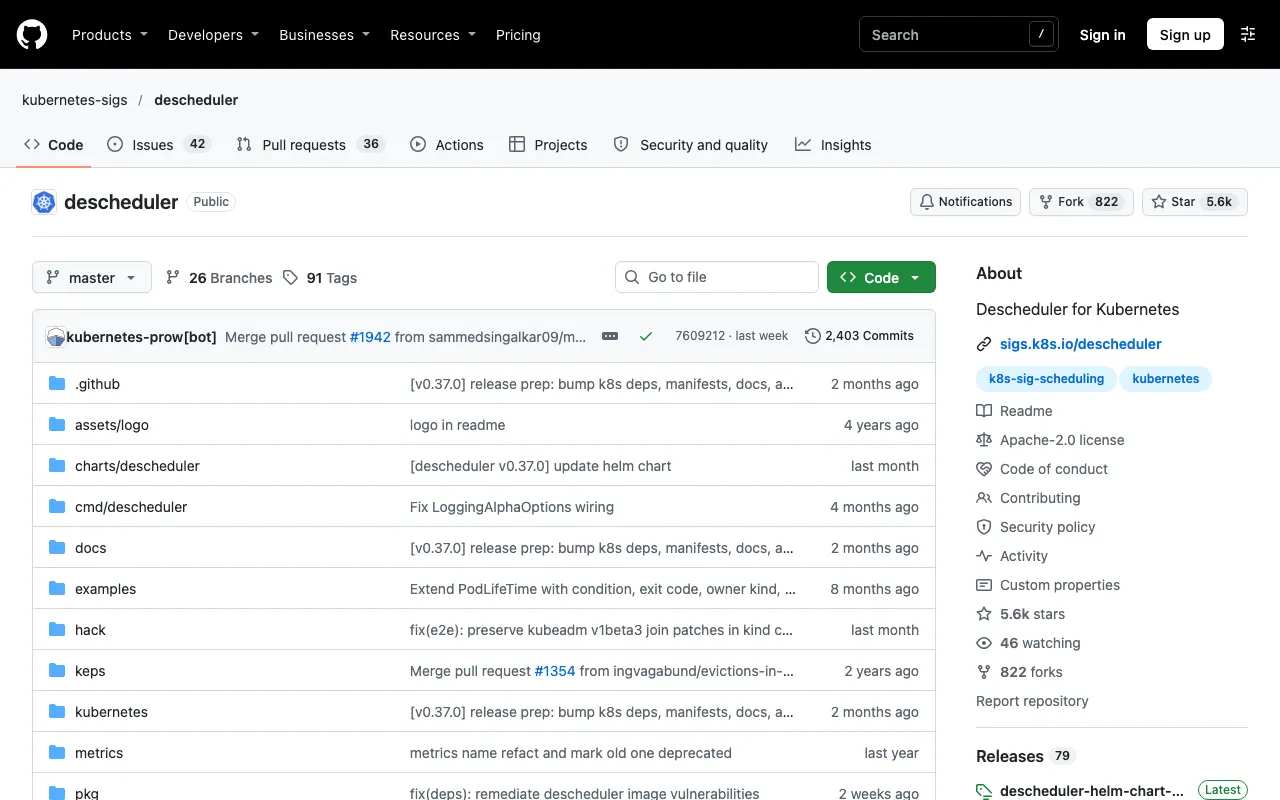
Descheduler finds running pods that no longer fit cluster conditions and evicts them so the default scheduler can place them elsewhere. It does not schedule replacements itself.
Descheduler for Kubernetes addresses cases where pods remain on nodes after the cluster changes. The kube-scheduler binds new pods when they appear, but over time nodes may be over or under utilized, labels and taints change, nodes fail, or new nodes join, leaving workloads on less suitable nodes.
Based on a configurable policy, Descheduler selects pods that can move and evicts them. The default kube-scheduler is expected to schedule replacements for evicted pods; Descheduler itself does not perform that scheduling step.
You run it inside a Kubernetes cluster as a Job, CronJob, or Deployment so it can execute repeatedly without manual steps. The pod typically runs in the kube-system namespace as a critical workload to reduce the chance it evicts itself. Installation options include manifest applies, an official Helm chart, and Kustomize builds documented in the project materials.
Policy configuration covers top-level eviction limits, metrics from the Kubernetes Metrics Server or Prometheus, a default Evictor plugin for filtering and protections, and strategy plugins grouped as Deschedule or Balance behaviors. Pod protection rules can allow or deny eviction for daemon sets, local storage, PVCs, system-critical pods, and related cases.
Open-source container scheduling and management system
Kubernetes (K8s) manages containerized applications across many hosts. It automates deployment, scaling, and ongoing operations for grouped containers.
Agentless IT automation and configuration engine
Ansible automates configuration management, deployments, cloud provisioning, ad-hoc tasks, and multi-node orchestration using SSH without installing agents on managed hosts.

Dynamic HTTP reverse proxy and load balancer for microservices
Traefik routes HTTP traffic to microservices and balances load across backends. It watches orchestrators and registries to update routes without manual restarts.

Multi-container Docker application definition tool
Docker Compose defines and runs multi-container applications described in a Compose file. A single docker compose up command starts the configured services, networks, and volumes together.

Secure lightweight microVM monitor for serverless workloads
Firecracker is a virtualization stack for running container and function workloads in microVMs. It pairs hardware isolation with low overhead for multi-tenant serverless-style hosting.

Compact certified Kubernetes distribution for constrained environments
K3s packages production-ready Kubernetes in a single small binary with lighter memory use, aimed at edge, IoT, CI, development, and ARM deployments.