
DB-GPT
Controlled agentic assistant for data analysis workflows
DB-GPT connects databases and files to LLM agents that produce SQL, reports, and dashboards with semantic definitions, skills, and reviewable execution boundaries.

AI-first data notebook with an open .deepnote format, Jupyter-compatible
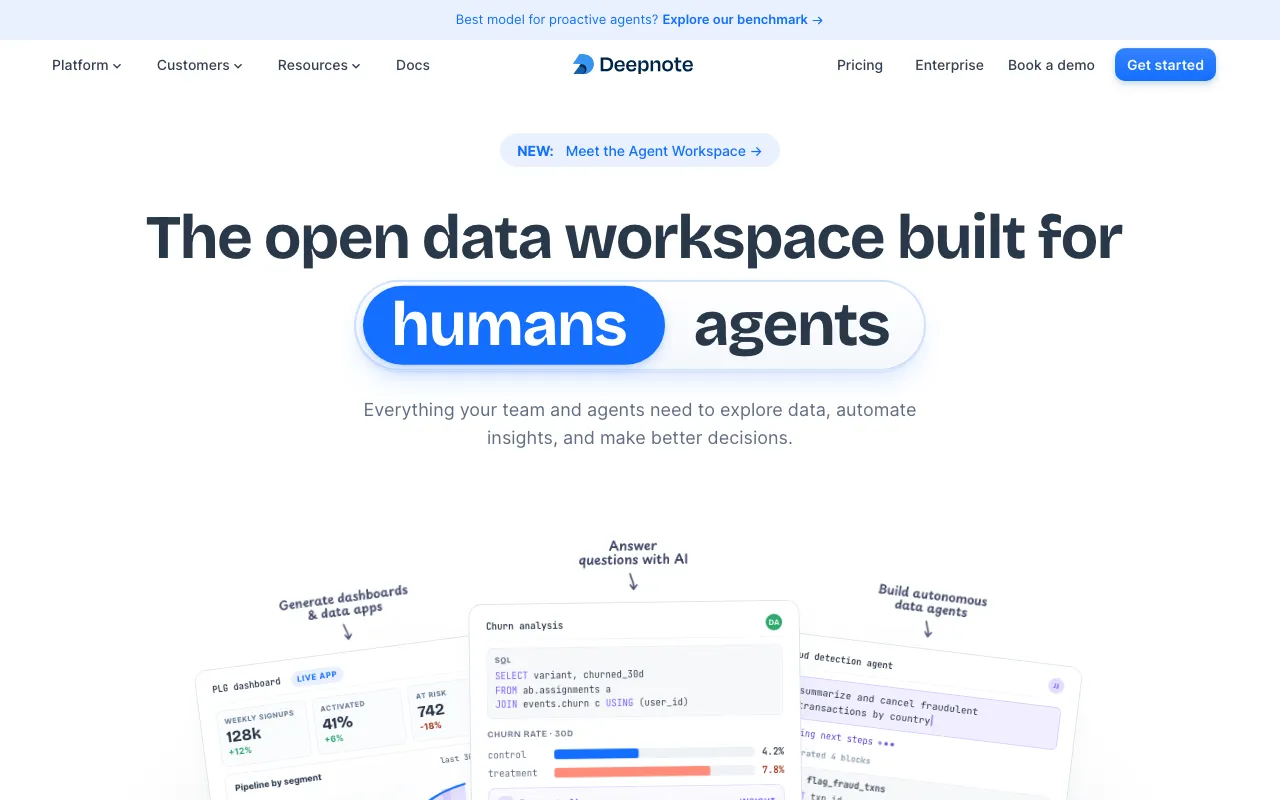
Deepnote is a data notebook positioned as a drop-in replacement for Jupyter, adding an AI agent, new block types and native data integrations. Work locally in your editor, then move to Deepnote Cloud.
Deepnote is a data notebook for Python, R and SQL that presents itself as a drop-in replacement for Jupyter. It uses the Deepnote kernel, which stays backwards compatible with Jupyter while adding an AI agent, a redesigned interface, extra block types and native connections to data sources. The open-source part lets you edit and run notebooks locally in editors such as VS Code, Cursor or Windsurf, and then move to Deepnote Cloud when you need team collaboration or more compute.
Notebooks are stored in a human-readable YAML .deepnote format instead of .ipynb JSON, with each notebook in its own file alongside its integrations and settings, so version-control diffs stay focused. Snapshot files keep outputs separate from source code, and a content hash records which code produced each output. Blocks go beyond code cells and cover SQL, inputs, charts, big numbers, buttons, images and text. Execution is reactive, so dependent blocks re-run when inputs or data change.
The project includes a TypeScript blocks package for block types and Python code generation, plus a conversion CLI and library. The converter moves projects between .deepnote and Jupyter, Quarto, Percent-format Python and Marimo, and keeps platform metadata from notebooks that come from Colab, SageMaker, Kaggle or Azure ML. A command-line tool can lint and run notebooks. AI coding agents such as Claude Code, Codex, Cursor and Gemini CLI can be taught the format through install-skills, and a plugin connects them to a hosted Deepnote MCP server.
Deepnote Cloud is the hosted product. According to the website, it adds real-time collaboration, comments, sharing by link, scheduled notebooks, notebooks deployed as APIs, data apps and dashboards, GPU compute, and 100+ integrations with warehouses, databases and BI tools. It also lists security features such as RBAC, SSO and custom deployments.
Controlled agentic assistant for data analysis workflows
DB-GPT connects databases and files to LLM agents that produce SQL, reports, and dashboards with semantic definitions, skills, and reviewable execution boundaries.
Semantic ontology layer for agent analytics over enterprise data
Auto Ontology builds a governed business ontology from database metadata and serves it to agents via web UI, API, MCP, and CLI. It grounds text-to-SQL answers with certified terms, joins, and metrics.

AI-native visual analytics framework for agents
JavaScript framework for natural-language data exploration, SQL analysis, and chart generation across files and databases, built for AI agents.

Open-source plugin-based agent harness from DeepSeek
DeepSeek Harness is an open-source agent harness built on an everything-is-a-plugin architecture powered by Cordis. It offers a web UI, desktop app, and extensible plugins for daily work, coding, and automation.

Self-improving open-source AI agent with memory, skills and messaging gateway
Open-source AI agent from Nous Research that keeps persistent memory, creates skills from experience, and runs from a terminal, desktop app or messaging platforms with any model provider.

Web scrape crawl and search infrastructure for AI agents
Firecrawl turns websites into LLM-ready markdown and structured data via API, CLI, and MCP. It supports scrape, crawl, map, batch jobs, optional cloud scale, and self-hosted server deployment.
 Anthropic Claude
 ChatGPT