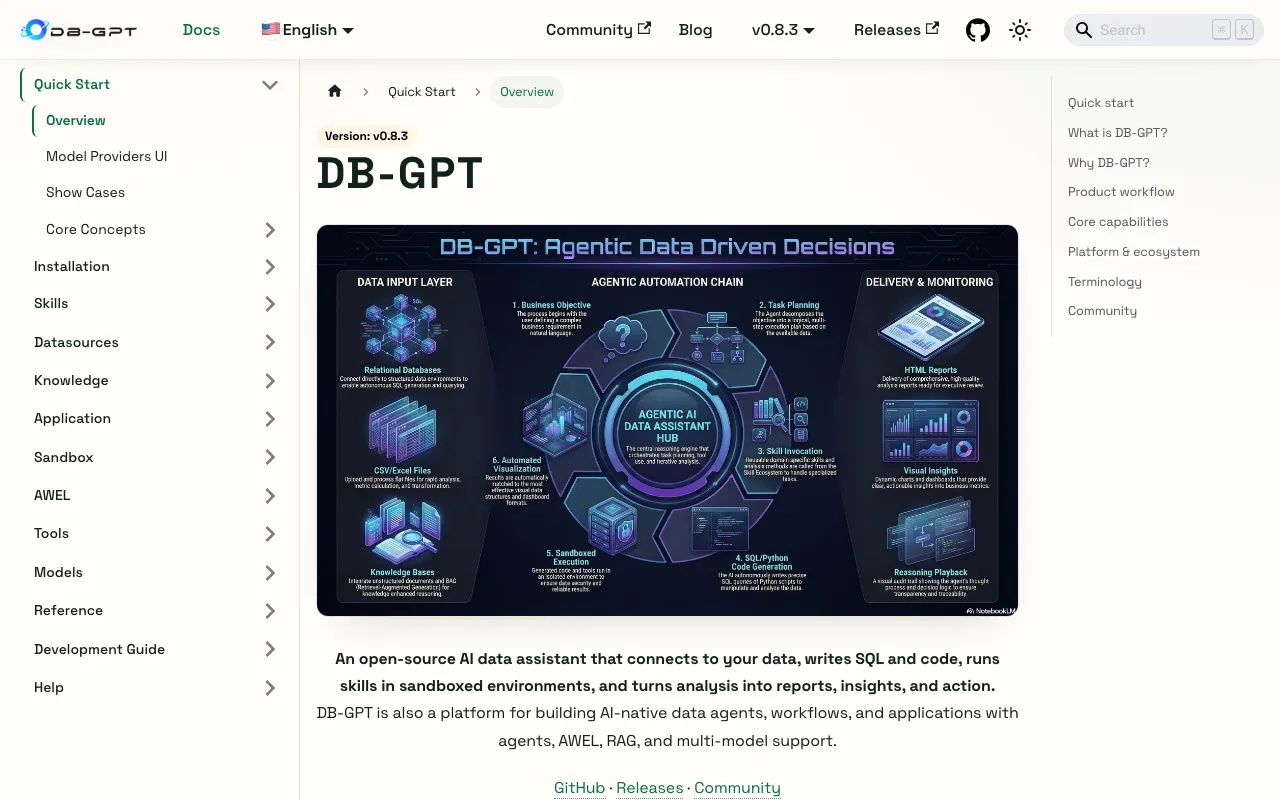
DB-GPT connects databases and files to LLM agents that produce SQL, reports, and dashboards with semantic definitions, skills, and reviewable execution boundaries.
Overview
DB-GPT is an agentic data assistant that turns questions into inspectable queries, analytical reports, and reusable dashboards. It unifies data connections, business semantics, expert plugins, orchestration, and analytical artifacts in one workflow for analysts and teams building AI-native data apps.
A Semantic Center holds schema metadata, metric formulas, synonyms, and published definition versions so agents ground answers in maintained business meaning. Expert plugins cover data query, analysis, SQL optimization, metadata architecture, and financial analysis, while Skills package reusable instructions and scripts and workflows make multi-step tasks explicit.
Dashboards move from plan or template to editable widgets with preview boards; users can adjust layout, queries, and filters and review AI-proposed changes before applying them. Data sources include common relational engines, analytical databases, and graph stores, managed through a shared connection inventory.
You can install via macOS and Linux installers, PyPI, source checkout with a web frontend, or Docker deployment described in the docs. Execution safety depends on least-privilege credentials, sandbox and network settings, and human review before publishing or scheduling artifacts.
Key features
- Semantic Center for metrics and definitions
- Expert plugins for query and analysis tasks
- Editable dashboards with preview boards
- Many SQL and analytical database connectors
- Visual agent workflow editor
- Knowledge bases and MCP tool connectors
- Sandboxed code and SQL execution options
- Scheduled task replay for artifacts
Use cases
- Natural language questions against warehoused data
- Building reusable analytics dashboards
- Packaging domain Skills for repeat analyses
- Governed self-hosted data agent deployments





 Anthropic Claude
 ChatGPT
