
TensorFlow
End-to-end machine learning platform and tooling ecosystem
TensorFlow is a machine learning platform with Python and C++ APIs, optional GPU packages, and companion libraries for data, training, deployment, and visualization.
Python framework for prototyping evolutionary and genetic algorithms
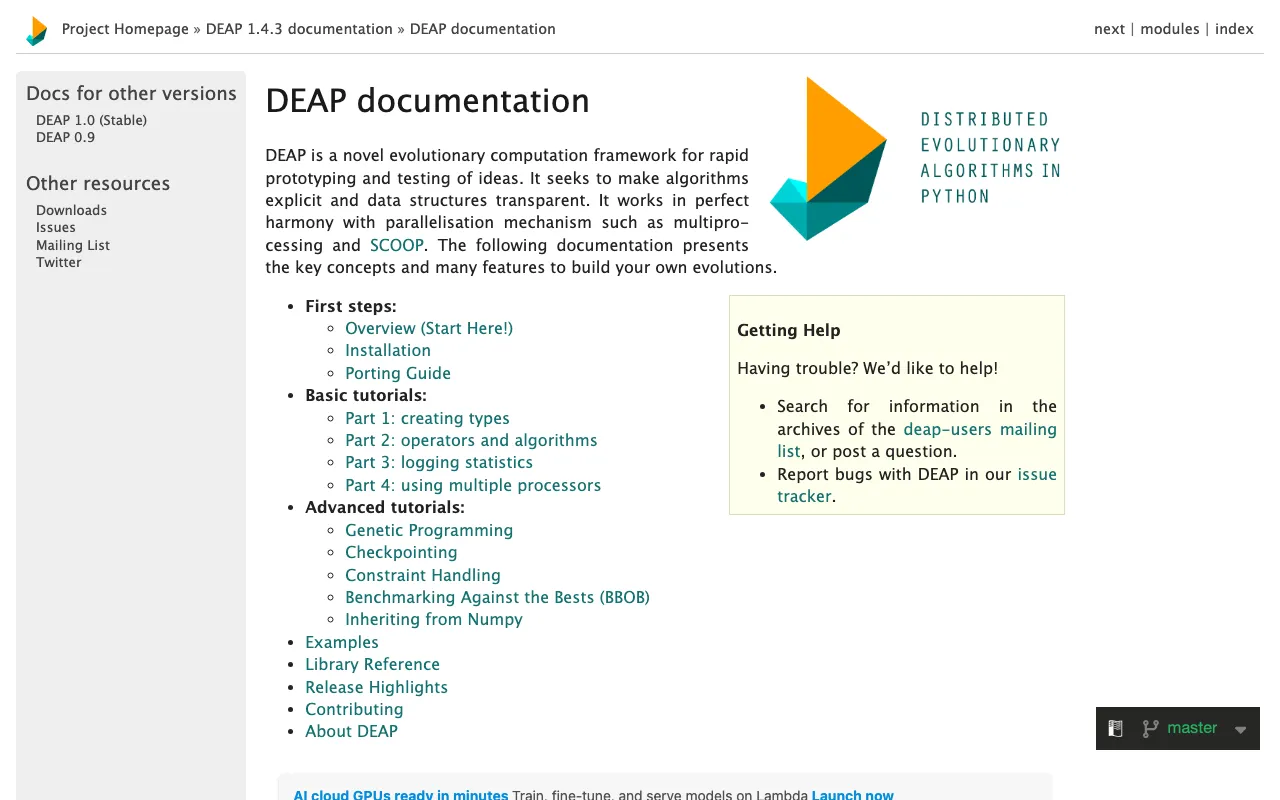
DEAP is a Python evolutionary computation framework for rapid prototyping and testing of algorithms. It exposes explicit algorithm structure and works with multiprocessing and SCOOP.
DEAP (Distributed Evolutionary Algorithms in Python) is a library for building and experimenting with evolutionary computation methods. It aims to make algorithms explicit and data structures transparent so researchers and engineers can iterate quickly on ideas.
Built-in technique coverage includes genetic algorithms with varied representations, genetic programming with prefix trees, evolution strategies such as CMA-ES, multi-objective optimizers like NSGA-II and SPEA2, co-evolution of multiple populations, parallel evaluation hooks, hall-of-fame tracking, and checkpoint snapshots. A benchmarks module supplies common test functions, and examples mention particle swarm optimization, differential evolution, and estimation of distribution algorithms.
Packages install from PyPI via pip or easy_install. Optional dependencies include NumPy for CMA-ES and matplotlib for plotting results. Documentation is published online with tutorials from basic types through multiprocessing, genetic programming, constraint handling, and numpy inheritance.
End-to-end machine learning platform and tooling ecosystem
TensorFlow is a machine learning platform with Python and C++ APIs, optional GPU packages, and companion libraries for data, training, deployment, and visualization.

Run open AI models locally or in the cloud
Ollama runs open language models such as Gemma, Qwen, DeepSeek and gpt-oss on macOS, Windows and Linux, locally or in the cloud. It offers a CLI, a REST API, and Python and JavaScript libraries.

Shared model definitions for multimodal ML workloads
Transformers is a Python library that defines pretrained text, vision, audio, and multimodal models once in PyTorch for shared inference and training across the ecosystem.

LLM inference engine in C/C++ for local and cloud hardware
llama.cpp runs large language models and multimodal models locally or in the cloud with minimal setup. It includes a CLI, an OpenAI-compatible server with a built-in chat app, and a C library API.

General-purpose speech recognition and translation model
Whisper is a speech recognition model trained on diverse audio. It supports multilingual transcription, speech-to-English translation, and language identification via Python or the command line.

High-throughput, memory-efficient inference and serving engine for LLMs
vLLM is a library and server for running and serving large language models. It uses PagedAttention and continuous batching for throughput, offers an OpenAI-compatible API, and runs on many GPU, CPU and accelerator types.