
TensorFlow
End-to-end machine learning platform and tooling ecosystem
TensorFlow is a machine learning platform with Python and C++ APIs, optional GPU packages, and companion libraries for data, training, deployment, and visualization.
Data-centric LLM training benchmark built on LLaMA-Factory
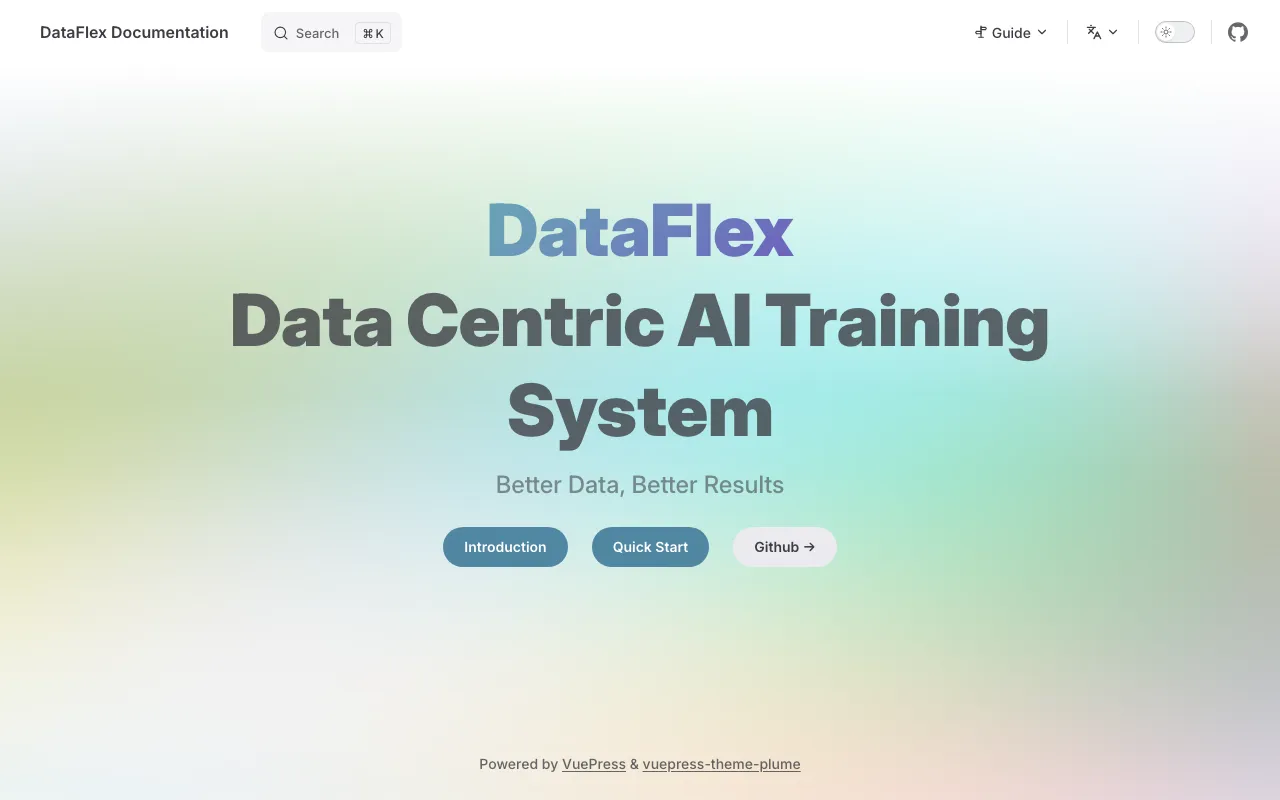
DataFlex schedules data selection, mixture, and reweighting inside LLM training loops as a drop-in extension of LLaMA-Factory.
DataFlex is a dynamic training framework layered on LLaMA-Factory. During optimization it schedules which training examples to use and unifies implementations of data selection, data mixture, and data reweighting that are otherwise scattered across hard-to-reproduce research code.
Data selection methods include loss-based pickers, distribution-based selectors, random baselines, and static full-data training. Mixture methods adjust domain ratios while training, and reweighting methods change per-sample weights during backpropagation. Some algorithms require the model in the training loop; others do not.
Training launches similarly to LLaMA-Factory, but YAML configs must include DataFlex-specific parameters. Optional DeepSpeed support covers ZeRO-3 gradient workflows, and an extra install provides TRAK for the LESS selector. The project positions itself as a unified benchmark and evaluation platform for data-centric large language model training.
Reported experiments compare selectors and mixers against random or default baselines on benchmarks such as MMLU. Output training JSON from tools like DataFlow or HuggingFace datasets can feed the same pipelines.
End-to-end machine learning platform and tooling ecosystem
TensorFlow is a machine learning platform with Python and C++ APIs, optional GPU packages, and companion libraries for data, training, deployment, and visualization.

Run open AI models locally or in the cloud
Ollama runs open language models such as Gemma, Qwen, DeepSeek and gpt-oss on macOS, Windows and Linux, locally or in the cloud. It offers a CLI, a REST API, and Python and JavaScript libraries.

Shared model definitions for multimodal ML workloads
Transformers is a Python library that defines pretrained text, vision, audio, and multimodal models once in PyTorch for shared inference and training across the ecosystem.

LLM inference engine in C/C++ for local and cloud hardware
llama.cpp runs large language models and multimodal models locally or in the cloud with minimal setup. It includes a CLI, an OpenAI-compatible server with a built-in chat app, and a C library API.

General-purpose speech recognition and translation model
Whisper is a speech recognition model trained on diverse audio. It supports multilingual transcription, speech-to-English translation, and language identification via Python or the command line.

High-throughput, memory-efficient inference and serving engine for LLMs
vLLM is a library and server for running and serving large language models. It uses PagedAttention and continuous batching for throughput, offers an OpenAI-compatible API, and runs on many GPU, CPU and accelerator types.