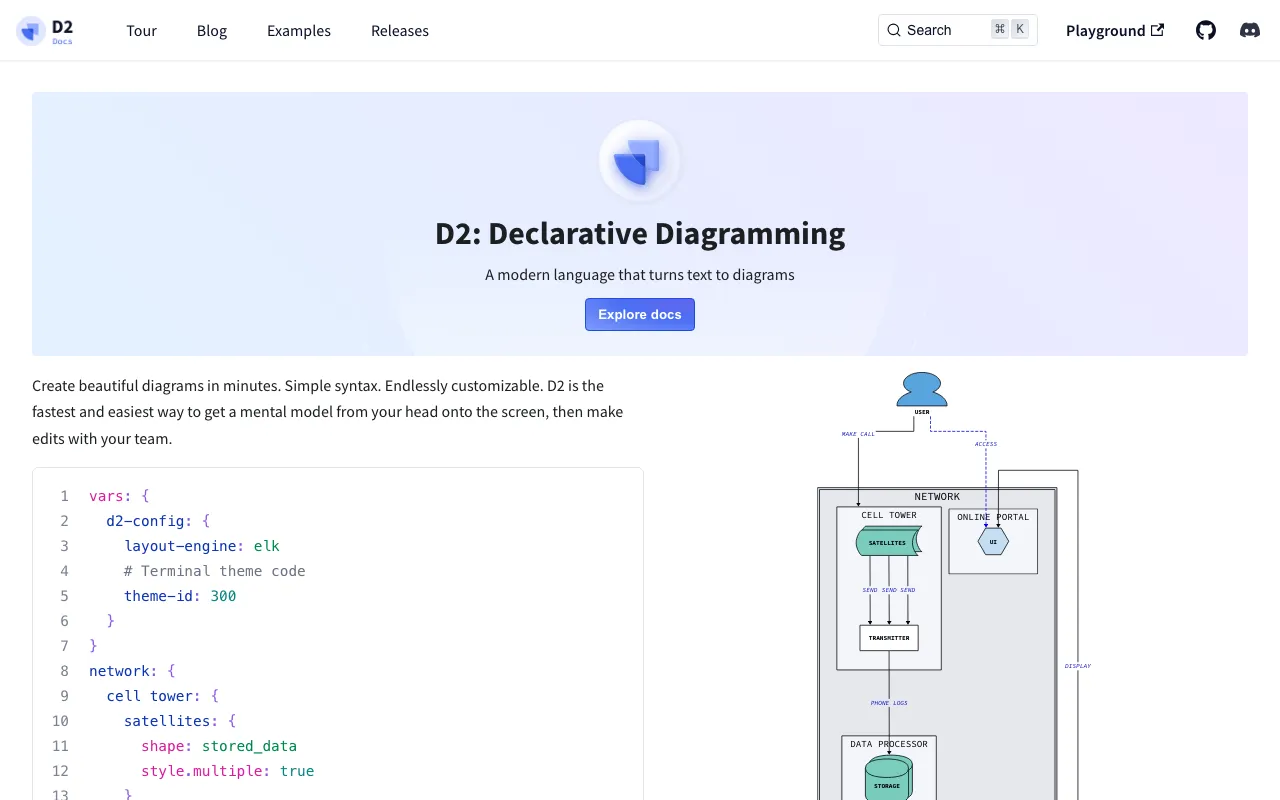
D2 turns text descriptions into diagrams through a declarative language. The usual workflow runs a CLI that reads .d2 files and exports vector or raster output.
Overview
D2 is a diagram scripting language aimed at people who want to define layouts and relationships in text and render them as diagrams. The quickstart path treats it as a command-line executable that produces SVGs from .d2 files, with optional live reload while you edit.
The language supports modular imports, variables, globs, containers, UML class shapes, and sequence diagrams. Diagrams can embed syntax-highlighted code, Markdown, tables, images, icons, tooltips, and links. An autoformatter handles indentation and spacing, and the parser is built to report multiple errors from a broken program.
Rendering can use bundled layout engines (dagre, elk, and opt-in TALA for architecture-style diagrams), official themes, custom fonts, sketch-style drawing, animations across boards, and LaTeX labels. Exports include SVG, PNG, GIF, PDF, PPTX, and ASCII. D2 can run fully offline after install and does not require a browser, though a hosted playground exists for quick sharing.
Editor integrations include official VSCode and Vim extensions, with language tooling such as syntax highlighting and planned LSP support. Go programs can also call D2 as a library to build diagrams programmatically. Packages are available for macOS, Linux, and Windows, including common package managers.
Key features
- Text-to-diagram declarative syntax
- CLI with watch and live reload
- Multiple layout engines
- SVG, PNG, PDF, and PPTX export
- Official themes and sketch mode
- VSCode and Vim extensions
- Go library for programmatic diagrams
- Sequence and class diagram support
Use cases
- Software architecture diagrams
- Offline diagram authoring
- Team-shared diagram sources in git
- Academic figures with LaTeX labels
- Embedding diagrams in docs and wikis


 Miro