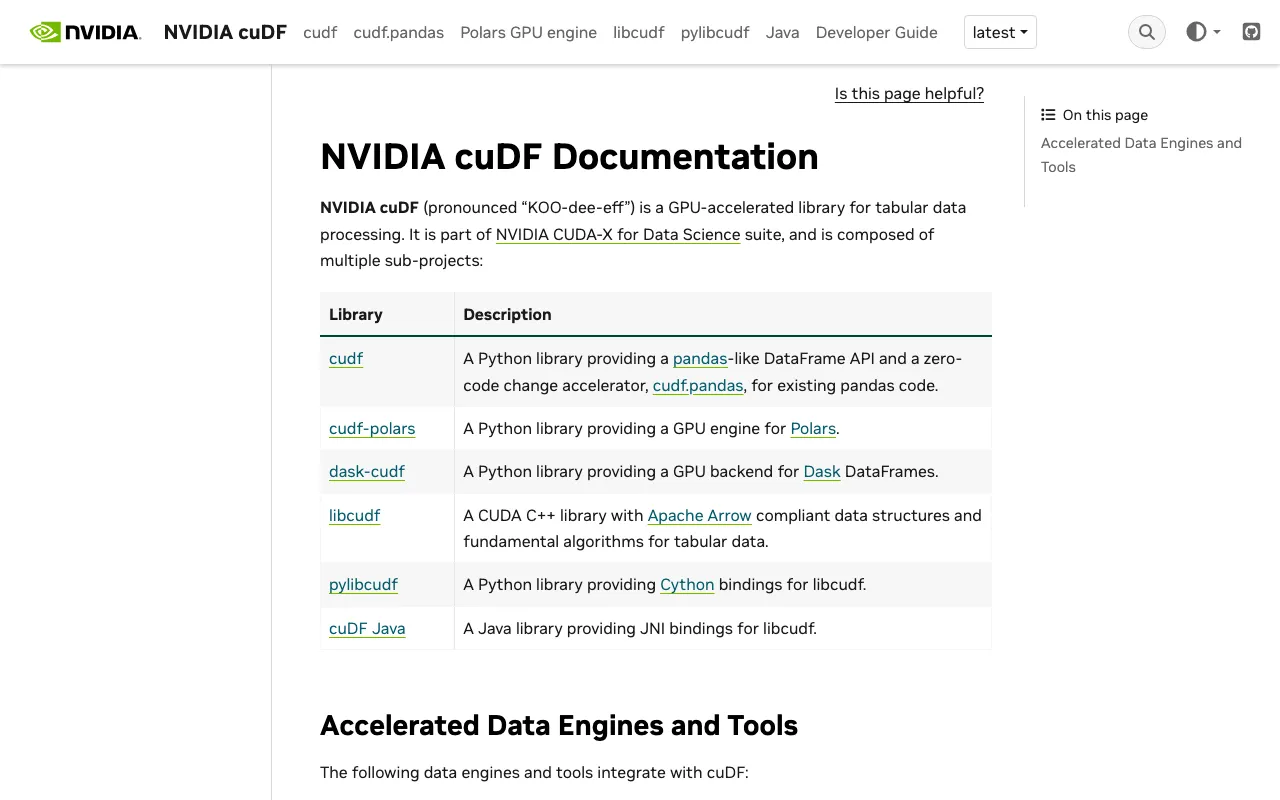
NVIDIA cuDF processes tabular data on GPUs with pandas-like Python APIs. It includes libcudf, optional pandas and Polars acceleration paths, and fits the RAPIDS CUDA-X stack.
Overview
cuDF is a GPU-accelerated library for working with columnar tabular data. The main Python package exposes DataFrame and Series APIs modeled on pandas, while underlying libcudf provides Apache Arrow–aligned structures and core algorithms in CUDA C++.
The cudf.pandas accelerator can run existing pandas code with minimal changes, either by invoking Python with the cudf.pandas module or loading an extension in Jupyter before importing pandas. Polars workflows can target a GPU engine during collection for lazy plans.
Related packages include dask-cudf for distributed GPU DataFrames, pylibcudf and Java bindings around libcudf, and integrations with cuML, cuGraph, XGBoost, Apache Spark, DuckDB, and other data engines documented on the project site.
Packages install from PyPI or conda channels, with nightly channels for development builds. Source builds follow a separate contribution guide for teams that compile on their own hardware.
Key features
- pandas-like Python DataFrame API
- libcudf Arrow columnar core
- cudf.pandas zero-change acceleration
- Polars GPU collection engine
- dask-cudf distributed backend
- Parquet read and groupby examples
- PyPI and conda installs
- Spark and DuckDB integrations
Use cases
- Large GPU dataframe analytics
- Accelerating existing pandas jobs
- RAPIDS ML and graph pipelines
- Distributed GPU ETL with Dask