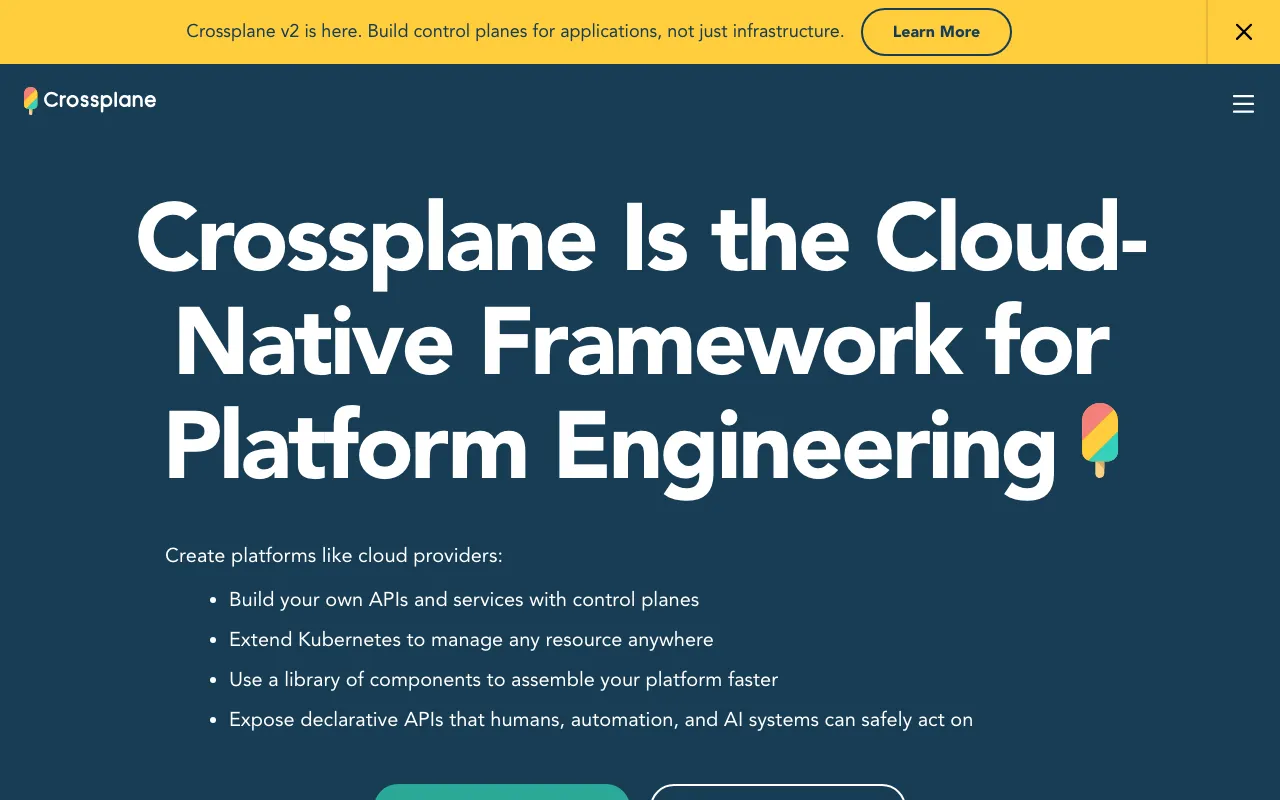
Crossplane helps teams build cloud-native control planes without writing large amounts of custom code. It extends Kubernetes to orchestrate applications and infrastructure across environments.
Overview
Crossplane provides an extensible backend for composing control planes and a configurable frontend for the declarative APIs those planes expose. It is a CNCF project aimed at platform engineering: organizations define their own APIs and services while reusing Kubernetes reliability, RBAC, and ecosystem tooling.
Providers extend Crossplane to manage external applications and infrastructure; configurations package APIs and policies. The design favors declarative, auditable intent that humans, automation, and agents can consume. Documentation covers installation, resource quickstarts, and community roadmap planning.
Because it builds on the Kubernetes control plane model, Crossplane is intended to manage more than containers alone, offering a unified layer for infrastructure orchestration. Extension points allow integration with higher-level automation, including AI-assisted workflows described on the project site.
Typical adoption starts by installing Crossplane on a Kubernetes cluster and adding providers or configurations that match the resources an organization needs to provision and govern.
Key features
- Composable control plane APIs
- Kubernetes RBAC foundation
- Provider extensions
- Configuration packages
- Declarative resource model
- Multi-environment orchestration
- Community provider ecosystem
- Platform engineering focus
Use cases
- Internal developer platforms
- Multi-cloud infrastructure APIs
- Declarative resource provisioning
- Custom cloud abstractions
- Unified infra control layers