qmetrics.net

AWS CDK

Define AWS cloud infrastructure in familiar programming languages

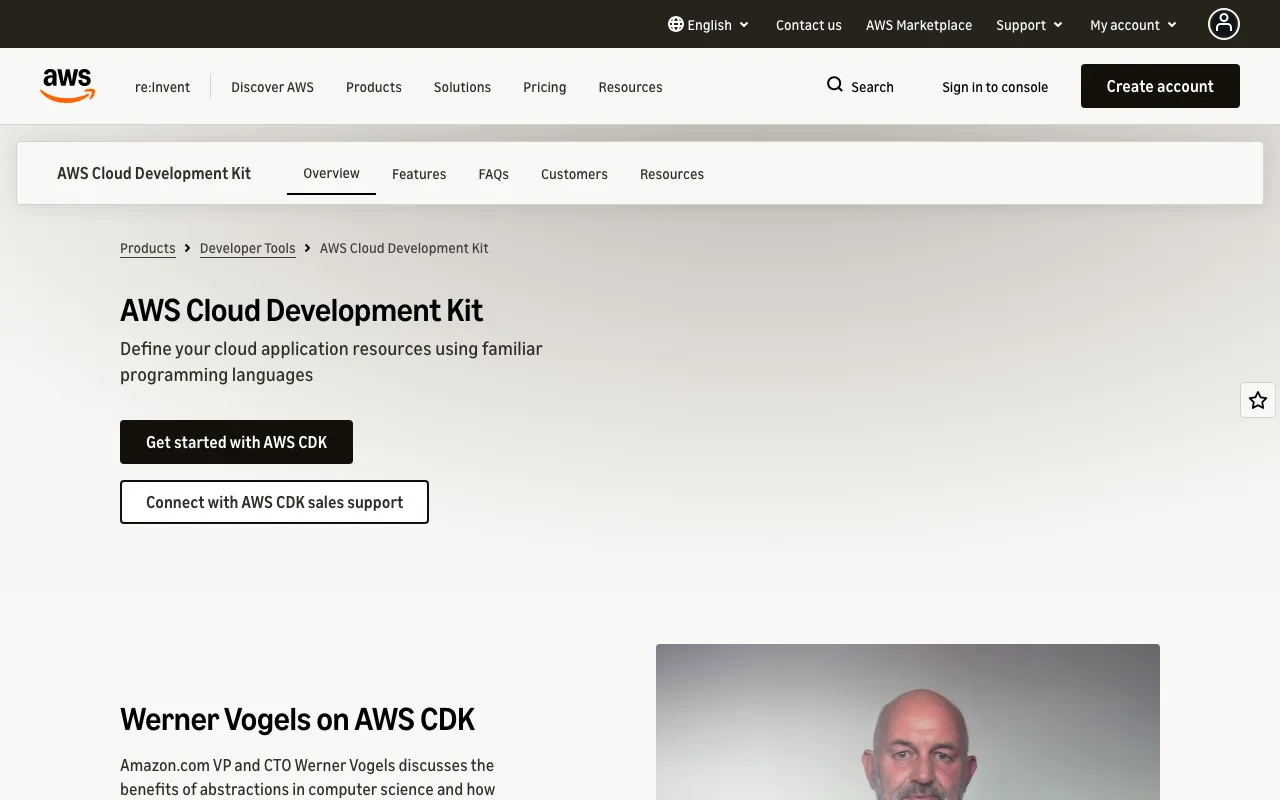
AWS CDK screenshot

AWS CDK models cloud resources as code and provisions them through AWS CloudFormation. Developers compose reusable constructs into stacks and manage deployments with the CDK CLI.

Overview

The AWS Cloud Development Kit is a framework for defining cloud infrastructure in code and provisioning it through AWS CloudFormation. It offers object-oriented abstractions in several supported programming languages so teams can describe AWS resources imperatively instead of hand-authoring large templates.

Developers define reusable cloud components called constructs, group them into stacks to form a CDK app, and use the AWS CDK CLI to synthesize CloudFormation templates, deploy stacks to AWS accounts, and diff local changes against what is already deployed. The AWS Construct Library provides modules for individual services with APIs that encode common integration patterns and usage details.

Construct Hub supports discovering community CDK constructs for building microservices programmatically. CDK Blocks packages infrastructure for app capabilities together with application code and local implementations, including blocks for databases, authentication, storage, realtime workloads, background jobs, and AI agents.

Typical workflows install the CLI from npm, initialize a project, and run deploy, synth, or diff commands. CDK Aspects can enforce organizational standards across generated infrastructure, and modules move from experimental to stable stability levels with semver expectations after stabilization.

Key features

  • CloudFormation provisioning from code
  • Reusable infrastructure constructs
  • CDK CLI synth deploy and diff
  • AWS Construct Library per service
  • Construct Hub community constructs
  • CDK Blocks for app capabilities
  • Multi-language CDK support
  • Aspects for policy enforcement

Use cases

  • Infrastructure as code on AWS
  • Reusable internal construct libraries
  • CI/CD driven stack deployment
  • Microservices from shared constructs
  • Local build then deploy to your account
Tags

Similar software

Spring Cloud Alibaba

Spring Cloud integration for Alibaba middleware components

Spring Cloud Alibaba connects Spring Cloud applications to Alibaba middleware for registration, configuration, messaging, flow control, and distributed transactions. Add annotations and configuration to use Nacos, Sentinel, RocketMQ, Seata, and related services.

★ 29.2k⟳ 14 days agoApache-2.0
Frameworks & PlatformsDesktop/CLI app

Wasmer

WebAssembly sandboxes for local, browser, and edge runs

Wasmer runs applications in lightweight WebAssembly sandboxes on your machine, in the browser, or on Wasmer Edge. A CLI, registry packages, and SDKs embed sandboxes in apps.

★ 21.3k⟳ 8 days agoMIT
Frameworks & PlatformsDesktop/CLI app

Crossplane

Kubernetes-native framework for custom control planes

Crossplane helps teams build cloud-native control planes without writing large amounts of custom code. It extends Kubernetes to orchestrate applications and infrastructure across environments.

★ 12.3k⟳ 2 days agoApache-2.0

AWS SDK Go V2

Go client libraries for Amazon Web Services APIs

Version 2 of the AWS SDK for Go: modular packages you import to call AWS service APIs from Go applications with shared configuration and credentials handling.

★ 3.7k⟳ todayApache-2.0
Frameworks & PlatformsDesktop/CLI app

AWS SDK Ruby

Modular Ruby gems for Amazon Web Services APIs

Official AWS SDK for Ruby version 3: install per-service gems from RubyGems to call AWS with Ruby classes, credentials from env or shared files, and rich client helpers.

★ 3.7k⟳ 2 days agoApache-2.0
Frameworks & PlatformsDesktop/CLI app

aws-sdk-rust

Rust crates for Amazon Web Services APIs

AWS SDK for Rust offers one crate per AWS service plus aws-config for credentials, generated from Smithy models for async Tokio-based clients.

★ 3.4k⟳ 2 days agoApache-2.0
Frameworks & PlatformsDesktop/CLI app