
TensorFlow
End-to-end machine learning platform and tooling ecosystem
TensorFlow is a machine learning platform with Python and C++ APIs, optional GPU packages, and companion libraries for data, training, deployment, and visualization.
Distributed deep learning parallelization toolkit
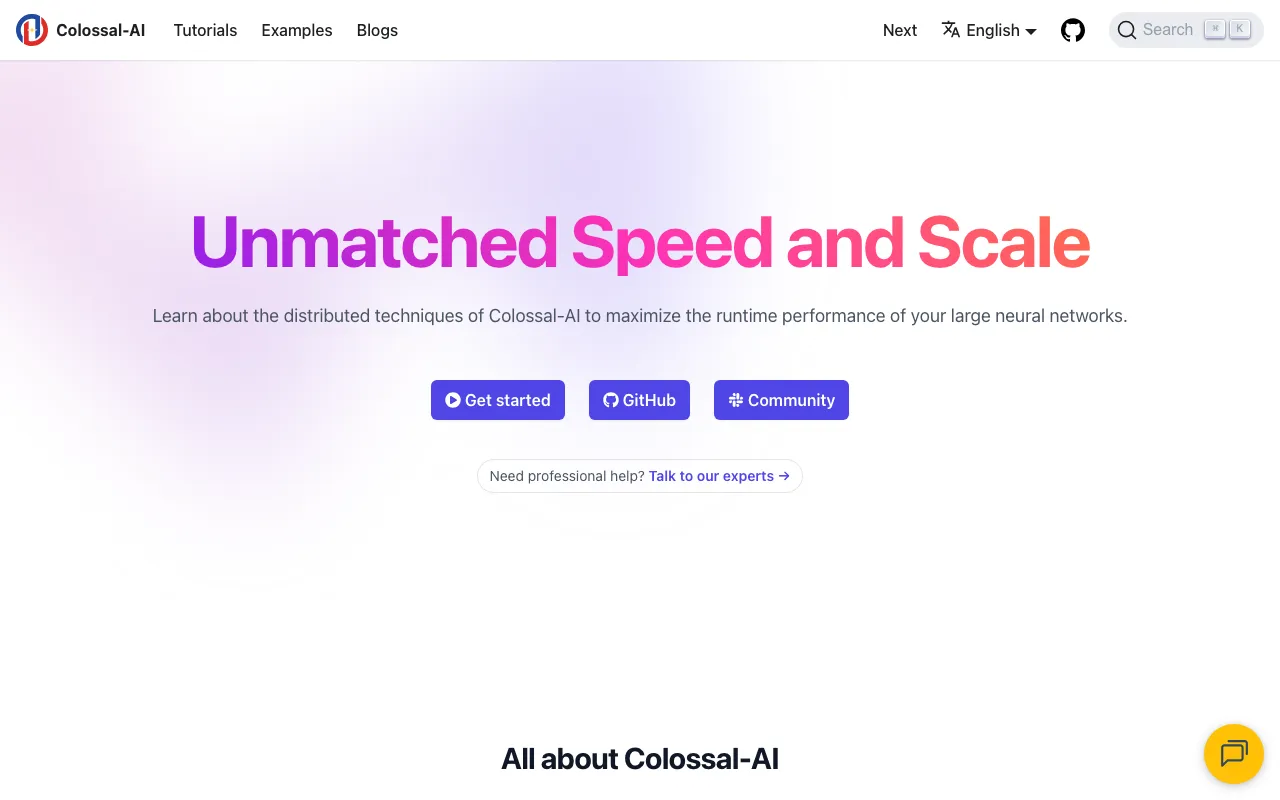
Colossal-AI is a PyTorch-oriented toolkit for training and inferencing large models with data, pipeline, and tensor parallelism. It targets cheaper, faster large-scale AI on clusters or single GPUs.
Colossal-AI collects parallel components and configuration-driven tools so teams can scale deep learning jobs across many GPUs with less custom plumbing. It emphasizes writing models similarly to laptop-scale code while enabling data parallelism, pipeline parallelism, tensor parallelism, and heterogeneous memory management.
The ecosystem includes training and inference examples for large language models, mixture-of-experts setups, diffusion models, and other architectures named in the project materials. Companion efforts such as ColossalChat, Colossal-Inference, and Open-Sora illustrate RLHF, serving, and video-model workflows built on the same stack.
Installation is available from PyPI, source, or Docker images, with Linux as the supported platform for the package. Optional CUDA kernel fusion can be enabled at install time or built at runtime. A command-line interface helps launch distributed jobs and manage project configuration files.
Documentation covers paradigms of parallelism, CLI usage, and sample paths such as hybrid GPT training and memory managers. The project is aimed at researchers and engineers who need to shrink hardware cost or wall-clock time for foundation-model work.
End-to-end machine learning platform and tooling ecosystem
TensorFlow is a machine learning platform with Python and C++ APIs, optional GPU packages, and companion libraries for data, training, deployment, and visualization.

Run open AI models locally or in the cloud
Ollama runs open language models such as Gemma, Qwen, DeepSeek and gpt-oss on macOS, Windows and Linux, locally or in the cloud. It offers a CLI, a REST API, and Python and JavaScript libraries.

Shared model definitions for multimodal ML workloads
Transformers is a Python library that defines pretrained text, vision, audio, and multimodal models once in PyTorch for shared inference and training across the ecosystem.

LLM inference engine in C/C++ for local and cloud hardware
llama.cpp runs large language models and multimodal models locally or in the cloud with minimal setup. It includes a CLI, an OpenAI-compatible server with a built-in chat app, and a C library API.

General-purpose speech recognition and translation model
Whisper is a speech recognition model trained on diverse audio. It supports multilingual transcription, speech-to-English translation, and language identification via Python or the command line.

High-throughput, memory-efficient inference and serving engine for LLMs
vLLM is a library and server for running and serving large language models. It uses PagedAttention and continuous batching for throughput, offers an OpenAI-compatible API, and runs on many GPU, CPU and accelerator types.