
Supabase
Open-source Postgres platform with auth, APIs, and storage
Supabase bundles a dedicated Postgres database with authentication, auto-generated REST and GraphQL APIs, realtime, functions, file storage, and vector tooling.

PostgreSQL extension for distributed and sharded relational databases
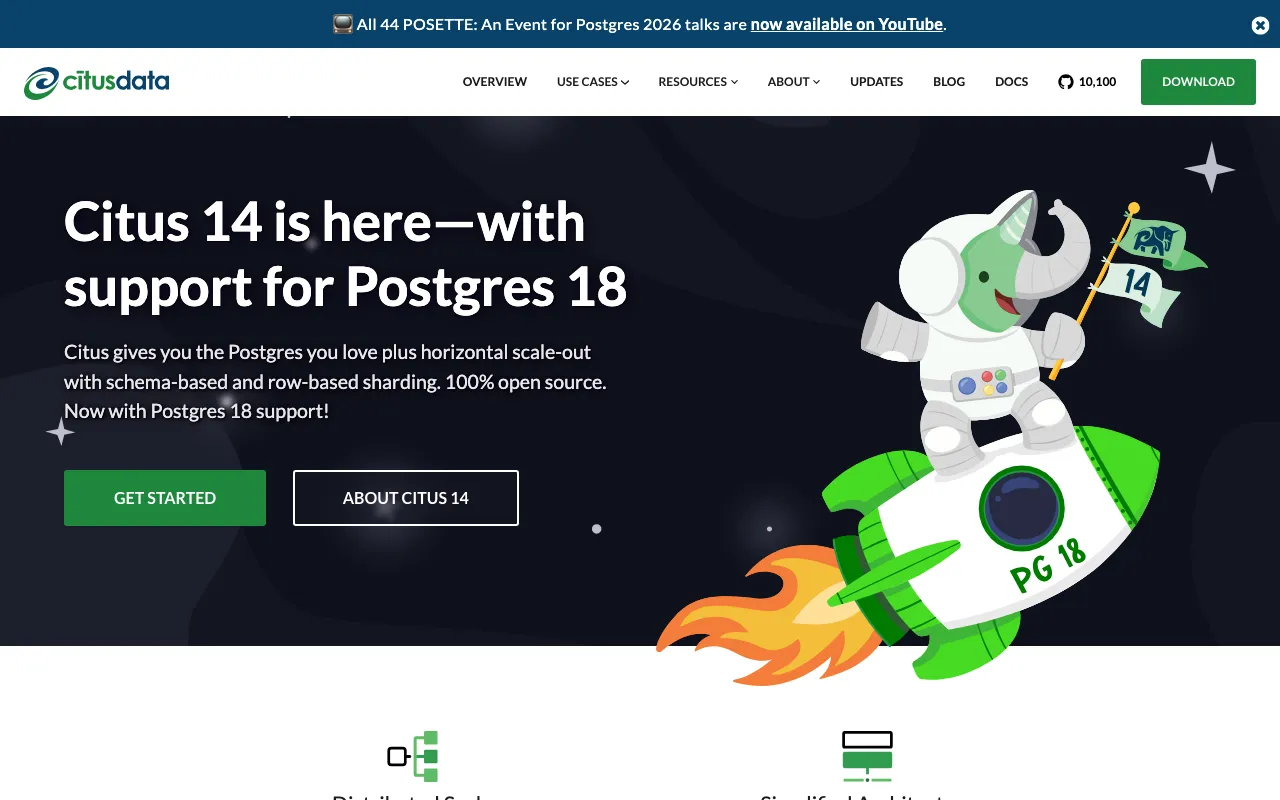
Citus turns PostgreSQL into a distributed database by sharding tables across nodes. It adds a distributed query engine, reference tables, and optional columnar storage while staying a Postgres extension.
Citus is a PostgreSQL extension that distributes data and queries across a cluster of Postgres nodes. Distributed tables are sharded so CPU, memory, storage, and I/O can scale together, while reference tables can be replicated to every node for joins and foreign keys that do not use the shard key.
A distributed query engine routes and parallelizes SELECT, DML, and related operations. Columnar storage compresses data and speeds scans on supported tables. You can start on a single node with Citus enabled and later add workers and rebalance shards as load grows. Schema-based sharding treats each schema as a logical shard, which the docs position for multi-tenant apps and microservices with minimal query changes.
Citus is not a fork of Postgres; it works with current PostgreSQL versions and familiar tools. Setup paths include managed Elastic Clusters on Azure, a single Docker container for trials, local package installs on Linux distributions, and multi-node clusters documented for several operating systems. Common workloads called out include multi-tenant SaaS, customer-facing real-time analytics, and mixed transactional and analytical use on one database.
Open-source Postgres platform with auth, APIs, and storage
Supabase bundles a dedicated Postgres database with authentication, auto-generated REST and GraphQL APIs, realtime, functions, file storage, and vector tooling.

Open-source metrics monitoring and time series database
Prometheus collects metrics from configured targets, evaluates rules, and can raise alerts. It stores time series data and exposes a query language called PromQL.
Self-hostable no-code database with spreadsheet interface
NocoDB turns Postgres, MySQL, SQLite, or a hosted database into editable tables with grid, kanban, form, gallery, and calendar views. Teams collaborate with roles, sharing, REST APIs, and workflow integrations.
Raft-backed distributed consistent key-value store
etcd stores small critical configuration and coordination data for clusters. It exposes a gRPC API, tolerates failures via Raft, and ships with the etcdctl command-line client.

Universal multi-platform database tool and SQL client
Free desktop client for developers and DBAs with SQL editing, data editing, ER diagrams, exports, and support for hundreds of JDBC or ODBC databases.

Column-oriented real-time analytics database management system
ClickHouse is a column-oriented database for generating analytical reports in real time using SQL on large datasets.
 Firebase
 Airtable