
TensorFlow
End-to-end machine learning platform and tooling ecosystem
TensorFlow is a machine learning platform with Python and C++ APIs, optional GPU packages, and companion libraries for data, training, deployment, and visualization.

Unreal Engine urban driving simulator for autonomy research
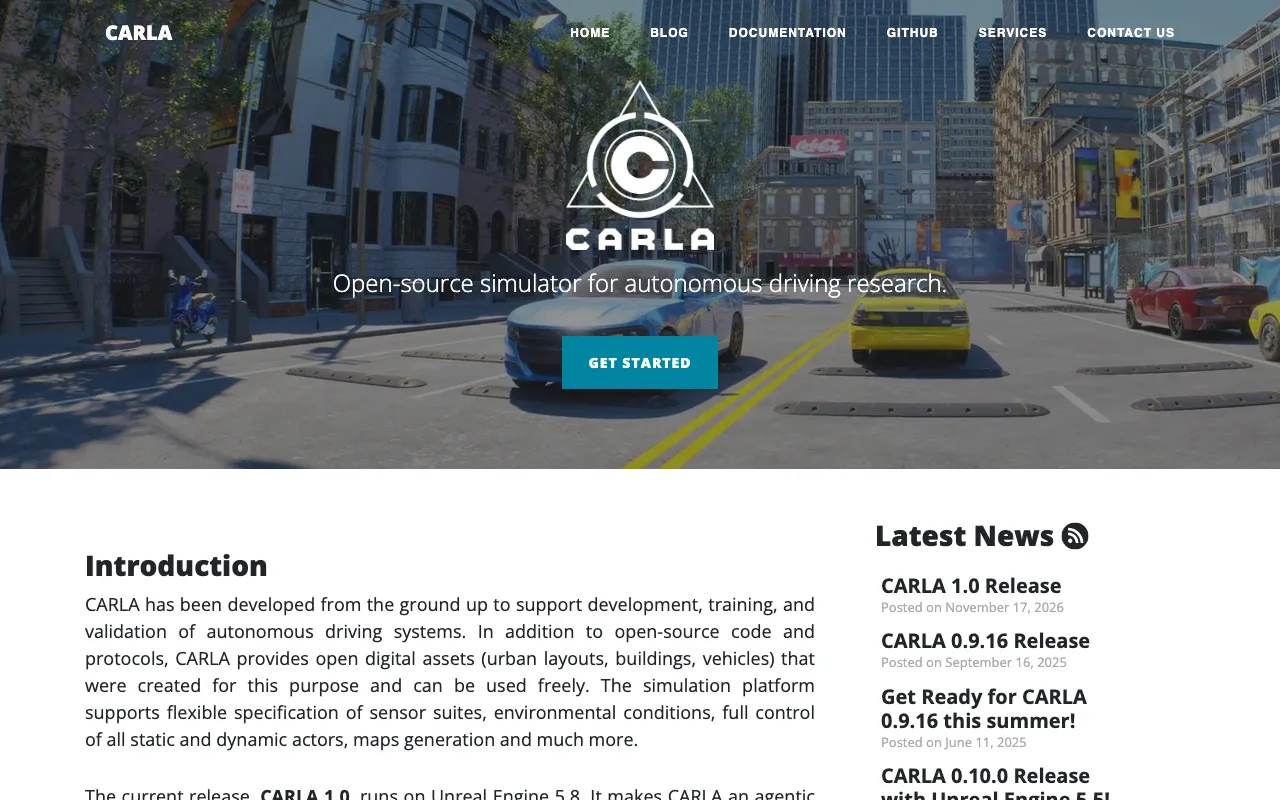
CARLA simulates urban driving for developing, training, and validating autonomous driving stacks. It ships open maps, vehicles, and sensor models controllable through Python and C++ APIs.
CARLA is built for researchers and engineers who need repeatable urban driving scenarios instead of only road miles. The platform provides digital towns, traffic actors, weather, and sensor suites so stacks can be exercised before deployment.
Recent releases run on Unreal Engine 5.8 with large-world maps, advanced camera and lidar simulation, ray-traced lens models, and hardware ray tracing features. Users get semantic segmentation, depth, bounding boxes, and related ground truth per frame alongside conventional RGB, depth, radar, GNSS, IMU, and V2X sensor types.
Operation is organized around a multi-client server: several processes can control different actors, and secondary servers can render sensors on additional GPUs. Traffic can be driven by a traffic manager, scripted scenarios, OpenSCENARIO tooling, Scenic, or leaderboard evaluation flows. Native ROS 2 publish and subscribe avoids a separate bridge, with selectable DDS middleware at launch.
Maps can follow ASAM OpenDRIVE, import from tools such as RoadRunner or OpenStreetMap, and ship as content packs. Integrations mentioned include NuRec scene replay, cosmos-style variation, Autoware over ROS 2, and agent-oriented MCP procedures for setup and packaging tasks.
End-to-end machine learning platform and tooling ecosystem
TensorFlow is a machine learning platform with Python and C++ APIs, optional GPU packages, and companion libraries for data, training, deployment, and visualization.

Run open AI models locally or in the cloud
Ollama runs open language models such as Gemma, Qwen, DeepSeek and gpt-oss on macOS, Windows and Linux, locally or in the cloud. It offers a CLI, a REST API, and Python and JavaScript libraries.

Shared model definitions for multimodal ML workloads
Transformers is a Python library that defines pretrained text, vision, audio, and multimodal models once in PyTorch for shared inference and training across the ecosystem.

LLM inference engine in C/C++ for local and cloud hardware
llama.cpp runs large language models and multimodal models locally or in the cloud with minimal setup. It includes a CLI, an OpenAI-compatible server with a built-in chat app, and a C library API.

General-purpose speech recognition and translation model
Whisper is a speech recognition model trained on diverse audio. It supports multilingual transcription, speech-to-English translation, and language identification via Python or the command line.

High-throughput, memory-efficient inference and serving engine for LLMs
vLLM is a library and server for running and serving large language models. It uses PagedAttention and continuous batching for throughput, offers an OpenAI-compatible API, and runs on many GPU, CPU and accelerator types.