Bullet Physics SDK provides real-time collision detection and multi-physics simulation for games, visual effects, VR, robotics, and machine learning. PyBullet Python bindings are recommended for robotics and RL workflows.
Overview
Bullet3 is the Bullet Physics SDK, a C++ library for real-time collision detection and multi-body physics simulation. Project materials list use cases spanning games, visual effects, virtual reality, robotics, and machine learning.
The core library targets platforms including Windows, Linux, macOS, iOS, and Android with a C++03-era toolchain requirement. Optional demos may use OpenGL graphics; non-graphical tests also exist. Experimental OpenCL paths can run collision and rigid-body dynamics on supported GPUs.
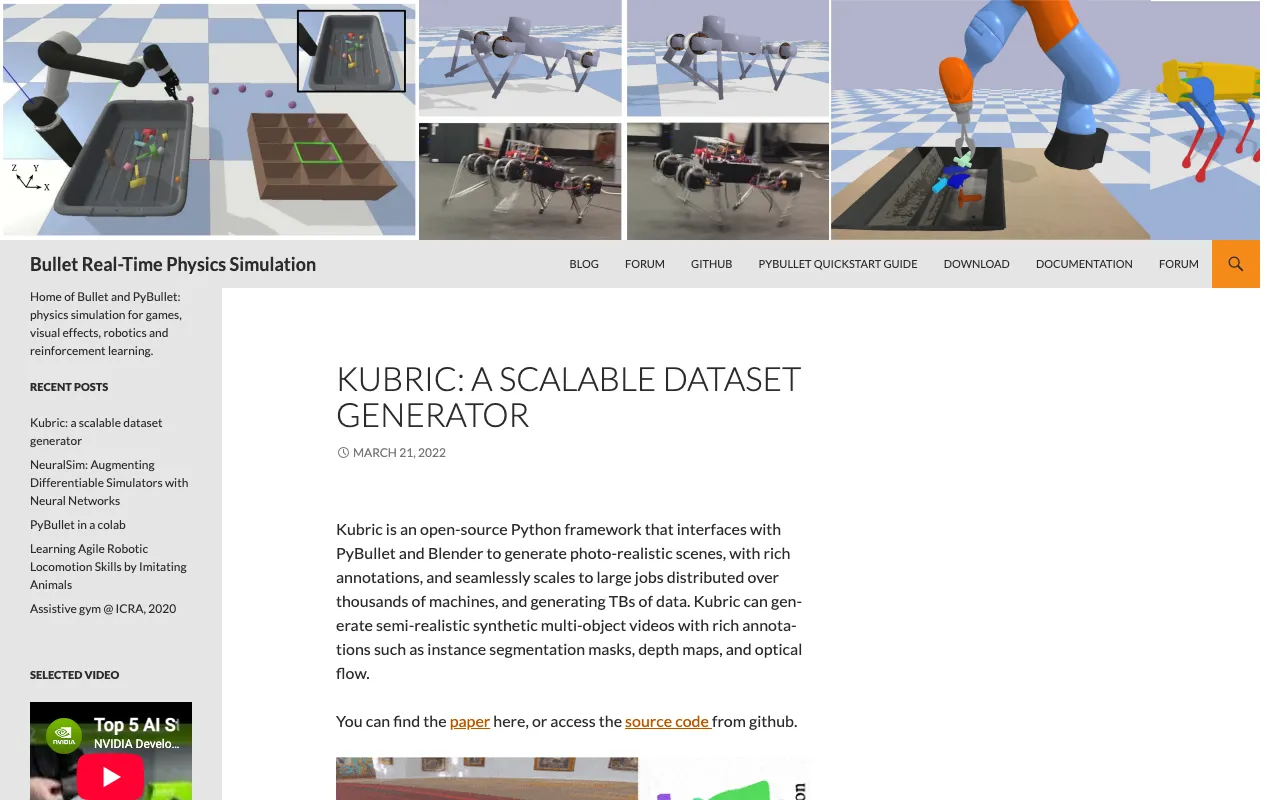
PyBullet offers Python bindings aimed at robotics, reinforcement learning, and VR, installable via pip with quickstart examples. The upstream site references research integrations such as sim-to-real robot learning, deformable FEM features, and embedding inside other simulation frameworks.
Example browser and VR sandbox executables ship with the SDK for interactive demos, mouse picking, and connecting from Python to shared-memory physics servers. Packaging is available through vcpkg and CMake or premake build flows.
Key features
- Real-time collision detection
- Rigid and multi-physics simulation
- PyBullet Python bindings
- VR sandbox shared-memory examples
- OpenCL GPU dynamics experiment
- Deformable FEM simulation support
- Example browser and demo executables
- vcpkg and CMake build integration
Use cases
- Game and VFX physics simulation
- Robotics simulation with PyBullet
- Reinforcement learning training environments
- VR physics sandboxes
- Research sim-to-real control policies