
TensorFlow
End-to-end machine learning platform and tooling ecosystem
TensorFlow is a machine learning platform with Python and C++ APIs, optional GPU packages, and companion libraries for data, training, deployment, and visualization.
Uniform SDK for biosensor acquisition and signal processing
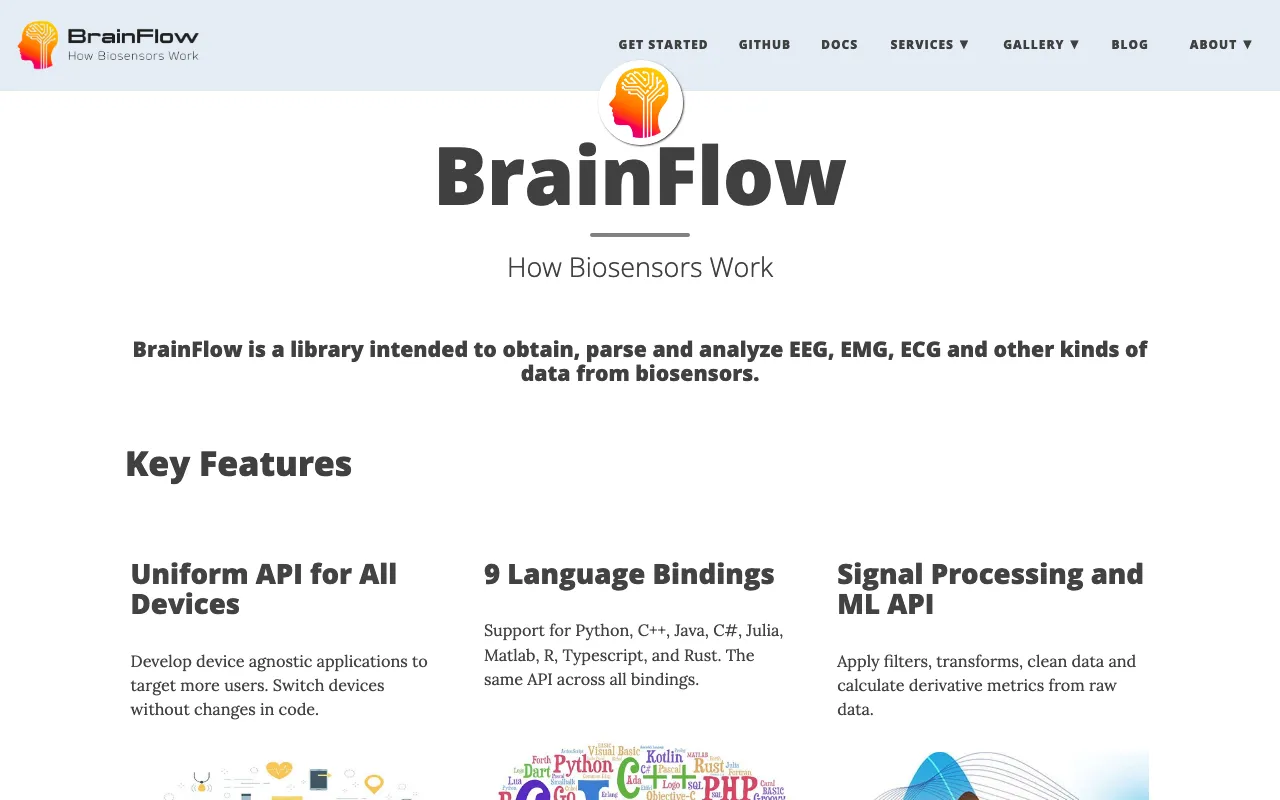
BrainFlow is a library to obtain, parse, and analyze EEG, EMG, ECG, and other biosensor data. It offers a uniform API across boards with bindings for many languages.
BrainFlow is a library for acquiring, parsing, and analyzing data from biosensors, with a focus on neurointerfaces and related signals such as EEG, EMG, and ECG. It is distributed under the MIT license and aims to give developers a single API across supported hardware.
The API covers data acquisition, signal filtering, denoising, downsampling, and related processing. Development aids include a synthetic board, a streaming board, and a logging API. Core acquisition and processing logic lives in C and C++; language bindings call into that shared implementation so behavior stays consistent across environments.
Bindings exist for Python, Java, R, C++, C#, Matlab, and Julia, and the website also lists TypeScript and Rust with the same API shape across bindings. Applications built on BrainFlow can switch boards without rewriting acquisition code because the interface is uniform across devices.
The project maintains automated integration tests across platforms and documents user and developer guides separately. Community support is available through GitHub issues and Slack.
End-to-end machine learning platform and tooling ecosystem
TensorFlow is a machine learning platform with Python and C++ APIs, optional GPU packages, and companion libraries for data, training, deployment, and visualization.

Run open AI models locally or in the cloud
Ollama runs open language models such as Gemma, Qwen, DeepSeek and gpt-oss on macOS, Windows and Linux, locally or in the cloud. It offers a CLI, a REST API, and Python and JavaScript libraries.

Shared model definitions for multimodal ML workloads
Transformers is a Python library that defines pretrained text, vision, audio, and multimodal models once in PyTorch for shared inference and training across the ecosystem.

LLM inference engine in C/C++ for local and cloud hardware
llama.cpp runs large language models and multimodal models locally or in the cloud with minimal setup. It includes a CLI, an OpenAI-compatible server with a built-in chat app, and a C library API.

General-purpose speech recognition and translation model
Whisper is a speech recognition model trained on diverse audio. It supports multilingual transcription, speech-to-English translation, and language identification via Python or the command line.

WiFi CSI spatial sensing without cameras
RuView turns WiFi channel state into presence, motion, breathing, heart rate, and activity signals using low-cost ESP32 nodes. Processing can stay on edge hardware with optional visualization and smart-home bridges.