Kubernetes
Open-source container scheduling and management system
Kubernetes (K8s) manages containerized applications across many hosts. It automates deployment, scaling, and ongoing operations for grouped containers.

Diskless Kafka-compatible streaming on object storage
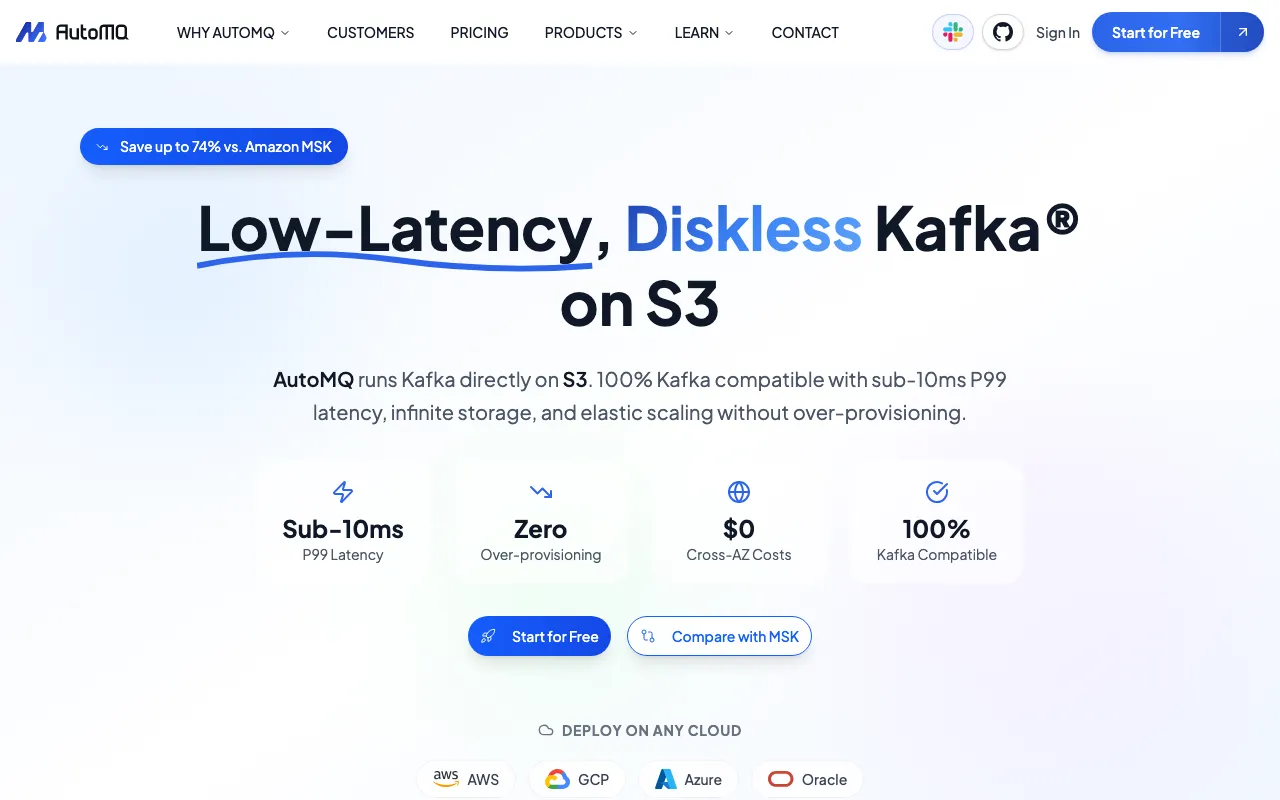
AutoMQ runs Kafka-compatible brokers with logs on S3 or S3-compatible stores. It targets elastic scaling, lower cloud costs, and reduced cross-AZ traffic compared with disk-backed Kafka.
AutoMQ is a streaming system positioned as a diskless, cloud-native take on Apache Kafka. Brokers store data on S3 or compatible object storage such as MinIO instead of local disks, with full compatibility with Kafka APIs and protocol behavior.
The architecture separates compute from storage with components such as an S3 storage adapter, shared streaming library with WAL and caches, an auto balancer for partition traffic, and rack-aware routing aimed at cross-AZ cost on AWS and GCP. Stateless brokers scale in or out within seconds, with automatic capacity adjustment tied to workload metrics.
Deployment paths include Docker Compose for single-node or small clusters, Linux multi-node installs, and Kubernetes. A Table Topic feature combines stream and table processing with Apache Iceberg and catalog integrations including AWS Glue and HMS, plus S3 tables support.
Offerings include an enterprise edition with a control plane, Kafka Linking for migration from Kafka-compatible clusters, managed connector support, and multi-cluster disaster recovery proxy routing. Case studies cite migrations from Apache Kafka and AWS MSK at various companies.
Open-source container scheduling and management system
Kubernetes (K8s) manages containerized applications across many hosts. It automates deployment, scaling, and ongoing operations for grouped containers.

Self-hostable PaaS for apps, databases, and one-click services
Coolify deploys static sites, databases, and full-stack apps on servers you control, with a dashboard similar to managed hosting platforms. Configurations stay on your machines over SSH.

Bidirectional real-time communication for web and Node
Socket.IO enables low-latency, event-based communication between clients and servers. It prefers WebSockets and falls back to HTTP long-polling when needed.
Automated Windows VMs inside Docker with KVM acceleration
Dockur Windows runs full Windows desktops or servers in a container with hands-free ISO install. It supports many releases, RDP, shared folders, and flexible networking.

Web UI for Docker, Swarm, and Kubernetes fleets
Portainer Community Edition offers a browser-based console to manage Docker, Swarm, Podman, Kubernetes, and ACI environments from one place. A commercial edition adds enterprise governance, GitOps, and support.
Self-hostable PaaS for apps and databases
Dokploy is a self-hostable platform-as-a-service for deploying applications and databases on your own VPS. It supports Docker, Compose, multi-server setups, backups, and monitoring.
 Heroku
 Netlify