
TensorFlow
End-to-end machine learning platform and tooling ecosystem
TensorFlow is a machine learning platform with Python and C++ APIs, optional GPU packages, and companion libraries for data, training, deployment, and visualization.
Distributed object storage cluster for AI workloads
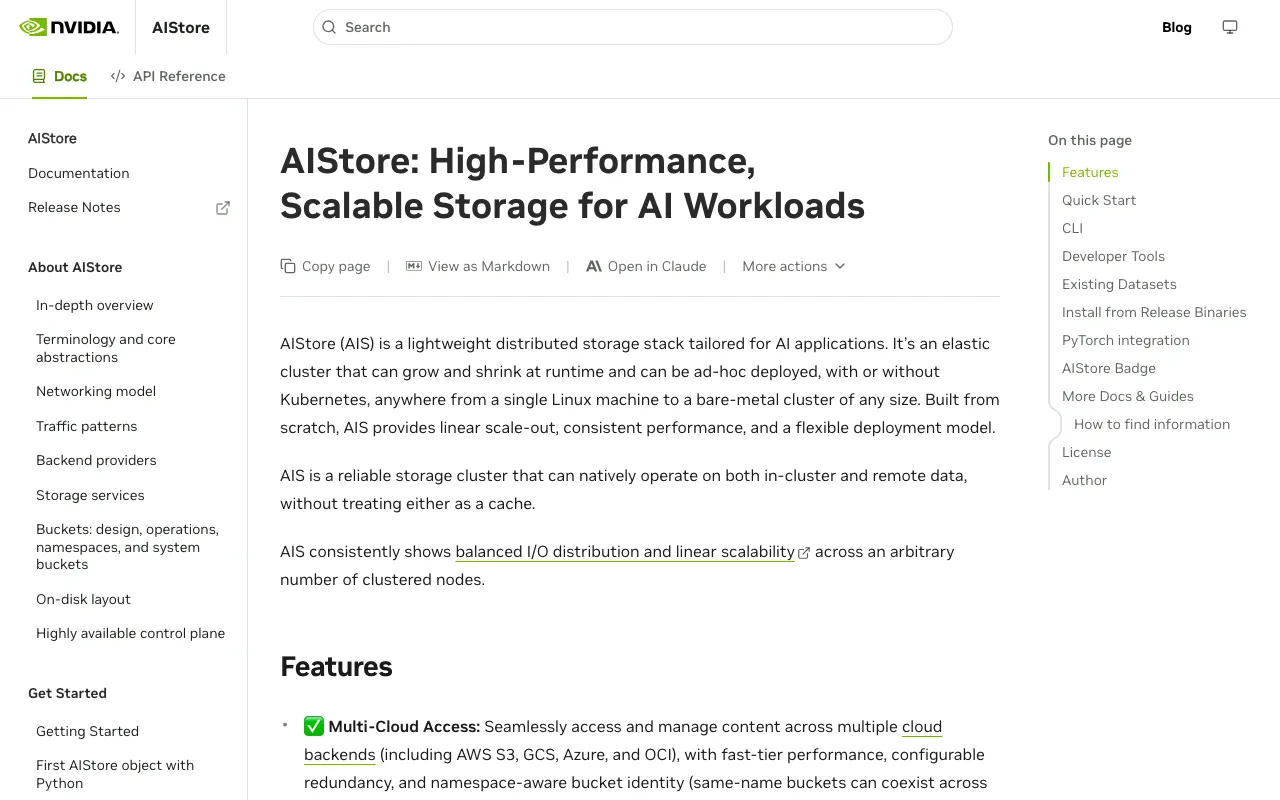
NVIDIA AIStore is a lightweight scalable storage stack for AI. It offers S3-compatible APIs, multi-cloud buckets, Kubernetes deployment, and ML-focused ingestion and batch jobs.
NVIDIA AIStore (AIS) is a distributed object storage system aimed at AI and machine-learning pipelines. Clusters can scale out linearly, shrink at runtime, and run on individual Linux hosts or large bare-metal deployments with or without Kubernetes.
The system treats in-cluster and remote data as first-class storage rather than a simple cache layer. It exposes a native HTTP API with Go and Python SDKs plus S3 compatibility for existing tools, and can front multiple cloud object stores with namespace-aware bucket identity.
Operational features include redundancy and self-healing, JWT and OIDC access control, intra-cluster request signing, Prometheus and Grafana observability, chunked objects, archive formats for small files, LRU bucket caching, ETL offload near data, and dozens of asynchronous batch jobs for copy, prefetch, mirroring, and related tasks.
Deployment paths range from local development and minimal Docker Compose smoke tests to Ansible, Slurm, Helm, and operator-based production setups. PyTorch datasets, dataloaders, and Boto3 integration are documented for training workflows.
End-to-end machine learning platform and tooling ecosystem
TensorFlow is a machine learning platform with Python and C++ APIs, optional GPU packages, and companion libraries for data, training, deployment, and visualization.

Run open AI models locally or in the cloud
Ollama runs open language models such as Gemma, Qwen, DeepSeek and gpt-oss on macOS, Windows and Linux, locally or in the cloud. It offers a CLI, a REST API, and Python and JavaScript libraries.

Shared model definitions for multimodal ML workloads
Transformers is a Python library that defines pretrained text, vision, audio, and multimodal models once in PyTorch for shared inference and training across the ecosystem.

LLM inference engine in C/C++ for local and cloud hardware
llama.cpp runs large language models and multimodal models locally or in the cloud with minimal setup. It includes a CLI, an OpenAI-compatible server with a built-in chat app, and a C library API.

General-purpose speech recognition and translation model
Whisper is a speech recognition model trained on diverse audio. It supports multilingual transcription, speech-to-English translation, and language identification via Python or the command line.

High-throughput, memory-efficient inference and serving engine for LLMs
vLLM is a library and server for running and serving large language models. It uses PagedAttention and continuous batching for throughput, offers an OpenAI-compatible API, and runs on many GPU, CPU and accelerator types.