
TensorFlow
End-to-end machine learning platform and tooling ecosystem
TensorFlow is a machine learning platform with Python and C++ APIs, optional GPU packages, and companion libraries for data, training, deployment, and visualization.

Self-hosted open-source AI metadata and experiment tracker
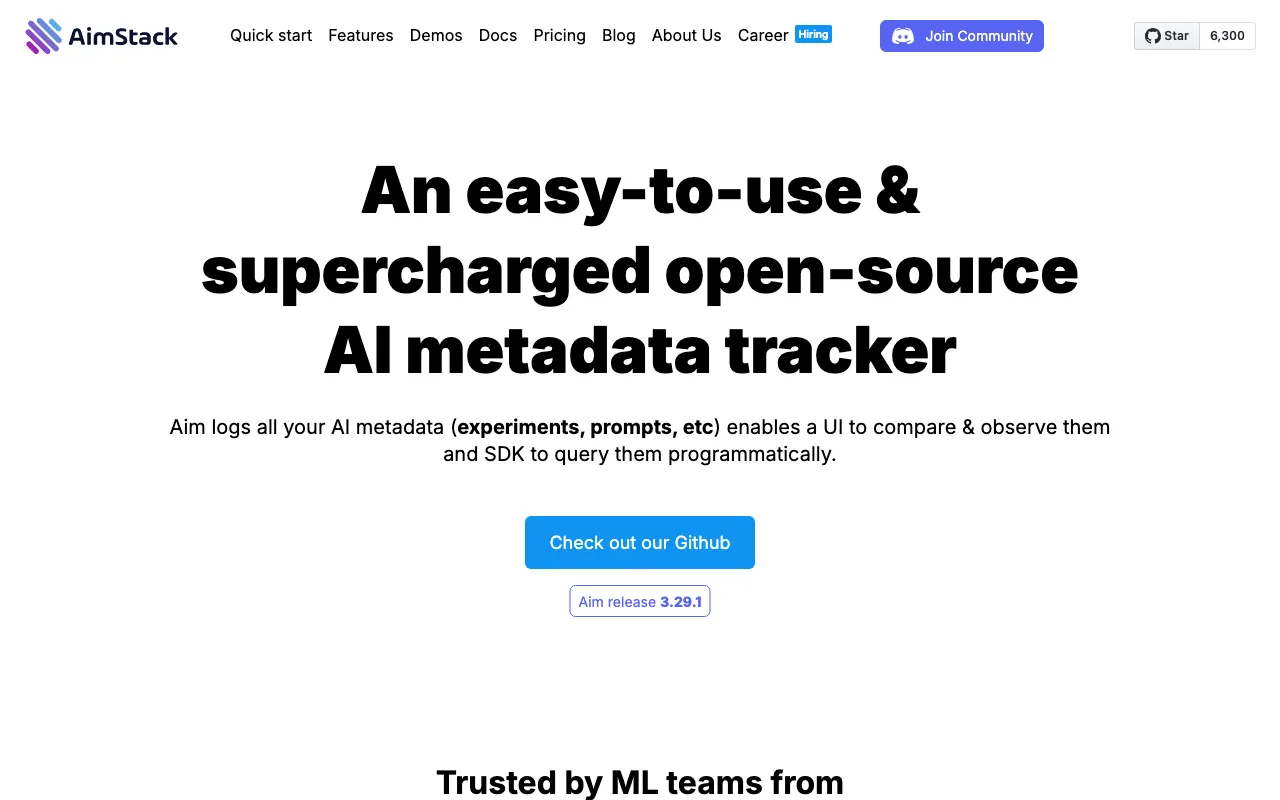
Aim records training runs and AI metadata, offers a UI to compare them, and an SDK to query data programmatically.
Aim is an open-source, self-hosted tool for tracking machine learning experiments and broader AI metadata, including prompt engineering sessions. It is built to store large numbers of training runs and metadata sequences while keeping exploration responsive in the UI.
You install Aim in your training environment, integrate it into your code to log hyperparameters, metrics, images, audio, text, and other objects, then launch the UI to browse and compare runs. A Python SDK supports querying tracked data with expressions, which suits notebooks and automation.
The product connects with many ML frameworks through callbacks and adapters, and can ingest logs converted from TensorBoard, MLflow, and Weights & Biases. A remote tracking server can centralize data from multiple hosts, and documentation covers deployment on Kubernetes.
Compared with TensorBoard, the source describes Aim as treating tracked parameters as first-class fields you can search, group, and aggregate in the UI, and as scaling better when many runs are compared. Compared with MLflow, Aim emphasizes experiment tracking and UI scalability for run comparison rather than full lifecycle management.
End-to-end machine learning platform and tooling ecosystem
TensorFlow is a machine learning platform with Python and C++ APIs, optional GPU packages, and companion libraries for data, training, deployment, and visualization.

Run open AI models locally or in the cloud
Ollama runs open language models such as Gemma, Qwen, DeepSeek and gpt-oss on macOS, Windows and Linux, locally or in the cloud. It offers a CLI, a REST API, and Python and JavaScript libraries.

Shared model definitions for multimodal ML workloads
Transformers is a Python library that defines pretrained text, vision, audio, and multimodal models once in PyTorch for shared inference and training across the ecosystem.

LLM inference engine in C/C++ for local and cloud hardware
llama.cpp runs large language models and multimodal models locally or in the cloud with minimal setup. It includes a CLI, an OpenAI-compatible server with a built-in chat app, and a C library API.

General-purpose speech recognition and translation model
Whisper is a speech recognition model trained on diverse audio. It supports multilingual transcription, speech-to-English translation, and language identification via Python or the command line.

High-throughput, memory-efficient inference and serving engine for LLMs
vLLM is a library and server for running and serving large language models. It uses PagedAttention and continuous batching for throughput, offers an OpenAI-compatible API, and runs on many GPU, CPU and accelerator types.