
Langflow
Visual low-code builder for AI agents and workflows
Langflow is a visual builder for AI agents and workflows. Flows can be customized in Python and deployed as an API or as an MCP server, with support for major LLMs and vector databases.

LLM pipeline from text to interactive knowledge graphs
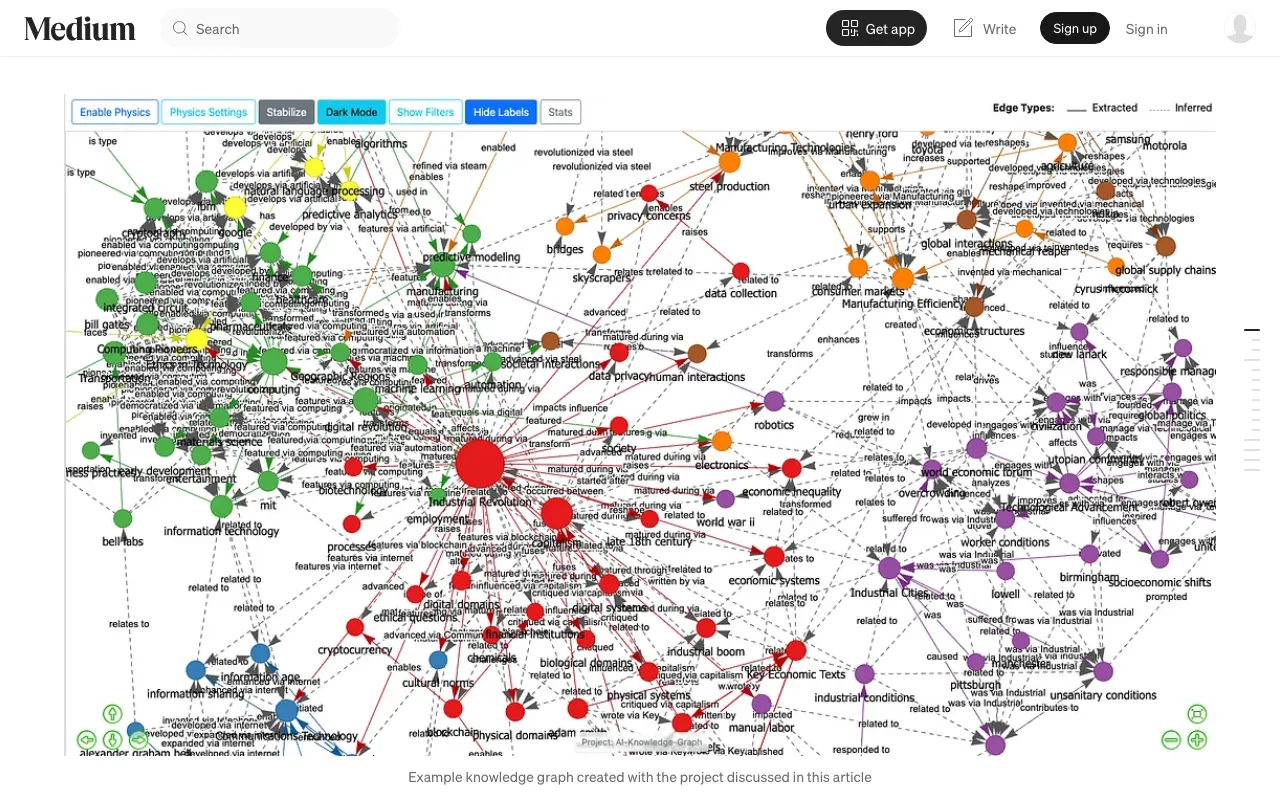
This system turns unstructured documents into typed subject-predicate-object graphs using an OpenAI-compatible LLM, then visualizes and queries them in the browser.
The product ingests unstructured text from formats such as plain text, Markdown, reStructuredText, PDF, and DOCX, optionally across whole directories and multiple languages. Large inputs are split on sentence boundaries with overlap, and chunks are processed in parallel to extract typed entities and relationships with source sentences attached.
A standardization pass merges obvious lexical variants and can optionally ask the LLM to align entities that refer to the same concept. Optional inference steps add conservative bridges between isolated graph components or well-known links among central entities, with each inferred edge labeled by method and capped relative to extracted facts.
Outputs include a self-contained interactive HTML explorer with search, highlighting, relationship panels, community names, filters, shortest-path lookup, and export options, plus JSON, CSV, GraphML, and Neo4j Cypher formats. The optional graph-chat command answers questions using only retrieved subgraph facts with citations, and graph-serve adds a local library UI with ingestion and the same Ask panel.
Configuration is TOML-driven with support for Ollama, LM Studio, vLLM, and other OpenAI-compatible providers, including response caching, truncation handling for reasoning models, and retry behavior. Sample graphs ship so exploration works without calling a model, while generation and chat require a configured endpoint.
Visual low-code builder for AI agents and workflows
Langflow is a visual builder for AI agents and workflows. Flows can be customized in Python and deployed as an API or as an MCP server, with support for major LLMs and vector databases.
Codebase knowledge graph skill for AI coding assistants
Graphify maps a project’s code, docs, and media into a queryable local knowledge graph and installs as a skill for assistants such as Cursor and Claude Code.

Framework for agents and LLM-powered applications
LangChain helps developers chain interoperable components and integrations to build agents and LLM-powered applications. It offers a standard interface for models, embeddings, vector stores, and related pieces.

Open-source orchestration platform for teams of AI agents
Node.js server and React UI for managing a team of AI agents like a company. Assign goals, build an org chart, set budgets, and track tasks and costs from one dashboard.
CLI toolkit for AI agents to search and read many web platforms
Agent Reach installs platform connectors so AI agents can search and read sites such as GitHub, YouTube, Reddit, Bilibili, and Xiaohongshu from one command line, without relying on paid APIs for default channels.

Open-source RAG engine and agent context platform
RAGFlow ingests heterogeneous documents, builds retrievable knowledge, and supports agent workflows with citations. It can run on your own hardware with Docker or a from-source server stack.