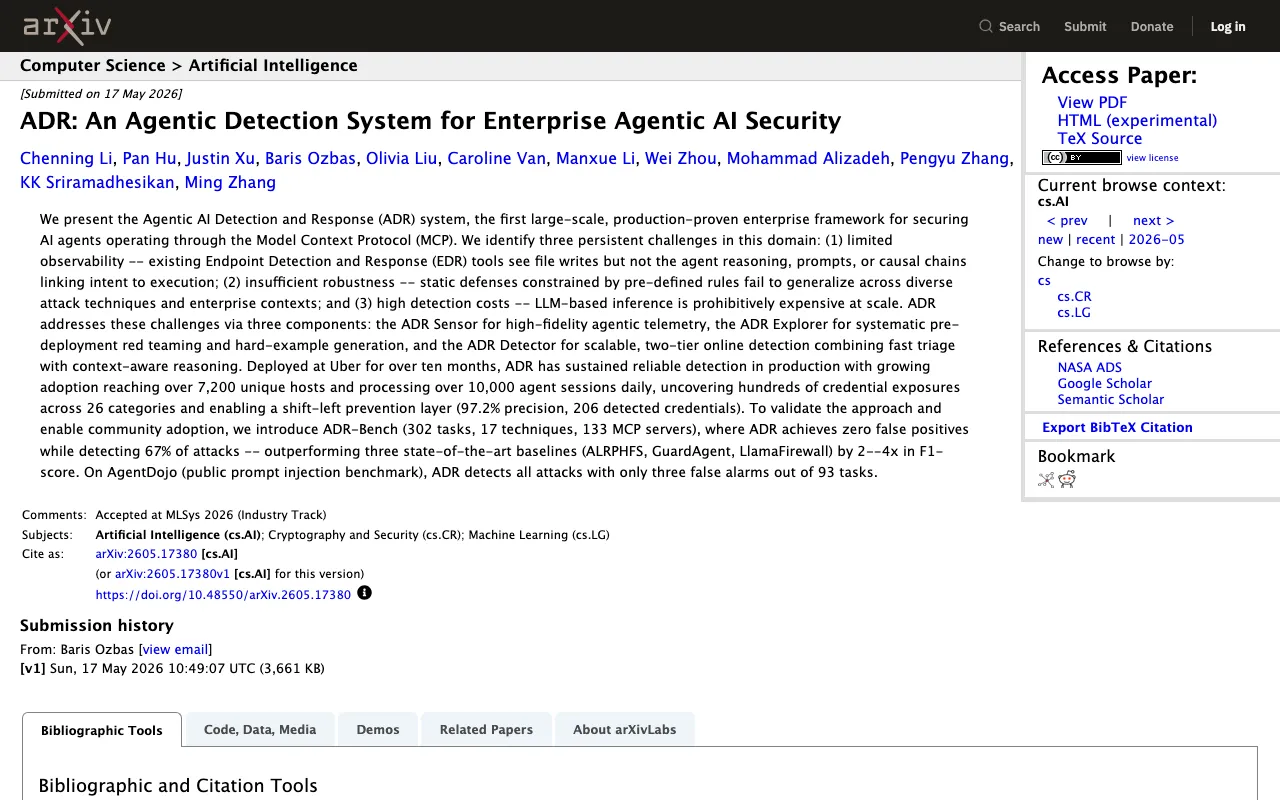
ADR (Agentic AI Detection and Response) secures employee-facing and customer-facing AI agents through discovery, observability, benchmarking, and threat detection.
Overview
ADR is an enterprise security system for AI agents used in settings such as coding assistants, CLI agents, IDE extensions, and customer support automations. Uber uses it in production; open-source components cover discovery, telemetry, benchmarking, and online detection while prevention and some offline hardening tooling sit outside the current public release.
ADR Discovery inventories AI applications, CLI agents, IDE extensions, local model runtimes, and MCP servers on endpoints and flags unknown surfaces. ADR Observability collects agent intent, tool use, and execution traces across multiple named coding tools on macOS, Linux, and Windows, plus internal automation and support agents. ADR-Bench supplies hundreds of tasks, many MCP servers, and coverage of numerous agent attack techniques for evaluation under enterprise-like conditions.
ADR Detection uses a two-tier architecture that pairs high-recall triage with deeper reasoning on suspicious sessions. The approach differs from traditional endpoint tools that see file activity but not agent reasoning chains, and from static rule-only defenses. The open release includes Discovery, Sensor, Bench, and Detector directories, with documentation for reproducing benchmark results.
Prevention that blocks unsafe actions before harm is not included in the open-source release. The offline ADR Explorer engine used for pre-deployment red teaming is also absent from the public codebase.
Key features
- Endpoint inventory of AI tools and MCP servers
- Unified agent telemetry and intent capture
- Security benchmark with MCP infrastructure
- Two-tier online threat detection
- Support for major coding agent products
- Credential exposure detection in production
- Open detection and discovery components
- Reproducible benchmark evaluation workflow
Use cases
- Securing employee AI coding assistants
- Monitoring customer-facing support agents
- Finding unsanctioned AI tools on endpoints
- Evaluating agent defenses under attack tasks
- Detecting risky agent sessions at scale