
TensorFlow
End-to-end machine learning platform and tooling ecosystem
TensorFlow is a machine learning platform with Python and C++ APIs, optional GPU packages, and companion libraries for data, training, deployment, and visualization.

PyTorch training helper for distributed devices and mixed precision
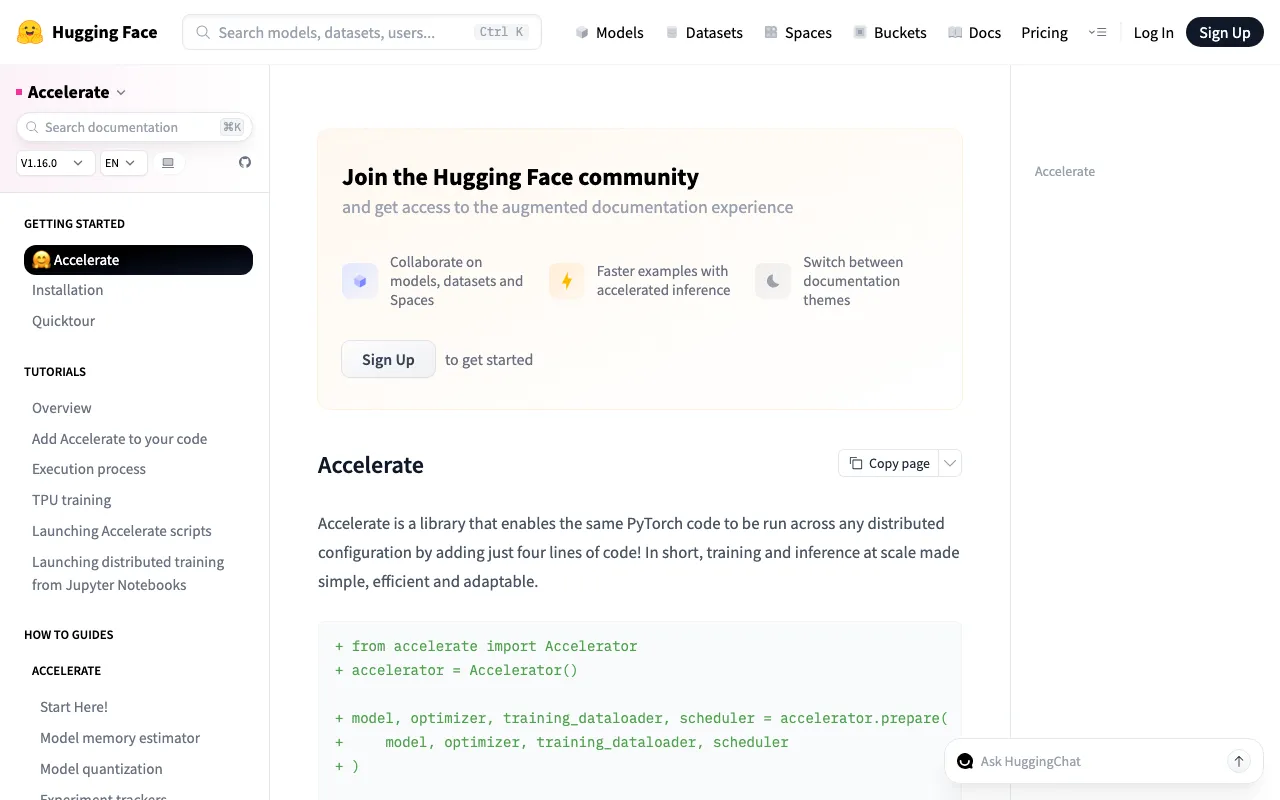
A Hugging Face library that wraps PyTorch training loops for multi-GPU, TPU, and mixed-precision runs with minimal code changes.
Accelerate is a Hugging Face library for running raw PyTorch training scripts across single and distributed hardware setups. It targets users who want to keep their own training loops but avoid maintaining boilerplate for multi-GPU, TPU, fp16, bf16, and fp8 setups.
Integrating typically means adding a small amount of code around your existing loop: create an Accelerator, pass model, optimizer, dataloader, and scheduler through prepare, and use accelerator.backward for the loss. The library can also handle device placement if you choose that mode. The same script can run locally for debugging and in a full training environment without rewriting the loop.
An optional CLI lets you run accelerate config to generate a config file and launch jobs with accelerate launch, including multi-GPU launches and multi-CPU runs via MPI. Supported configurations listed in the docs include CPU-only, multi-CPU on one or many nodes, single and multi-GPU, TPU, mixed precision, and experimental DeepSpeed, FSDP, and Megatron-LM integrations. A notebook launcher helper exists for distributed training from Colab or Kaggle notebooks.
Accelerate is intentionally a thin wrapper over PyTorch rather than a high-level trainer framework; the public API centers on the Accelerator class. It builds on torch.distributed and torchxla under the hood.
End-to-end machine learning platform and tooling ecosystem
TensorFlow is a machine learning platform with Python and C++ APIs, optional GPU packages, and companion libraries for data, training, deployment, and visualization.

Run open AI models locally or in the cloud
Ollama runs open language models such as Gemma, Qwen, DeepSeek and gpt-oss on macOS, Windows and Linux, locally or in the cloud. It offers a CLI, a REST API, and Python and JavaScript libraries.

Shared model definitions for multimodal ML workloads
Transformers is a Python library that defines pretrained text, vision, audio, and multimodal models once in PyTorch for shared inference and training across the ecosystem.

LLM inference engine in C/C++ for local and cloud hardware
llama.cpp runs large language models and multimodal models locally or in the cloud with minimal setup. It includes a CLI, an OpenAI-compatible server with a built-in chat app, and a C library API.

General-purpose speech recognition and translation model
Whisper is a speech recognition model trained on diverse audio. It supports multilingual transcription, speech-to-English translation, and language identification via Python or the command line.

High-throughput, memory-efficient inference and serving engine for LLMs
vLLM is a library and server for running and serving large language models. It uses PagedAttention and continuous batching for throughput, offers an OpenAI-compatible API, and runs on many GPU, CPU and accelerator types.