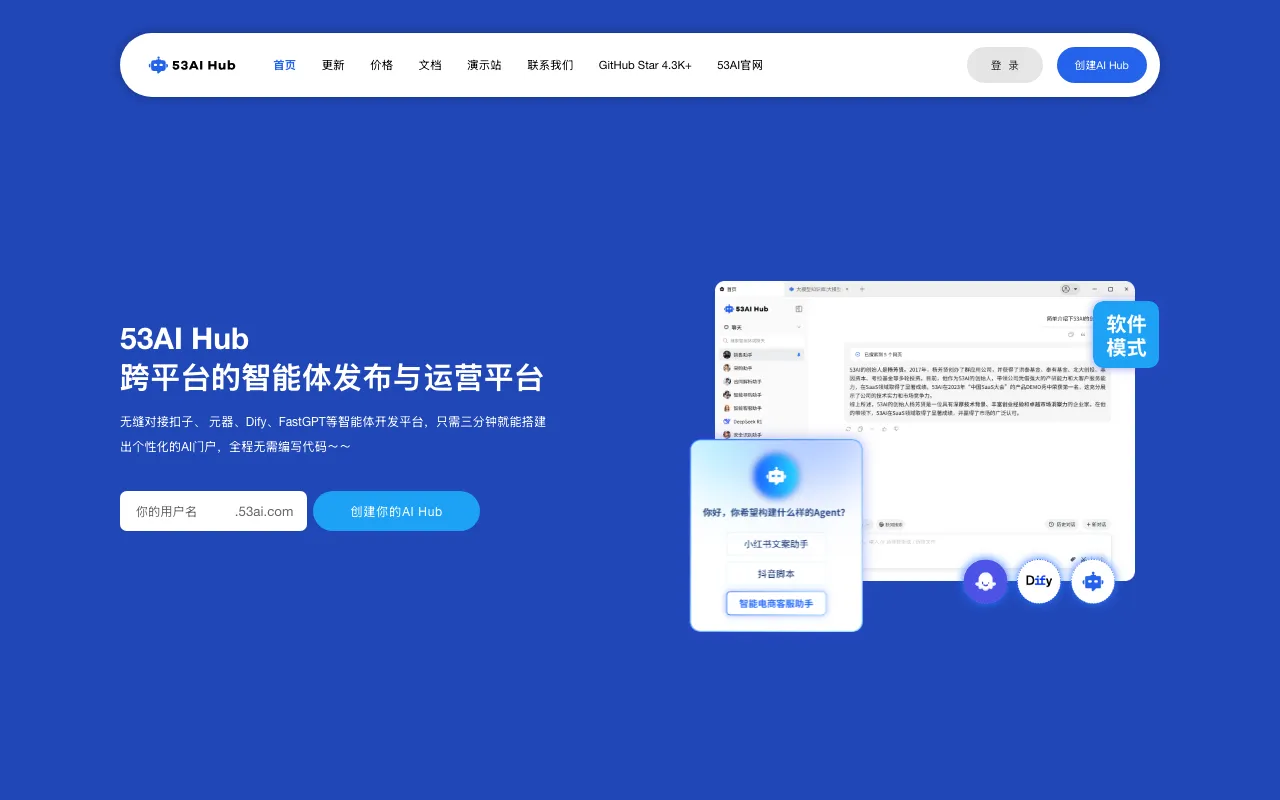
53AI Hub is an open-source portal for launching and operating AI agents, prompts, and tools. It connects to agent platforms such as Coze, Dify, FastGPT, and RAGFlow.
Overview
53AI Hub is an open-source AI portal aimed at organizations that want a single place to publish and run AI agents, prompt libraries, and AI tools. Operators can stand up an operational portal, choose site templates and styles, and adjust the interface without coding everything from scratch.
The product ties into mainstream agent development platforms and cloud providers named in its materials, including Coze, Dify, FastGPT, RAGFlow, and 53AI Studio, plus cloud environments such as Aliyun, Tencent Cloud, and Baidu Cloud. That integration focus is meant to reduce custom wiring when rolling out a production-facing AI portal.
Application management covers the full lifecycle for agents, prompts, and tools: publishing, grouping, sorting, and configuring user permissions. User operations support both registered users and internal users, with login and usage records available to administrators. Compared with tools like NextChat, lobehub, and Cherry Studio in its own comparison table, it emphasizes enterprise-style access controls, agent integration, internal users, SSO with WeCom, DingTalk, and Feishu, an AI knowledge base, and an AI workbench.
Deployment can follow a hosted cloud offering with tiered editions or the community open-source edition. The community path documents local deployment via a one-line installer or Docker Compose, with optional custom domains. Documentation and a demo site are offered alongside the self-hosted options.
Key features
- Integration with major agent platforms
- Lifecycle management for agents and prompts
- Registered and internal user operations
- Customizable portal templates and styles
- Enterprise SSO with WeCom, DingTalk, Feishu
- AI knowledge base and workbench
- Cloud or local one-click deployment
- Permission and grouping for published AI assets
Use cases
- Enterprise AI portal for internal teams
- Aggregating agents built on external platforms
- Operating prompts and tools for end users
- Industry or domain-specific AI hubs
- Subscription packaging for portal customers



 Anthropic Claude
 ChatGPT