
Taste Skill
Agent skill for designed company sites and browser QA
Taste Skill packages art direction, asset scripts, and headless browser checks so coding agents produce company websites with consistent layout, imagery, and copy rules.

Accessible multilingual government web front-end framework
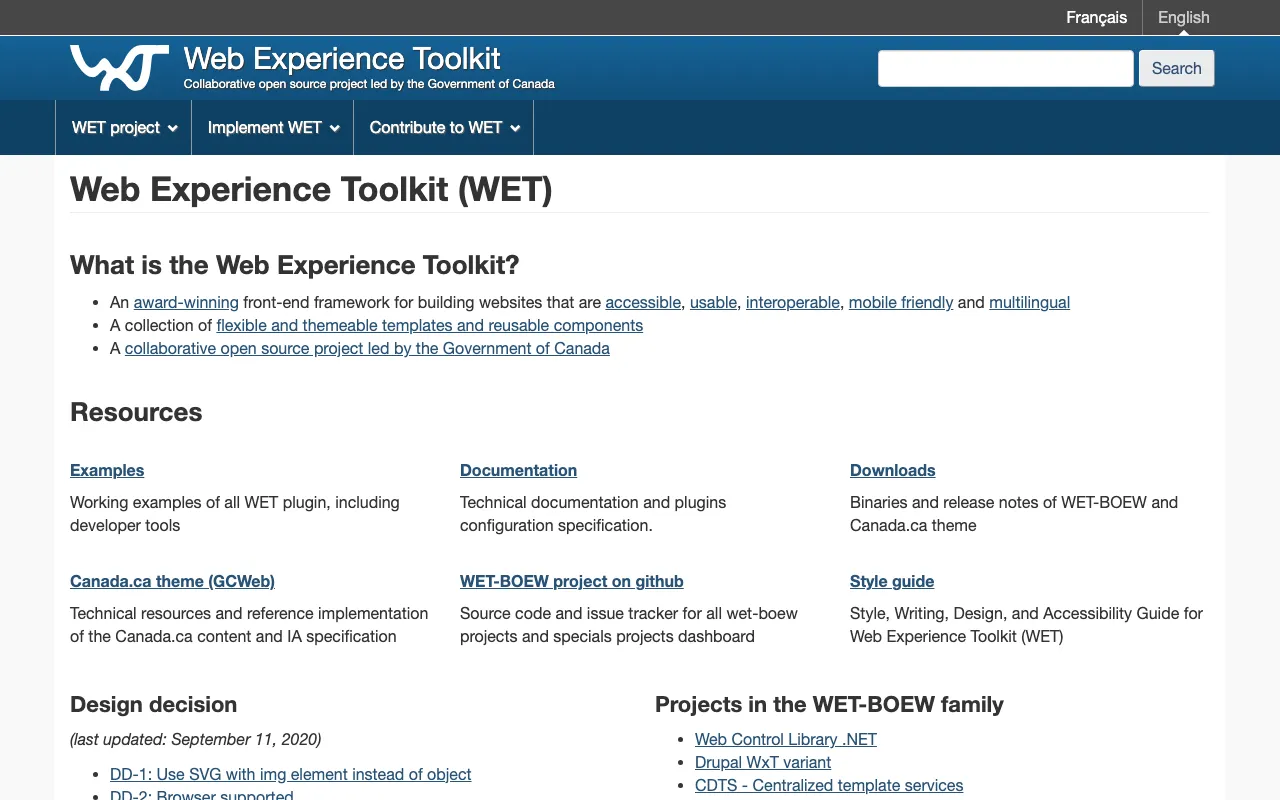
The Web Experience Toolkit is an open front-end framework and component library for sites that must be accessible, mobile-friendly, and multilingual.
The Web Experience Toolkit, often called WET-BOEW, helps teams build websites that meet accessibility, usability, interoperability, responsive mobile, and multilingual requirements. It is led as a collaborative open-source effort by the Government of Canada and ships flexible templates, plugins, and reusable widgets.
Components target modern HTML with progressive enhancement, polyfills where needed, and conformance goals such as WCAG 2.0 level AA cited on the project site, along with WAI-ARIA usage and assistive-technology testing through community working groups. The framework supports many browsers including Edge, Firefox, Chrome, Safari, and Opera, with responsive layouts and touchscreen-oriented patterns.
Internationalization covers dozens of languages, including right-to-left scripts listed in project documentation. Themes are customizable, with multiple theme packages including a Canada.ca reference implementation. Integrations and variants are documented for Drupal, WordPress, PHP, SSI, Java/Maven, and in-development SharePoint and DotNetNuke adapters.
Resources include working examples, technical documentation, downloadable releases, a public GitHub issue tracker, and contribution review processes combining automated and manual checks. Related family projects cover centralized templates, Drupal WxT, .NET controls, and WCAG review tooling.
Agent skill for designed company sites and browser QA
Taste Skill packages art direction, asset scripts, and headless browser checks so coding agents produce company websites with consistent layout, imagery, and copy rules.
Go-based static site generator with flexible templating
Hugo is a static site generator written in Go. It turns content and templates into deployable HTML sites with asset pipelines for CSS, JavaScript, Sass, and images.

React-based static site generator for documentation
Docusaurus builds documentation sites, blogs, and marketing pages from MDX content. It ships preset layouts and plugins so teams can publish quickly.

JavaScript web framework for content-driven sites
Astro builds content sites, web apps, and server APIs with server-first rendering, optional UI islands, and integrations for major frameworks.

Full-stack Vue framework for web applications
Nuxt builds type-safe Vue apps with file routing, multiple render modes, server directory APIs, and a large module ecosystem.

React-based framework for fast content-driven sites
Gatsby is a React framework for building websites and apps, blending static generation with dynamic React capabilities. It pulls data from markdown, CMSs, and APIs through a unified GraphQL layer.