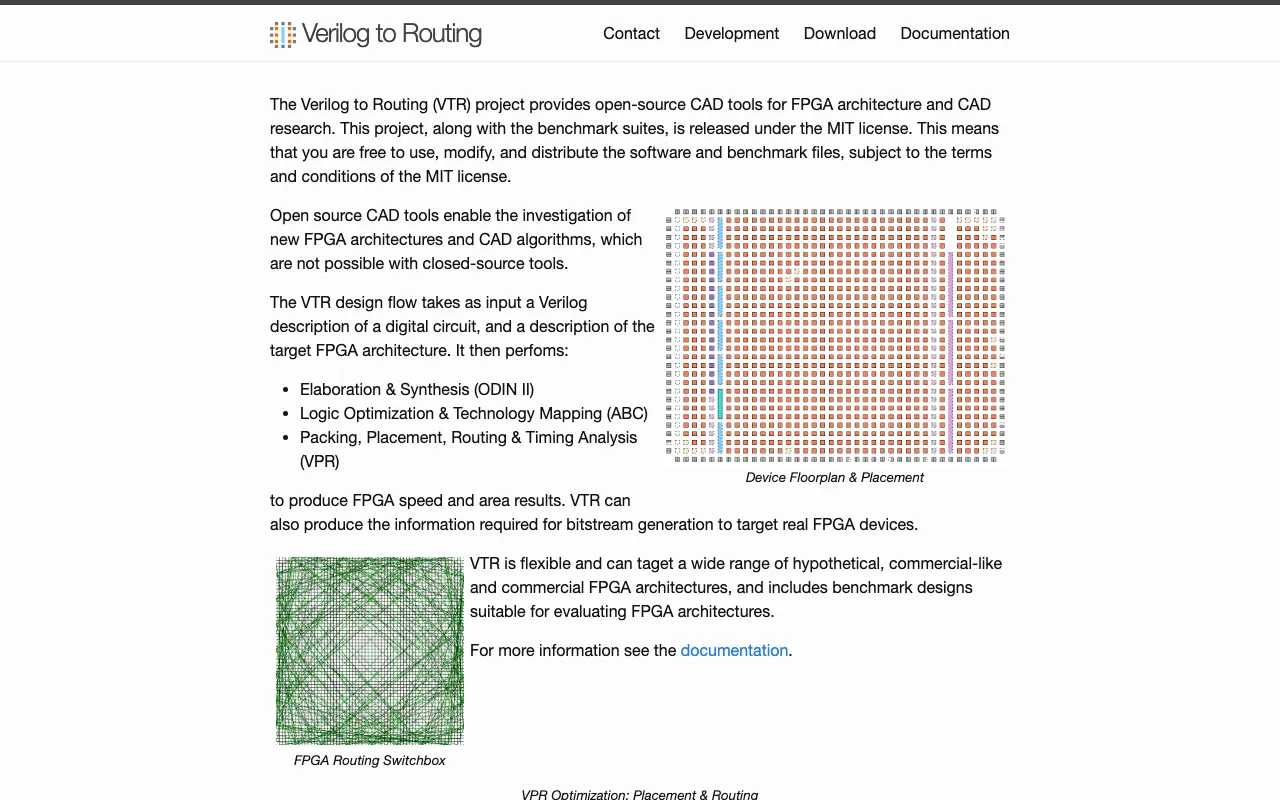
Verilog-to-Routing is an open framework that maps Verilog designs through synthesis, packing, placement, and routing to FPGA timing and area results.
Overview
The Verilog-to-Routing project provides an open-source CAD flow for FPGA architecture exploration and related research. It accepts a Verilog description of a digital circuit plus a description of a target FPGA architecture, then runs elaboration, synthesis, optimization, packing, placement, routing, and timing analysis to report speed and area.
Flow stages named in project documentation include elaboration and partial mapping, logic optimization and technology mapping with ABC, and packing, placement, routing, and timing with VPR. Benchmark designs ship with the tools to validate the flow. The project can emit FASM for programming some commercial FPGAs through Symbiflow and can produce bitstream-related information for real devices per the website.
VTR is flexible across hypothetical, commercial-like, and commercial FPGA architectures. Researchers worldwide contribute; official releases are regression tested, while development trunk builds may be less stable. Documentation covers tutorials, tool options, and support resources.
Users on Unix-like systems build from the root directory with make, and a Dockerfile packages dependencies for running the flow in containers.
Key features
- Verilog to placed-and-routed designs
- ABC logic optimization
- VPR placement and routing
- Architecture description support
- Bundled benchmark circuits
- FASM output for some FPGAs
- Timing and area reporting
- Dockerized build environment
Use cases
- FPGA architecture research
- Academic CAD algorithm development
- Benchmarking FPGA tools
- Exploring hypothetical FPGA fabrics




 Bolt.new