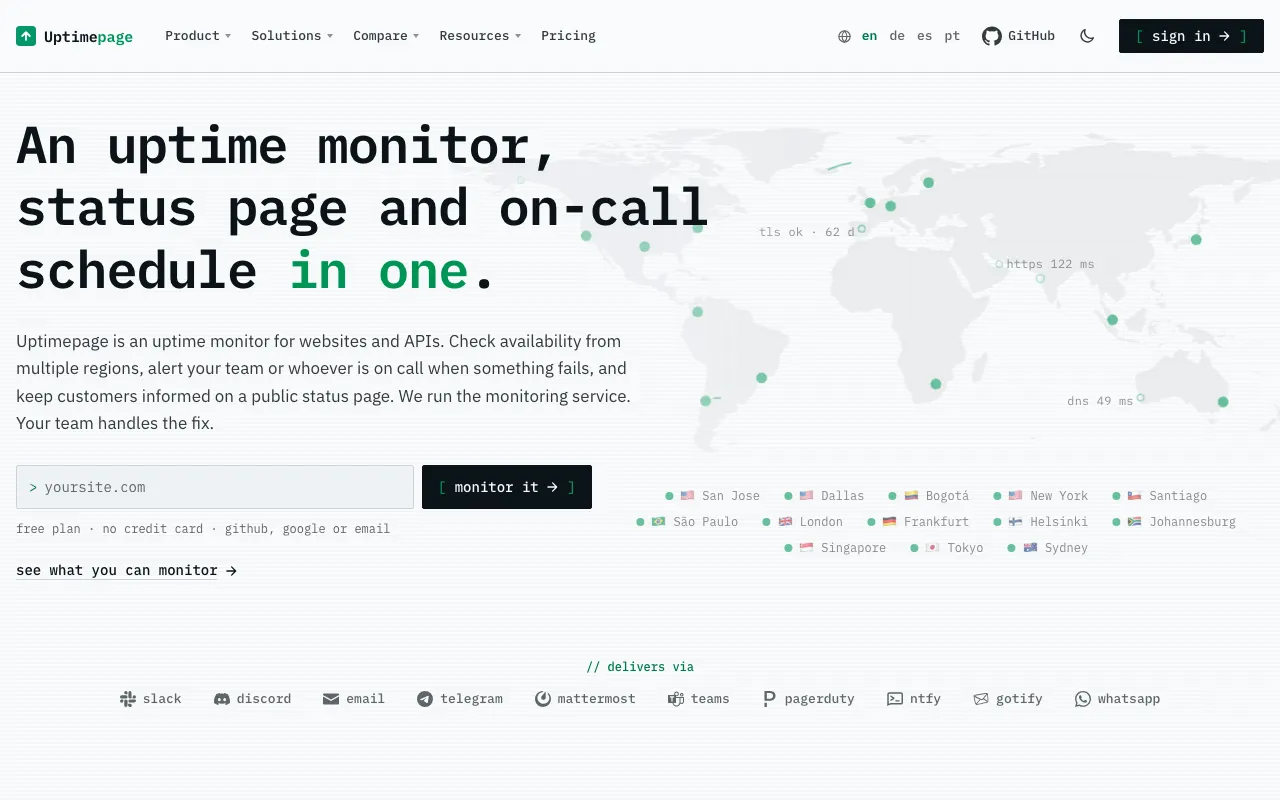
Uptimepage combines uptime checks, customer-facing status pages, and on-call alerting in one product. You can use the hosted service or run the open-source stack yourself.
Overview
Uptimepage is built for teams that need website and API monitoring together with public status communication and incident paging. It runs checks such as HTTP, TCP, ICMP ping, DNS, TLS certificate expiry, domain expiry, cron heartbeats, browser login flows, and manually set states, often from multiple geographic regions.
When monitors fail, the system can open incidents, repeat notifications until someone acknowledges, and route pages through on-call rotations and escalation policies. Alert channels include Slack, PagerDuty, Discord, Microsoft Teams, email, SMS, webhooks, and several other integrations.
Public status pages expose HTML, JSON, and RSS views with component-level detail, incident updates, maintenance windows, and subscriber notifications. Operators can manage monitors through a dashboard, REST API, Terraform provider, or MCP server for automated workflows.
A hosted tier is available without installing software, while the AGPL-licensed source can be self-hosted as a single binary with Postgres and ClickHouse, including Docker Compose and production deployment guides. Regional probe agents can run on infrastructure you control to match where your users connect from.
Key features
- Multi-type uptime and synthetic checks
- Public status pages with RSS and JSON
- On-call rotations and escalation
- Multi-channel alert notifications
- REST API and Terraform provider
- MCP server for automation clients
- Multi-region probe agents
- Incident and maintenance workflows
Use cases
- SaaS uptime and API monitoring
- Customer-facing outage communication
- On-call paging for production failures
- Certificate and domain expiry watches
- Infrastructure-as-code monitor setup
Open-source alternative to
PPingdom“If you are looking for a Pingdom alternative, here is what Uptimepage gives you by default: the checks and a public status page are the same product rather than a paid add-on, and you can start free with no card.” source
Does the same job as
uptimepage doesn't name these products itself, but its own description shows it does the same job.