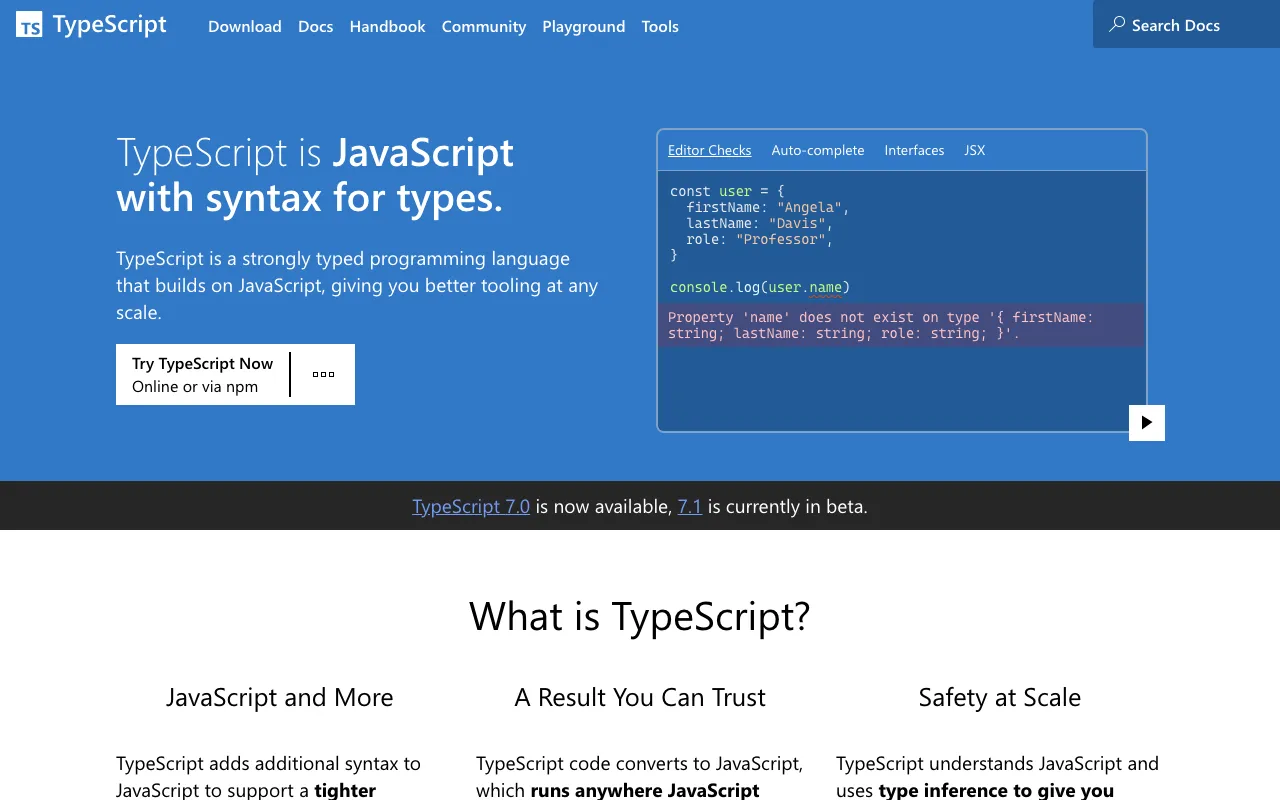
TypeScript adds optional static types to JavaScript and compiles to standard JavaScript. It targets application-scale code on browsers, Node.js, and other JavaScript runtimes.
Overview
TypeScript is a programming language built on JavaScript. It adds syntax for types so editors can catch mistakes before code runs and surface auto-complete, interfaces, and JSX-related checks. Typed source is removed during compilation, leaving plain JavaScript that runs wherever JavaScript runs.
Developers can adopt typing gradually on existing JavaScript using checks or JSDoc, or write fully typed files with interfaces, unions, and explicit parameter types. The language is meant for large-scale JavaScript work across browsers and hosts on common operating systems.
Output is readable, standards-based JavaScript. Tooling integrates with editors for in-editor error reporting and fixes. Learning material includes a short introduction, a handbook, and an online playground.
TypeScript is widely used in ecosystems such as Angular, Vue, Jest, Redux, and Deno, and can be installed via npm or tried in the browser playground.
Key features
- Optional static types on JavaScript
- Compiles to standard JavaScript
- Editor error checking and autocomplete
- Interfaces and type aliases
- JSX support
- Gradual typing with JSDoc or ts-check
- Type inference for tooling
- Runs wherever JavaScript runs
Use cases
- Large JavaScript codebases
- Catching errors before runtime
- Describing object and function shapes
- Incremental typing of legacy JS
- Cross-platform application JavaScript