qmetrics.net

TruLens

OpenTelemetry-native LLM agent evaluation

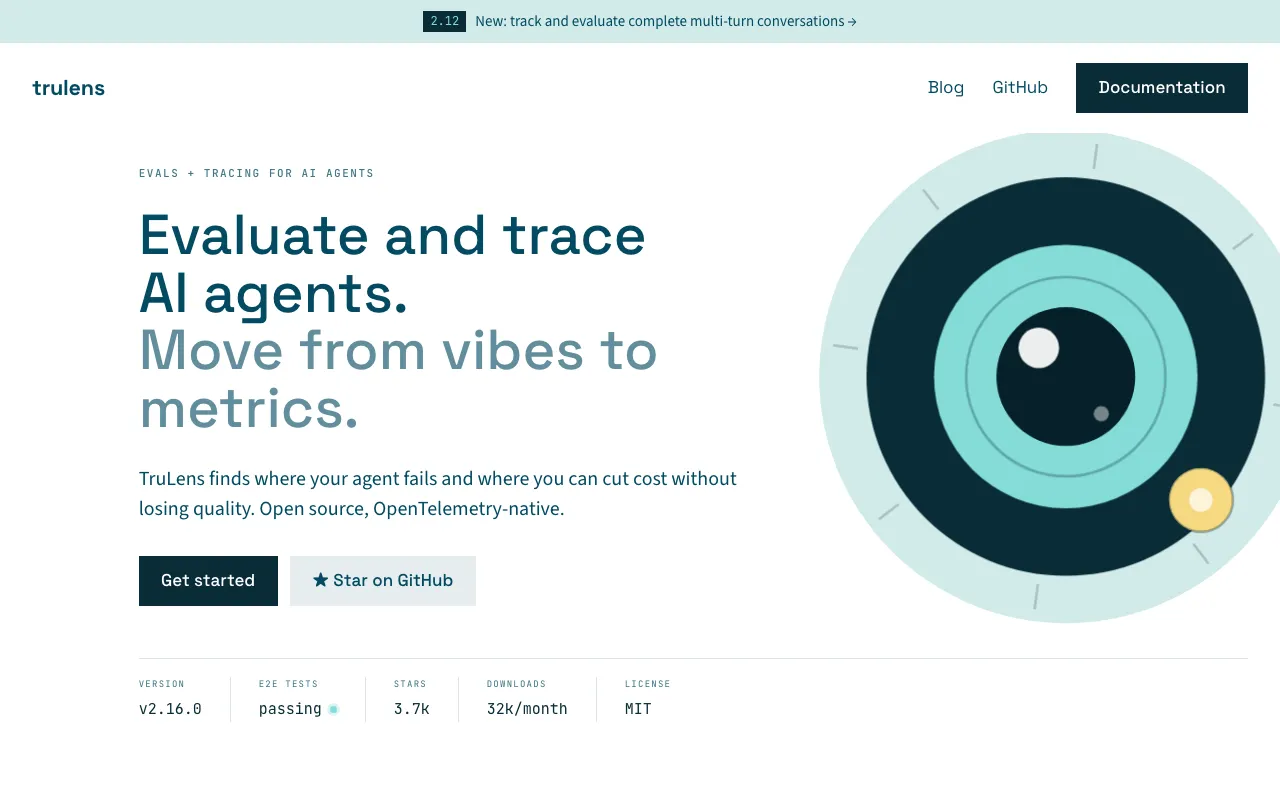
TruLens screenshot

TruLens instruments AI apps with decorators, records OpenTelemetry spans, and scores steps with LLM judges. Teams compare app versions on quality, latency, and cost.

Overview

TruLens is an open-source toolkit for evaluating and tracing large language model applications and agents. You instrument functions with a decorator so each LLM call, retrieval, and tool use becomes a structured OpenTelemetry span. Feedback metrics—often LLM-as-judge—explain scores so failures have traceable causes instead of opaque outputs.

Tracing captures latency, inputs, outputs, tokens, and cost per step. Evaluations can run inline as traces arrive or over datasets in batch runs. Traces export to any OTLP-compatible backend such as Jaeger, Grafana Tempo, Datadog, or New Relic, so TruLens can sit alongside existing observability stacks.

Built-in evaluators target agent behavior, including tool selection, plan adherence, execution efficiency, and reasoning consistency, plus RAG-focused metrics like groundedness and context relevance. Integrations cover LangGraph, LlamaIndex, LangChain-style apps, and plain Python via the instrument API. Provider packages supply judges from OpenAI, LiteLLM, Google, Bedrock, and others.

The selector API lets teams aim metrics at specific span fields. MCP tool calls can be traced with dedicated span types. Documentation emphasizes comparing versions on a leaderboard to pick tradeoffs between quality and cost before shipping changes.

Key features

  • OpenTelemetry-based tracing
  • LLM-as-judge feedback metrics
  • Agent-specific evaluators
  • RAG triad style evaluations
  • LangGraph and LlamaIndex integrations
  • Batch and inline evaluation runs
  • MCP tool span instrumentation
  • Flexible span attribute selectors

Use cases

  • Debugging failing AI agents
  • Comparing RAG pipeline versions
  • Exporting traces to OTLP backends
  • Batch scoring on labeled datasets
  • Cost-quality frontier analysis

Tags

Similar software

Langfuse

Open-source AI engineering platform for LLM observability, evals and prompts

Langfuse is an open-source platform for tracing, evaluating and managing AI agents and LLM calls. It covers observability, prompt and skill management, evaluations, dashboards and an AI gateway, as cloud or self-hosted

★ 37.9k⟳ todayMIT · open core
Open Source Alternative to:BraintrustDatadog+2

Opik

Self-hostable LLM observability and agent evaluation platform

Opik traces LLM and AI agent calls, runs evaluations and experiments, manages prompts, and monitors production usage through dashboards and online scoring rules

★ 23.5k⟳ todayApache-2.0
Open Source Alternative to:BraintrustDatadog LLM Observability

RagaAI Catalyst

Python SDK for LLM project observability and evaluation

RagaAI Catalyst is a Python package for managing LLM projects: datasets, evaluations, traces, prompts, guardrails, and agent monitoring via authenticated API access.

★ 16.2k⟳ 1 year agoApache-2.0
AI Development PlatformsNo commits in 18+ monthsDesktop/CLI app

Arize Phoenix

AI observability and evaluation platform for LLM applications

Arize Phoenix is a platform for tracing, evaluating and debugging LLM applications. It offers datasets, experiments, a prompt playground and prompt management, built on OpenTelemetry and OpenInference instrumentation.

★ 12.5k⟳ 2 days agoSource-available

OpenLLMetry

Open-source OpenTelemetry-based observability for LLM applications

OpenLLMetry is a set of OpenTelemetry extensions and a Traceloop SDK that trace LLM applications, including LLM provider and vector database calls, and send standard telemetry to existing observability tools.

★ 7.6k⟳ 4 days agoApache-2.0

Latitude

Open-source observability for AI agents with automated fix dispatch

Observability platform for AI agents that traces production runs, groups failures into tracked signals, dispatches coding agents to fix them, and replays fixes against real failing traces.

★ 4.8k⟳ 3 days agoMIT
Open Source Alternative to:BraintrustDatadog LLM Observability