
Frigate NVR
Local NVR with realtime IP camera object detection
Frigate records IP camera streams, detects objects with local AI, and integrates with Home Assistant over MQTT.

Linux eBPF runtime security and observability
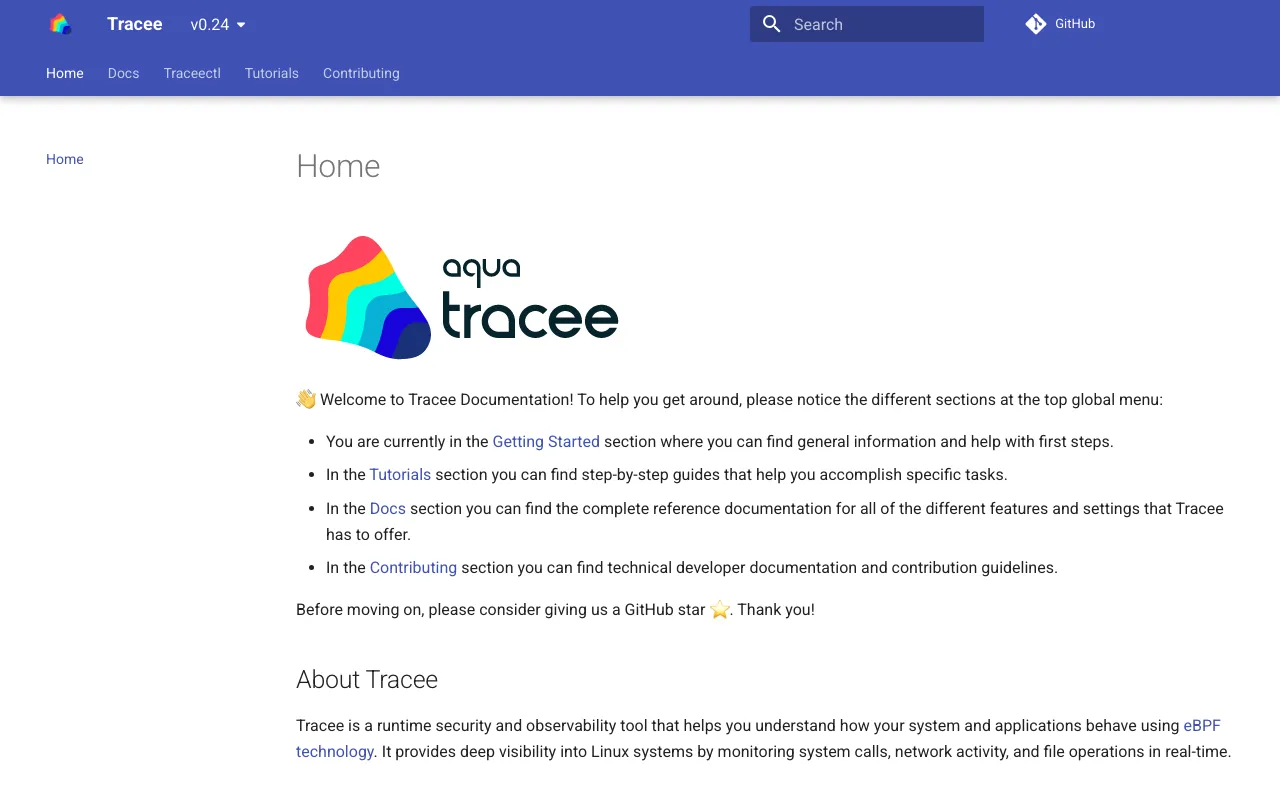
Tracee uses eBPF on Linux to stream system and security events for monitoring, threat detection, forensics, and compliance visibility.
Tracee is a runtime security and observability tool that explains how Linux systems and workloads behave by collecting events from the kernel via eBPF. Output ranges from factual activity such as syscalls and file operations to higher-level security detections for suspicious patterns.
It advertises monitoring without modifying application code, low overhead through eBPF programs, and awareness of containers and Kubernetes environments. Users can tailor policies for what to capture and how to react, with rich context like process lineage, paths, and network endpoints. Documented use cases include malware and privilege-escalation detection, compliance monitoring, troubleshooting, and incident forensics.
Quick starts run Tracee in a privileged Docker container on the host or install a Helm chart as a Kubernetes DaemonSet in a dedicated namespace. Documentation covers prerequisites for Linux distributions and kernels, plus separate guides for Docker and Kubernetes deployments.
Tracee is an Aqua Security open source project with community discussion channels and contribution documentation. Organizations running Linux or Kubernetes who want kernel-level visibility and security telemetry in one agent-style tool are the intended audience.
Local NVR with realtime IP camera object detection
Frigate records IP camera streams, detects objects with local AI, and integrates with Home Assistant over MQTT.

Scriptable open-source passive network security monitor
Zeek analyzes network traffic on a sensor and produces structured logs for security teams. It focuses on visibility and forensics rather than blocking traffic.

Self-hosted uptime monitoring with status pages and alerts
Uptime Kuma is a self-hosted monitoring tool for checking whether services stay online. It covers many probe types and can notify you through numerous messaging and email channels.
Real-time global intelligence dashboard for news and geopolitics
World Monitor combines live news, market data, and geopolitical signals on interactive world maps. Available on the web, as desktop builds, a terminal UI, CLI, SDKs, and an MCP server.
AI-guided terminal toolkit for authorized security testing
Hackingtool bundles many security utilities in one console with optional AI help to pick tools and commands. It targets Linux and macOS and is meant for authorized testing only.

Per-second full-stack infrastructure observability platform
Netdata collects metrics, logs, and traces where they are generated, with per-second resolution, built-in dashboards, alerts, and machine learning anomaly detection on every metric.