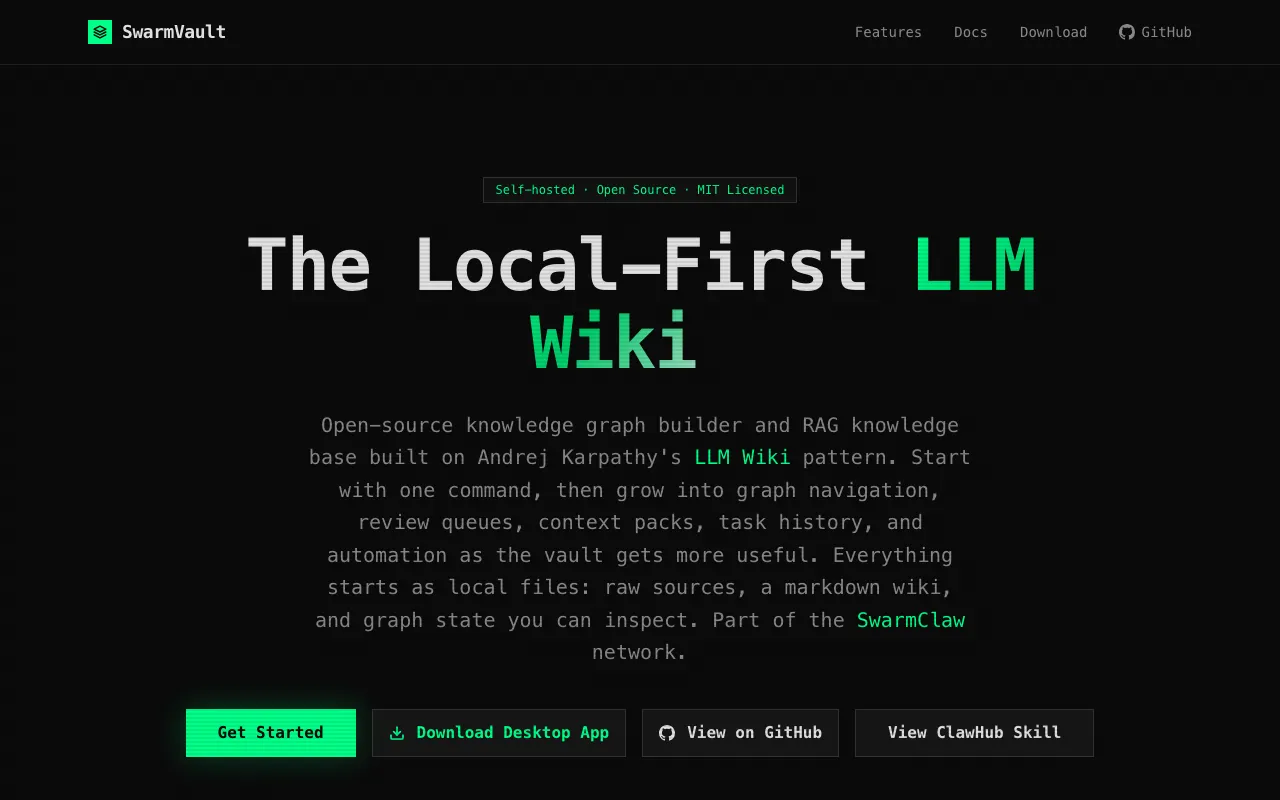
SwarmVault ingests docs, code, and URLs into a markdown wiki, searchable graph, and agent context packs. It runs offline with optional local or cloud models.
Overview
SwarmVault implements a local-first LLM wiki pattern: immutable raw sources, generated markdown wiki pages, and a schema file that evolves with your domain. One quickstart command can initialize a vault, ingest local or GitHub material, compile pages, and open a graph viewer.
The toolchain writes graph JSON, retrieval indexes, share artifacts, and review bundles on disk. CLI commands cover ingest, compile, hybrid search, contradiction linting, approval queues, context pack building, task ledgers, chat over the vault, exports to Neo4j or Obsidian, and an MCP server for agents.
A built-in heuristic provider works without API keys; you can add Ollama, whisper.cpp for audio, or cloud models for richer extraction. Features include code-aware tree-sitter parsing, watch mode, git-backed commits, and desktop apps that bundle the runtime.
SwarmVault targets personal knowledge management, research notebooks, code documentation, and durable memory for coding agents, with graph navigation to query large vaults without loading every page into context.
Key features
- Three-layer raw, wiki, and schema vault
- Knowledge graph with interactive viewer
- Hybrid SQLite FTS and embedding search
- CLI quickstart ingest and compile loop
- Approval queues and contradiction linting
- MCP server and agent context packs
- 30+ ingest formats including code repos
- Offline heuristic provider without API keys
Use cases
- Building a personal research knowledge base
- Compiling codebases into linked wiki pages
- Supplying agents with bounded context packs
- Reviewing inferred versus extracted graph edges
- Local RAG search over accumulated notes
Open-source alternative to
OObsidian“An Obsidian alternative for personal knowledge management, AI second brain, and durable Claude Code / Codex / OpenClaw memory.” source


 Coda
 Miro

 Confluence


 Notion