qmetrics.net

SenseVoice

Multilingual speech understanding model with deployable API

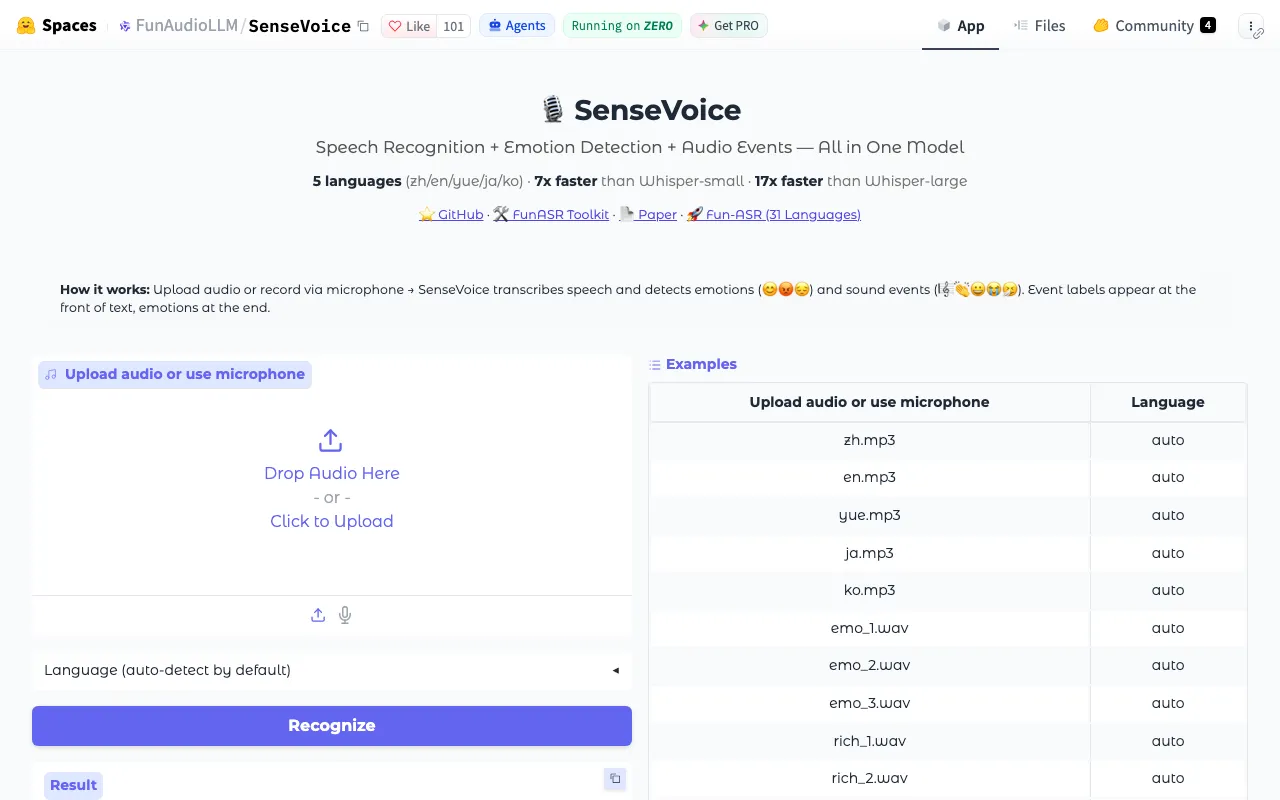
SenseVoice screenshot

SenseVoice is a speech foundation model for recognition, language ID, emotion tags, and audio events. SenseVoiceSmall targets Mandarin, Cantonese, English, Japanese, and Korean.

Overview

SenseVoice bundles automatic speech recognition with spoken language identification, speech emotion recognition, and audio event detection in one model family. The released SenseVoiceSmall checkpoint covers ASR and language ID for Mandarin, Cantonese, English, Japanese, and Korean, plus emotion and event labels on transcripts.

SenseVoiceSmall uses a non-autoregressive end-to-end setup aimed at lower-latency inference. It can detect interaction sounds such as applause, laughter, crying, coughing, and background music. Finetuning scripts and data formats are provided for custom domains. Speaker diarization in examples chains separate VAD and speaker models through FunASR rather than the core checkpoint alone.

Inference supports common audio formats, optional VAD segmentation for long audio, bounded window decoding without VAD, ONNX and LibTorch export, and a llama.cpp path for CPU edge use. A FastAPI deployment option and Docker builds expose a network service on a documented port, with compose workflows for CPU and GPU hosts.

The project links to ModelScope and Hugging Face checkpoints, online demos, and client examples in several languages for multi-request serving.

Key features

  • Multilingual ASR and language ID
  • Speech emotion recognition
  • Audio event detection tags
  • Non-autoregressive SenseVoiceSmall
  • Docker and FastAPI deployment
  • FunASR pipeline integration
  • Finetuning and export formats
  • Long-audio windowed decoding

Use cases

  • Meeting and call transcription
  • Multilingual voice analytics
  • Emotion-aware speech apps
  • Self-hosted speech API
  • Custom ASR finetuning

Tags

Similar software

Ollama

Run open AI models locally or in the cloud

Ollama runs open language models such as Gemma, Qwen, DeepSeek and gpt-oss on macOS, Windows and Linux, locally or in the cloud. It offers a CLI, a REST API, and Python and JavaScript libraries.

★ 188.3k⟳ 2 days agoMIT
Open Source Alternative to:OpenAI API

llama.cpp

LLM inference engine in C/C++ for local and cloud hardware

llama.cpp runs large language models and multimodal models locally or in the cloud with minimal setup. It includes a CLI, an OpenAI-compatible server with a built-in chat app, and a C library API.

★ 136.5k⟳ todayMIT
Open Source Alternative to:OpenAI API

Whisper

General-purpose speech recognition and translation model

Whisper is a speech recognition model trained on diverse audio. It supports multilingual transcription, speech-to-English translation, and language identification via Python or the command line.

★ 113.6k⟳ 2 months agoMIT

GPT4All

Desktop app for running LLMs privately on local hardware

GPT4All is a desktop chat application that runs large language models locally on everyday computers, with no API calls or GPU required. It also offers a Python client and an OpenAI-compatible API server.

★ 77.3k⟳ 1 year agoMIT
Machine Learning InfrastructureNo commits in 18+ monthsDesktop/CLI app
Open Source Alternative to:LM StudioMicrosoft Copilot

Real-Time Voice Cloning

Real-time multispeaker text-to-speech voice cloning toolbox

Real-Time Voice Cloning implements a three-stage deep learning pipeline that builds a voice embedding from seconds of audio and synthesizes speech from arbitrary text in real time.

★ 60.3k⟳ 8 months agoMIT

LocalAI

Self-hosted OpenAI-compatible server for running open AI models locally

LocalAI runs open models for chat, images, speech, video and music on your own hardware, with OpenAI- and Anthropic-compatible APIs. It works on CPU or GPU and adds team chats, files, agents and add-ons.

★ 50.6k⟳ todayMIT
Open Source Alternative to:Anthropic APIChatGPT+2