FreeDomain
Free domain registration with DNS learning resources
DigitalPlat FreeDomain lets people register free domains under several extensions, point custom nameservers at a DNS provider, and follow guides from setup through deployment.

Scheduled network scans with self-updating topology diagrams
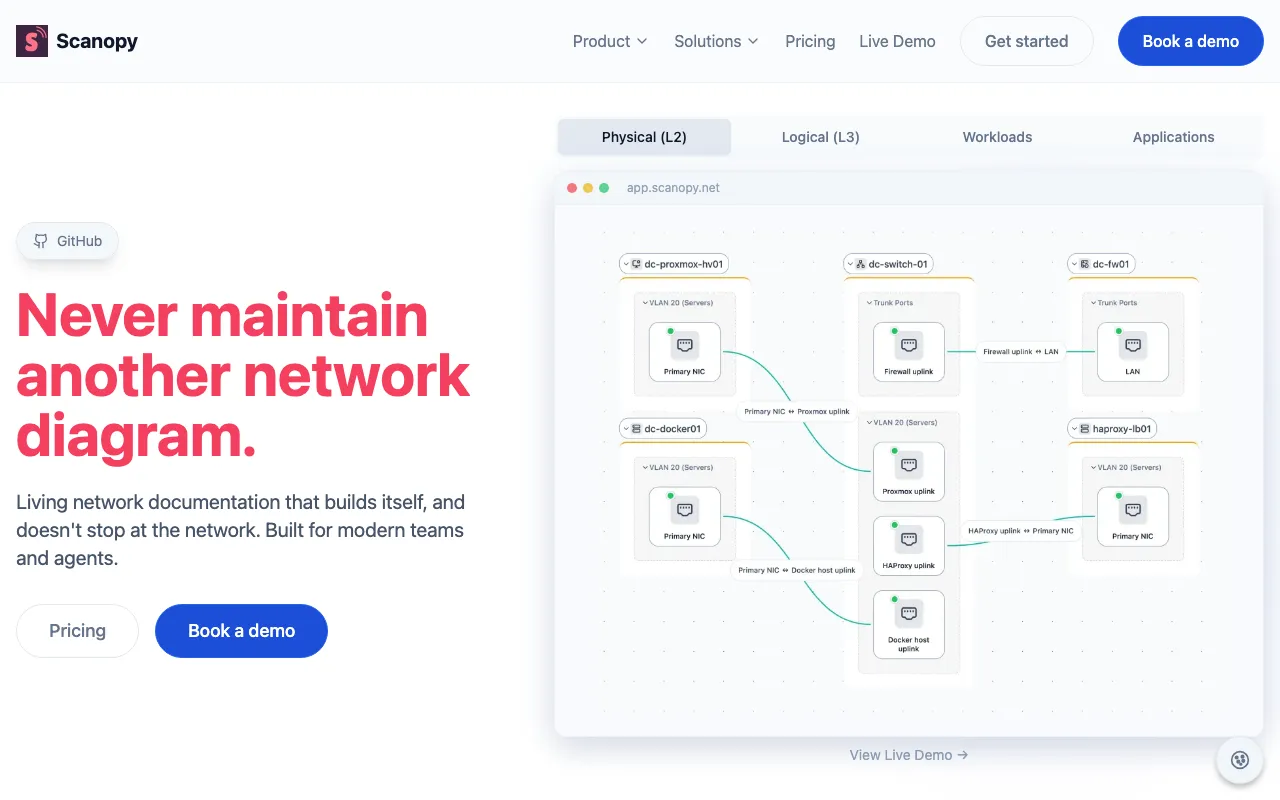
Scanopy scans networks on a schedule and builds L2, L3, workload, and application views. It aims to replace manually maintained diagrams with a continuously updated model.
Scanopy is automated network diagram and documentation software that discovers hosts and maps topology on a repeating schedule. A scanner produces four synchronized views: physical L2 links, logical L3 subnets, workloads from bare metal through hypervisors and containers, and application-level service dependencies when hosts are tagged.
An inventory layer records IPs, MACs, interfaces, open ports, services, and SNMP hardware details, with search, filtering, and CSV or REST export. VLAN and subnet information can be read from switches over SNMP. After each scan, digests and snapshots support change tracking, audits, and sharing via read-only links, embeds, and exports to image, document, diagram, and wiki formats.
Discovery runs from a daemon without per-device agents on Linux, macOS, Windows, or Docker, with integrations such as Docker, Podman, Proxmox VE, UniFi, libvirt, SNMP, SSH, and gNMI. The web UI is accessed on port 60072 after setup. Deployment options include Docker Compose, Proxmox helper scripts, and an Unraid community app.
Community and commercial self-hosted editions run on your own infrastructure, with an optional hosted Scanopy Cloud service for teams that do not want to operate the stack themselves.
Free domain registration with DNS learning resources
DigitalPlat FreeDomain lets people register free domains under several extensions, point custom nameservers at a DNS provider, and follow guides from setup through deployment.
Cross-platform Tauri desktop GUI for Clash Meta proxying
Clash Verge Rev is a desktop GUI for the Clash Meta proxy kernel on Windows, macOS, and Linux. It offers profile management, system proxy modes, and keeps configuration on your device.
Desktop GUI client for proxy cores
v2rayN is a graphical client for Windows, Linux, and macOS that works with Xray, sing-box, and related proxy stacks. Prebuilt packages ship for common CPU architectures.
Self-deployed reverse proxy for NAT and firewall bypass
frp pairs a public-facing frps server with frpc clients to expose TCP, UDP, HTTP, and HTTPS services behind NAT or firewalls, including P2P connect mode.

Text-defined diagrams from Markdown-like syntax
Mermaid turns plain-text diagram definitions into flowcharts, sequence charts, Gantt charts, and many other diagram types. It renders in browsers, documentation tools, and GitHub Markdown.

Extensible server platform with automatic TLS
Caddy is an extensible server platform that enables HTTPS by default. It is often used as an HTTPS and HTTP server with a modular Go-based architecture.