
AList
Multi-backend file list and WebDAV gateway
AList unifies many cloud and protocol storages behind one web file browser with previews, WebDAV, and upload or download features.
Distributed S3-compatible object storage in Rust
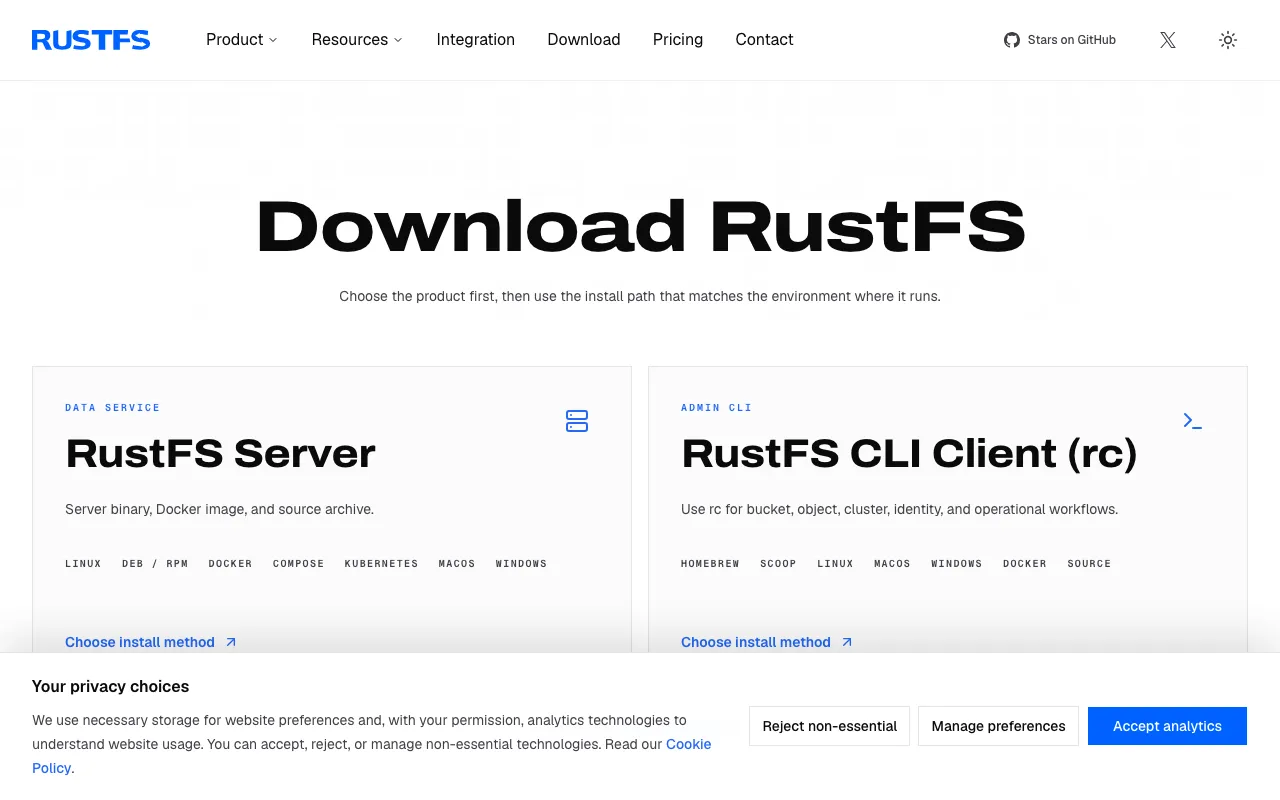
RustFS is a high-performance distributed object store with broad S3 API coverage, a web console, and deployment via Docker, Kubernetes, or native binaries. It targets data lakes, AI, and large-scale storage workloads.
RustFS stores objects in a distributed, erasure-coded layout implemented in Rust with Apache 2.0 licensing. It advertises compatibility with common S3 clients and tooling, optional Swift API support with Keystone authentication, and features such as versioning, object lock, server-side encryption, lifecycle rules, replication, and event notifications.
Operators can run single-node or multi-node pools, expand by adding pools, and integrate IAM policies, OIDC SSO, audit logging, and observability stacks. A management console, Helm charts, Docker Compose examples, and optional Grafana, Prometheus, and Jaeger services support production monitoring. Separate SFTP, WebDAV, and FTPS interfaces can be enabled through build features.
Installation paths include one-click scripts, container images running as a non-root user, Compose files, Helm on Kubernetes, Nix flakes, and source builds. An rc CLI handles bucket, object, and cluster operations on Linux, macOS, and Windows. Documentation emphasizes pool layout rules, permission requirements on mounted data paths, and migration notes from other S3-compatible systems.
The project positions itself for multi-cloud and on-premises deployments where permissive licensing and Rust’s safety properties matter, with compatibility matrices tracking S3 feature coverage over time.
Multi-backend file list and WebDAV gateway
AList unifies many cloud and protocol storages behind one web file browser with previews, WebDAV, and upload or download features.

Local-first cross-platform virtual filesystem for personal data
Spacedrive is open personal data infrastructure that turns storage you control into one private filesystem across devices, with search, sharing, and remote access without a hosted account.
Scalable distributed storage with S3 and POSIX
SeaweedFS is a distributed file system aimed at storing many files and serving them quickly. One cluster can expose S3, POSIX, lakehouse tables, and vector search on shared storage.

Self-hosted file management with multi-cloud storage support
Cloudreve is a self-hosted file management system that stores files on local disks, remote nodes, and many object-storage APIs. It offers a web interface for upload, sharing, and preview.

Fast real-time lossless compression library and CLI
Zstandard (zstd) is a lossless compression algorithm with a C library and a command-line tool for .zst and other formats. It targets real-time speeds with configurable ratio-versus-speed trade-offs and optional training dictionaries for small data.
JSON file and browser local database
Lowdb stores and updates JSON documents in files or browser storage with plain JavaScript objects and optional TypeScript typing.
 Dropbox