
Langflow
Visual low-code builder for AI agents and workflows
Langflow is a visual builder for AI agents and workflows. Flows can be customized in Python and deployed as an API or as an MCP server, with support for major LLMs and vector databases.

Official Rust Model Context Protocol SDK
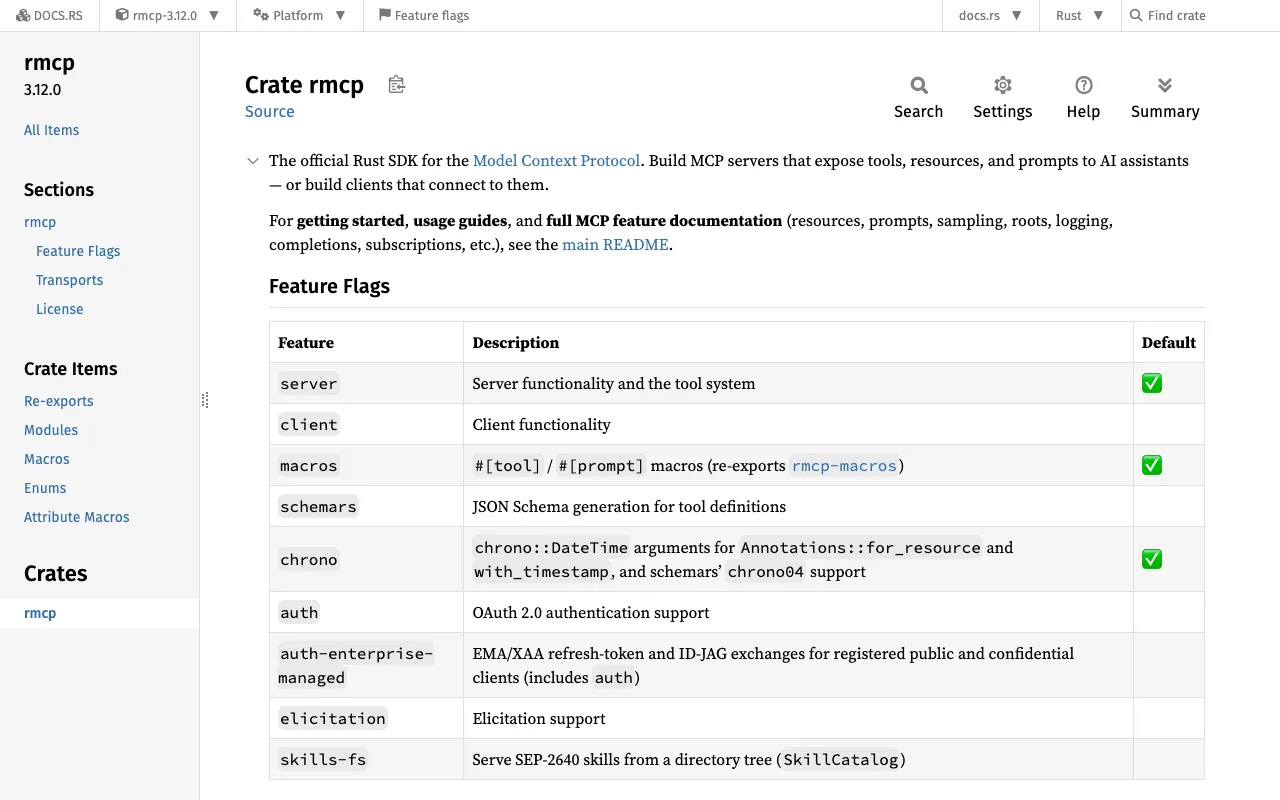
Rust crates for building MCP clients and servers with Tokio. Implements the MCP specification with tools, resources, prompts, and pluggable transports.
Rust SDK (RMCP) is the official Rust implementation for the Model Context Protocol. It lets developers expose MCP servers that offer tools, resources, and prompts to AI assistants, or build clients that connect to those servers.
The core rmcp crate provides the protocol implementation on the Tokio async runtime. A companion rmcp-macros crate supplies procedural macros for generating tool and prompt handlers. The SDK tracks the stable MCP specification while remaining compatible with earlier protocol releases, including newer features such as server discovery, transport-neutral subscriptions, long-running tasks, response caching, multi-round-trip requests, and standard HTTP routing headers.
Servers can define callable tools with JSON Schema parameters, publish readable resources by URI, and offer reusable prompt templates. Clients can discover capabilities, invoke tools, read resources, and handle notifications. Optional feature flags enable server-only or client-only builds, macro helpers, JSON Schema generation, OAuth authentication, elicitation, and skills served from a directory tree.
Transport is pluggable: common setups pair stdio on both sides or streamable HTTP between client and server. Types implementing the Transport trait—or sinks, streams, or async read/write pairs—can be adapted automatically. HTTP transports can use rustls or platform-native TLS backends.
Visual low-code builder for AI agents and workflows
Langflow is a visual builder for AI agents and workflows. Flows can be customized in Python and deployed as an API or as an MCP server, with support for major LLMs and vector databases.

Framework for agents and LLM-powered applications
LangChain helps developers chain interoperable components and integrations to build agents and LLM-powered applications. It offers a standard interface for models, embeddings, vector stores, and related pieces.

Enterprise AI low-code platform on Java and Vue
JeecgBoot is an AI low-code platform with permissions, workflows, reporting, and built-in AI apps. Teams deploy it privately to generate CRUD, forms, and business modules quickly.

Platform for building, running and managing AI agents in your own cloud
Agno is an agent platform for building agents, teams and workflows, then running them as durable services with API and MCP access. It runs in your own cloud and includes a control UI.

TypeScript framework for AI agents and apps
Mastra helps teams build AI agents, workflows, and apps in TypeScript with model routing, tools, memory, MCP, and observability. It embeds in React, Next.js, and Node or runs as its own server.

TypeScript toolkit for AI applications and agents
The AI SDK is a provider-agnostic TypeScript library for building AI-powered applications and agents with popular UI frameworks and Node.js runtimes.