
Vite
Frontend build tool for modern web projects
Vite is a build tool for modern web projects, combining a development server with an optimized production build. It targets a faster, leaner local development workflow.

Reusable TypeScript monorepo build and API tooling family
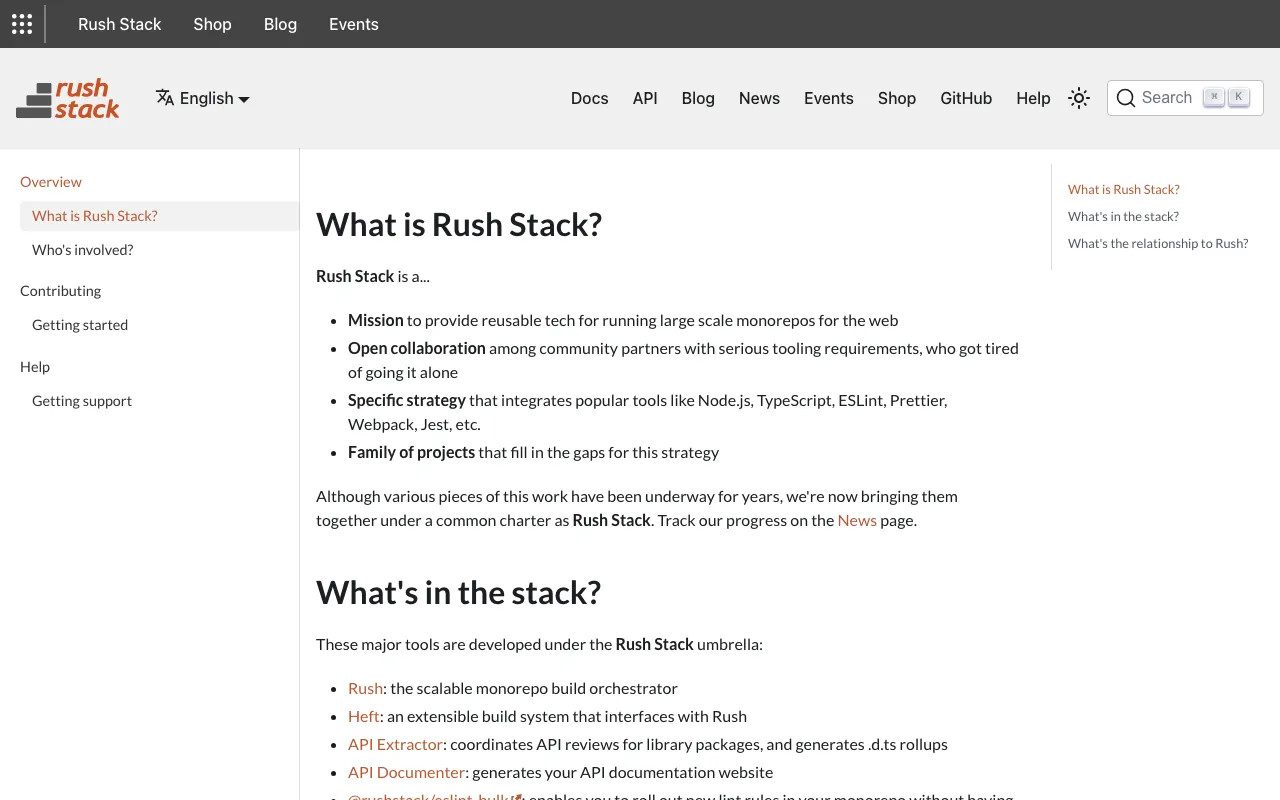
Rush Stack bundles open tooling for large TypeScript monorepos. It coordinates installs, builds, API reviews, linting, and documentation around Node.js ecosystem tools.
Rush Stack is a coordinated set of projects aimed at running large-scale TypeScript monorepos for web development. Its stated mission is reusable technology for deterministic installs, fast multi-project builds, publishing workflows, and consistent repo layouts.
Major components include Rush as the monorepo build orchestrator, Heft as an extensible build system that plugs into Rush, API Extractor for library API review and declaration rollups, and API Documenter for generated API documentation sites. Additional packages cover ESLint configuration and patches for monorepos, bulk lint suppressions, lockfile conflict investigation, Node startup optimization, and module resolution debugging.
The stack integrates with common JavaScript tooling such as TypeScript, ESLint, Prettier, Webpack, and Jest rather than replacing each choice in isolation. Shared library packages provide command-line parsing, incremental build hashing, shared rig configurations, and utilities used across the tools.
Rush itself can be used alone, while Rush Stack offers a more opinionated, integrated path for teams that want combined build, lint, and API workflows. Documentation presents it as community-backed tooling for organizations with serious monorepo requirements.
Frontend build tool for modern web projects
Vite is a build tool for modern web projects, combining a development server with an optimized production build. It targets a faster, leaner local development workflow.

Modular toolkit for assembling container systems
Moby bundles container build, runtime, registry, and orchestration components so integrators can craft custom container platforms instead of using a single fixed product.

Agent-ready open-source backend cloud with unified app services
Appwrite bundles auth, databases, storage, functions, messaging, realtime, hosting, and firewall for building apps. It runs as managed cloud or self-hosted on Docker

Go and web frontend toolkit for desktop apps
Wails bundles Go backends with HTML, CSS, and JavaScript UIs into native desktop binaries. It uses OS WebViews instead of shipping a full browser runtime.

Electron and React starter for desktop applications
Electron React Boilerplate combines Electron, React, React Router, and Vite tooling so teams can develop, hot-reload, and package cross-platform desktop apps from one template.

Full-stack generator for web apps and microservices
JHipster is a development platform that scaffolds, develops, and deploys modern web applications and microservice architectures. It wires front ends, back ends, and cloud-native deployment in one workflow.
 Auth0
 Clerk