Kubernetes
Open-source container scheduling and management system
Kubernetes (K8s) manages containerized applications across many hosts. It automates deployment, scaling, and ongoing operations for grouped containers.

Kubernetes operator orchestrating Ceph storage clusters
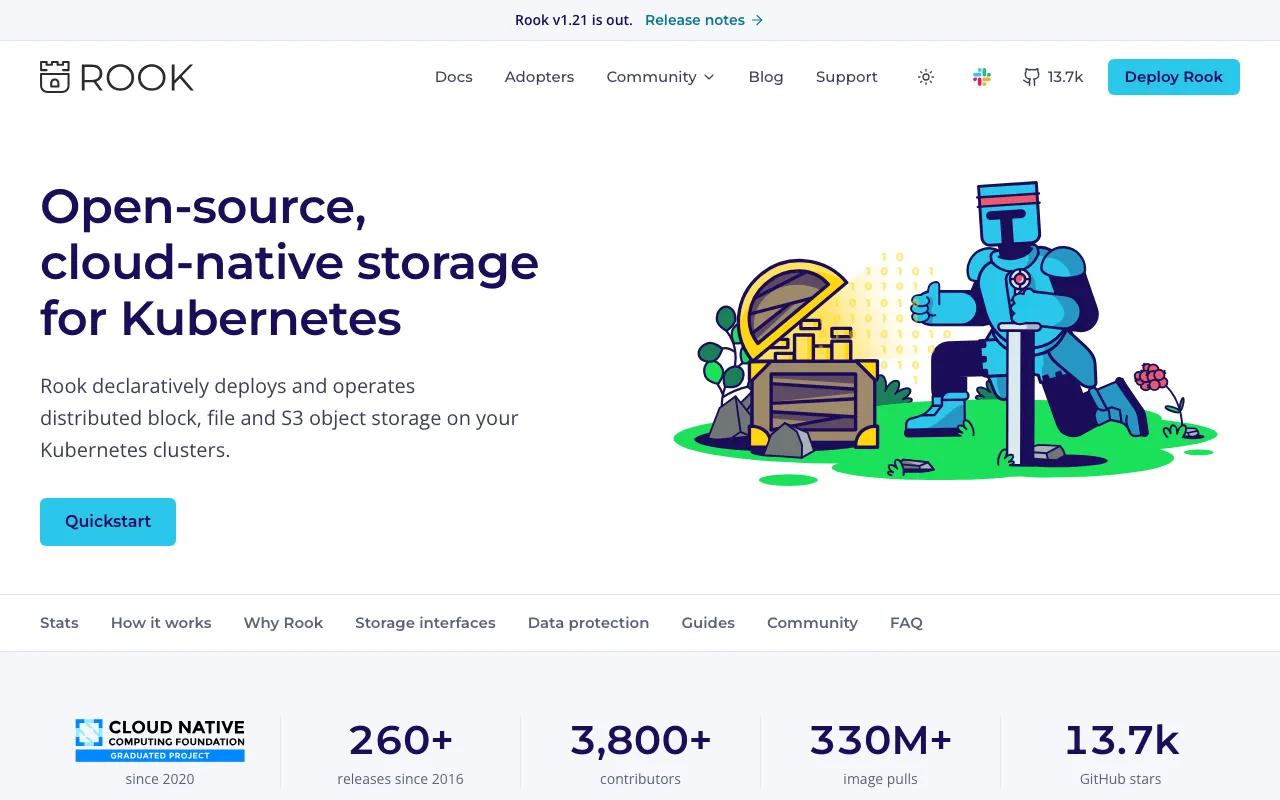
Deploys and manages Ceph file, block, and S3-compatible object storage on Kubernetes with automated scaling, upgrades, and healing.
Rook is a cloud-native storage orchestrator for Kubernetes that runs the Ceph distributed storage system through a Kubernetes operator. Ceph provides file, block, and object interfaces; Rook automates deployment, configuration, provisioning, scaling, upgrades, and monitoring so storage services stay self-managing on the cluster.
You declare desired clusters, device filters, replication or erasure policies, and pools in YAML. Rook provisions monitors, OSDs, CSI drivers, object stores, and NFS exports from those specs. Day-two operations include rolling Ceph image upgrades, safe node drains, disk replacement, and onboarding new hardware as it appears.
Applications consume storage through Kubernetes primitives: block volumes via RBD and Ceph CSI, shared filesystems via CephFS, and buckets through RGW with S3 compatibility or ObjectBucketClaims. Documentation covers stretch clusters across zones, multisite replication, encryption with external KMS, monitoring with Prometheus and Grafana, and NVMe metadata tiers on HDD data nodes.
Rook runs upstream Ceph images and is a graduated CNCF project. Storage data flows directly through Ceph when the operator is unavailable; management tasks resume after the operator returns. It targets bare-metal or cloud Kubernetes on amd64 and arm64 with local disks or provider block volumes.
Open-source container scheduling and management system
Kubernetes (K8s) manages containerized applications across many hosts. It automates deployment, scaling, and ongoing operations for grouped containers.
Agentless IT automation and configuration engine
Ansible automates configuration management, deployments, cloud provisioning, ad-hoc tasks, and multi-node orchestration using SSH without installing agents on managed hosts.

Dynamic HTTP reverse proxy and load balancer for microservices
Traefik routes HTTP traffic to microservices and balances load across backends. It watches orchestrators and registries to update routes without manual restarts.

Multi-backend file list and WebDAV gateway
AList unifies many cloud and protocol storages behind one web file browser with previews, WebDAV, and upload or download features.

Local-first cross-platform virtual filesystem for personal data
Spacedrive is open personal data infrastructure that turns storage you control into one private filesystem across devices, with search, sharing, and remote access without a hosted account.

Multi-container Docker application definition tool
Docker Compose defines and runs multi-container applications described in a Compose file. A single docker compose up command starts the configured services, networks, and volumes together.